
லேட்டரல் எபிகாண்டிலைட்டிஸ், டென்னிஸ் முழங்கை (Lateral Epicondylitis, Tennis Elbow) தகவல்
டென்னிஸ் முழங்கை (tennis elbow) எப்படிக் கையாளப்படுகிறது, அதற்கு எப்படி மறுவாழ்வுப் பயிற்சி செய்வது என்பதை இந்தப் பக்கம் விளக்குகிறது — நீங்கள் அறுவை சிகிச்சை இல்லாமல் சிகிச்சை பெற்றுக்கொண்டிருந்தாலும் சரி (ஏறக்குறைய அனைவருக்கும் இதுவே நிலை), தசைநாணைச் சுத்தம் செய்யும் அறுவை சிகிச்சைக்குப் பிறகு மீண்டுவந்துகொண்டிருந்தாலும் சரி. Mater Private Hospital Rockhampton-இல் டாக்டர் கியரன் ஹிர்பரா இதை மேற்பார்வையிடுகிறார். இது உங்கள் வீட்டுப் பயிற்சித் திட்டத்துடன் தொடங்குகிறது; அதைத் தொடர்ந்து, உங்கள் இயன்முறை சிகிச்சையாளருக்கோ கை சிகிச்சையாளருக்கோ எழுதப்பட்ட, கட்டமைக்கப்பட்ட மருத்துவ நெறிமுறை வருகிறது. உங்கள் மறுவாழ்வுப் பயிற்சி ஒருங்கிணைந்து இருக்க, இந்தப் பக்கத்தையோ அதன் PDF-ஐயோ உங்கள் சிகிச்சைச் சந்திப்புகளுக்குக் கொண்டு வாருங்கள். உங்கள் மீட்சி எப்படி முன்னேறுகிறது என்பதைப் பொறுத்து, உங்கள் சிகிச்சையாளர் திட்டத்தை மாற்றியமைக்கலாம்.
என்ன எதிர்பார்க்கலாம்
டென்னிஸ் முழங்கை (tennis elbow; லேட்டரல் எபிகாண்டிலைட்டிஸ், lateral epicondylitis) என்பது முழங்கையின் வெளிப்புறத்தில் உள்ள தசைநாணில் ஏற்படும் பிரச்சினை — குறிப்பாகப் பொது நீட்டு தசைநாணில் (common extensor tendon), அதிலும் குறிப்பாக ECRB என்று அழைக்கப்படும் ஒரு சிறிய தசையில். பெயரில் "-itis" இருந்தாலும், இது ஓய்வெடுத்தால் சரியாகிவிடும் அழற்சி அல்ல. இது தசைநாணில் ஏற்படும் தேய்மான மாற்றம் (ஒரு டெண்டினோசிஸ், tendinosis); இதில் தசைநாண் இழைகள் ஒழுங்கு குலைந்து, முறையாகக் குணமடையாமல் இருக்கின்றன.
இது முக்கியம், ஏனெனில் இது சிகிச்சையை முற்றிலும் மாற்றிவிடுகிறது. முழங்கைக்கு ஓய்வு கொடுத்துப் பாதுகாப்பதால் நீங்கள் குணமடைவதில்லை; உண்மையில், நீண்ட ஓய்வு தசைநாணை மேலும் பலவீனமாக்கி, அது தணிவதைத் தாமதப்படுத்தும் போக்கு உடையது. தசைநாணுக்குப் படிப்படியாகச் சுமை கொடுப்பதன் மூலமே நீங்கள் குணமடைகிறீர்கள்; அப்போதுதான் அது மறுவடிவம் பெற்று, வேலைக்கும் பிடிப்பதற்குமான தாங்கும் திறனை மீண்டும் கட்டியெழுப்புகிறது. வழிமுறை இதுதான்: முதலில் வலியைத் தணிக்க வேண்டும், பிறகு படிப்படியாக வலுப்படுத்த வேண்டும் — மென்மையாக இறுக்கிப் பிடித்து வைக்கும் (ஐசோமெட்ரிக், isometric) பயிற்சிகளில் தொடங்கி, டைலர் ட்விஸ்ட் (Tyler twist) போன்ற கட்டுப்பாடான, மெதுவான வலுப்படுத்தும் பயிற்சிகள் வரை படிப்படியாக உயர்த்த வேண்டும்.
நல்ல செய்தி என்னவென்றால், சரியான சுமைப் பயிற்சித் திட்டத்துடன் டென்னிஸ் முழங்கை பொதுவாகத் தானாகவே தணிந்துவிடுகிறது. சுமார் 80–90% பேர் ஓர் ஆண்டுக்குள் குணமடைகிறார்கள்; இருப்பினும் முழுமையாகச் சரியாக அவ்வப்போது 12–18 மாதங்கள் ஆகலாம். தரமான, தொடர்ச்சியான மறுவாழ்வுப் பயிற்சியைக் குறைந்தது ஆறு மாதங்கள் செய்தும் அது பலனளிக்காதபோது மட்டுமே அறுவை சிகிச்சை பரிசீலிக்கப்படுகிறது; மிகச் சிலரே (ஏறக்குறைய 4–11%) அந்தக் கட்டத்தை எட்டுகிறார்கள்.
முன்னெச்சரிக்கைகளும் கட்டுப்பாடுகளும்
செய்ய வேண்டியவை:
- கையைத் தொடர்ந்து பயன்படுத்துங்கள்: தசைநாணுக்குச் சுமை கொடுங்கள், அதற்கு ஓய்வு கொடுக்காதீர்கள்.
- வலியையே உங்கள் வழிகாட்டியாகக் கொள்ளுங்கள்: பயிற்சியின்போதும் அதற்குப் பிறகும் லேசான வலி இருப்பது பரவாயில்லை, அது எதிர்பார்க்கப்படுவதுதான்; கூர்மையான அல்லது அதிகரித்துச் செல்லும் வலி என்றால் பயிற்சியைக் குறைக்க வேண்டும் என்று பொருள்.
- வலிக்கும் தசைநாணிலிருந்து சுமையை எடுக்க, உள்ளங்கை மேல்நோக்கி இருக்கும்படித் தூக்குங்கள் (ஒரு கிண்ணம் சூப்பைத் தூக்கிச் செல்வது போல).
- பிடிக்கும், தூக்கும் வேலைகளின்போது முன்கைத் தசையின் மேல் ஒரு எதிர்விசைத் தாங்கியை (counterforce brace) அணியுங்கள்.
செய்யக் கூடாதவை:
- அறுவை சிகிச்சையின்றிச் சிகிச்சை அளிக்கப்படும் டென்னிஸ் முழங்கைக்காக முழங்கையை மாவுக்கட்டிலோ (cast) கைத்தாங்கியிலோ (sling) அசைவின்றி வைக்காதீர்கள்; டெண்டினோசிஸுக்கு அது தவறான சிகிச்சை. (அறுவை சிகிச்சைக்குப் பிறகு நிலைமை வேறு: கீழே உள்ள அறுவை சிகிச்சைக்குப் பிந்தைய வழிமுறையில் குறிப்பிட்டுள்ளபடி, முதல் வாரத்தில் சௌகரியத்துக்காகக் கைத்தாங்கி பயன்படுத்தப்படுகிறது.)
- முழங்கை நேராகவும் மணிக்கட்டு வளைந்தும் இருக்கும் நிலையில், வலியைத் தூண்டும் கனமான பிடிப்பு வேலைகளைச் செய்யாதீர்கள் (உதாரணமாக, உள்ளங்கை கீழ்நோக்கி இருக்கும்படி ஒரு கனமான பொருளைத் தூக்குவது).
- ஸ்டீராய்டு ஊசி போடுவதற்கு அவசரப்படாதீர்கள். கார்ட்டிசோன் சில வாரங்களுக்கு நன்றாக உணர வைக்கலாம்; ஆனால் இயன்முறை சிகிச்சையோடோ வெறுமனே காத்திருப்பதோடோ ஒப்பிடும்போது, 6–12 மாதங்களில் அது மோசமான முடிவுகளுக்கும் அதிகமான மறுதோன்றல்களுக்கும் வழிவகுக்கிறது என்று சான்றுகள் காட்டுகின்றன. இது முதல்நிலைச் சிகிச்சை அல்ல.
உங்கள் பயிற்சிகள்
Kieran Hirpara 4.0
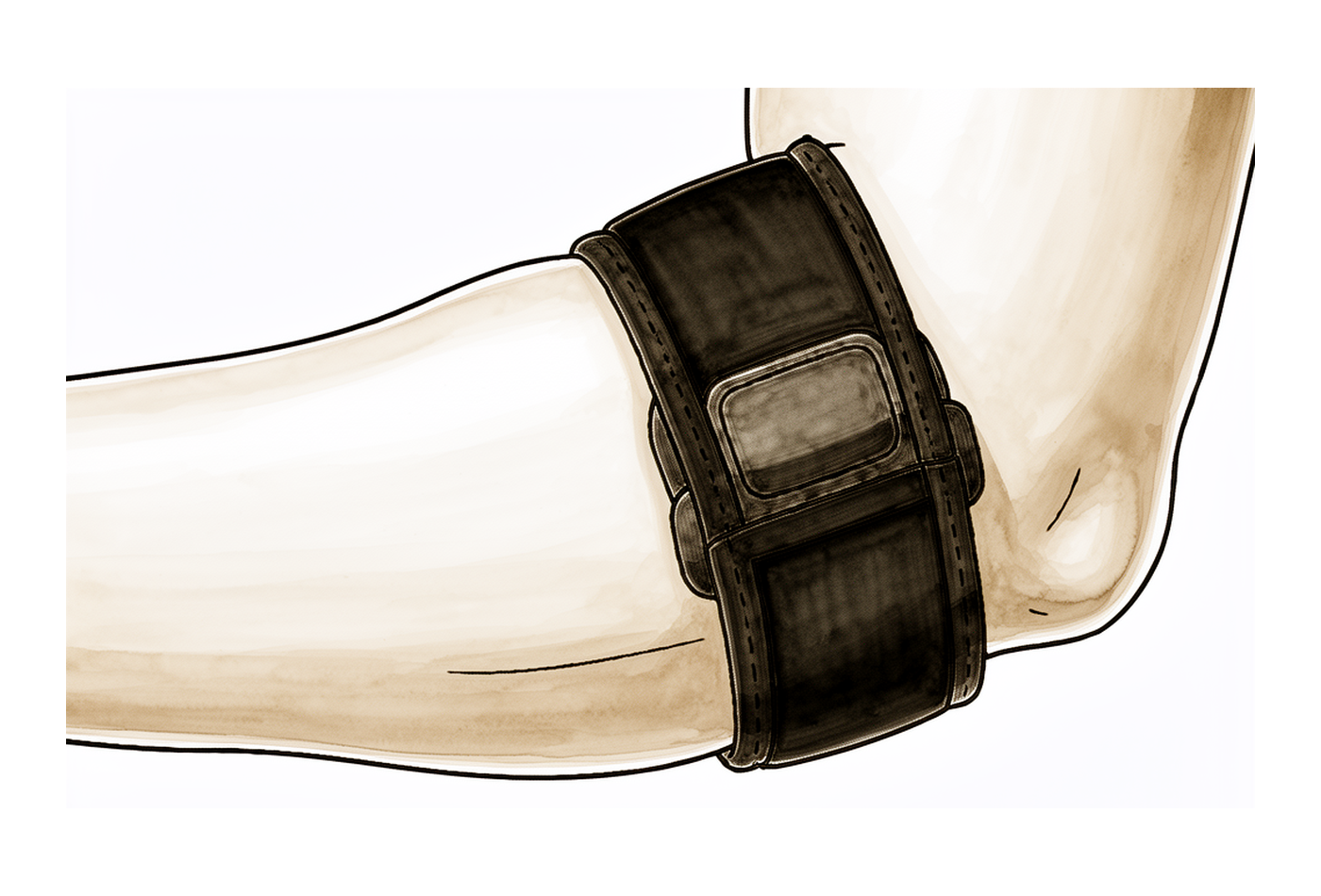
எதிர்விசைத் தாங்கி (counterforce brace)
எதிர்விசைப் பட்டையை உங்கள் முன்கையைச் சுற்றி, முழங்கைக்குச் சற்றுக் கீழே இரண்டு விரல் அகலத்தில், தசையின் திரட்சியான பகுதியின் மேல் அணியுங்கள் (எலும்பு முனையின் மேல் அல்ல). அது இறுக்கமாக இருக்க வேண்டும்; ஆனால் உங்கள் கையில் கூச்சம் ஏற்படும் அளவுக்கு இறுகக் கூடாது. வலிக்கும் தசைநாணிலிருந்து சுமையை எடுக்க, பிடிக்கும், தூக்கும் வேலைகளின்போது இதைப் பயன்படுத்துங்கள்; ஓய்வாக இருக்கும்போதோ படுக்கையில் இருக்கும்போதோ இதை அணிய வேண்டிய அவசியமில்லை.
வலியை அதிகரிக்கும் செயல்களின்போது; உங்கள் கையில் கூச்சம் ஏற்பட்டால் தளர்த்துங்கள்
Kieran Hirpara 4.0
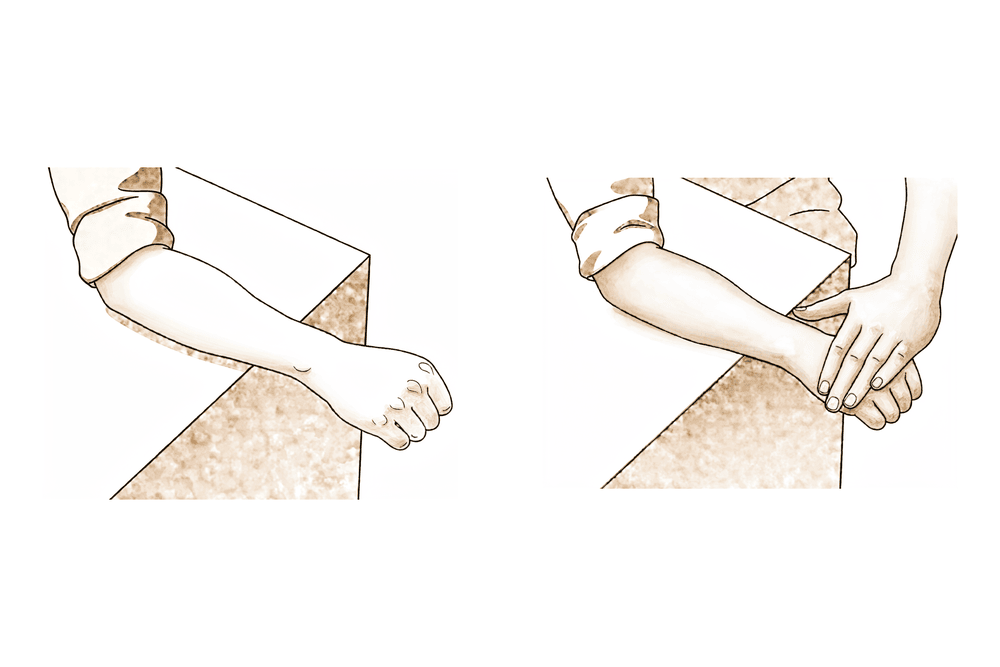
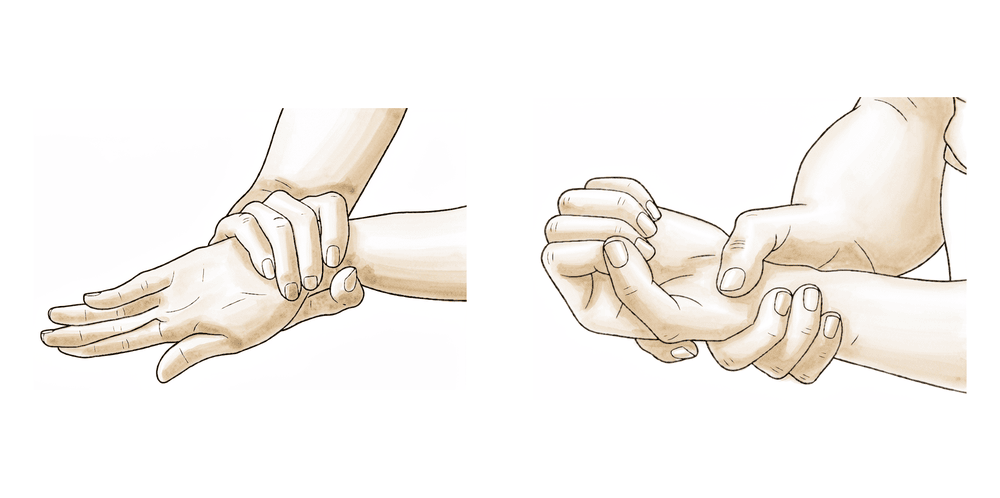
ஐசோமெட்ரிக் மணிக்கட்டு நீட்டல் (isometric wrist extension)
உள்ளங்கை கீழ்நோக்கி இருக்கும்படி, கை மேசையின் விளிம்புக்கு வெளியே இருக்கும்படி, உங்கள் முன்கையை ஒரு மேசையின் மேல் வையுங்கள். உங்கள் மறு கையை, வலிக்கும் கையின் புறங்கையின் மேல் வையுங்கள். மறு கை அதை அசையாமல் பிடித்து வைத்திருக்க, புறங்கையை மேல்நோக்கி உயர்த்த முயலுங்கள் — அதாவது உண்மையில் எதுவும் அசையக் கூடாது; இது எதிர்ப்புக்கு எதிராகத் தள்ளிப் பிடித்து வைக்கும் பயிற்சி. இது நல்ல முயற்சியாக உணரப்பட வேண்டும்; ஆனால் கூர்மையாக வலிக்கக் கூடாது. தள்ளுவதைத் தொடர்ந்து பிடித்து வைத்து, பிறகு தளர்த்துங்கள்.
30–45 வினாடிகள் பிடித்து வைக்கவும், 5 முறை, நாளொன்றுக்கு 1–2 முறை
Kieran Hirpara 4.0
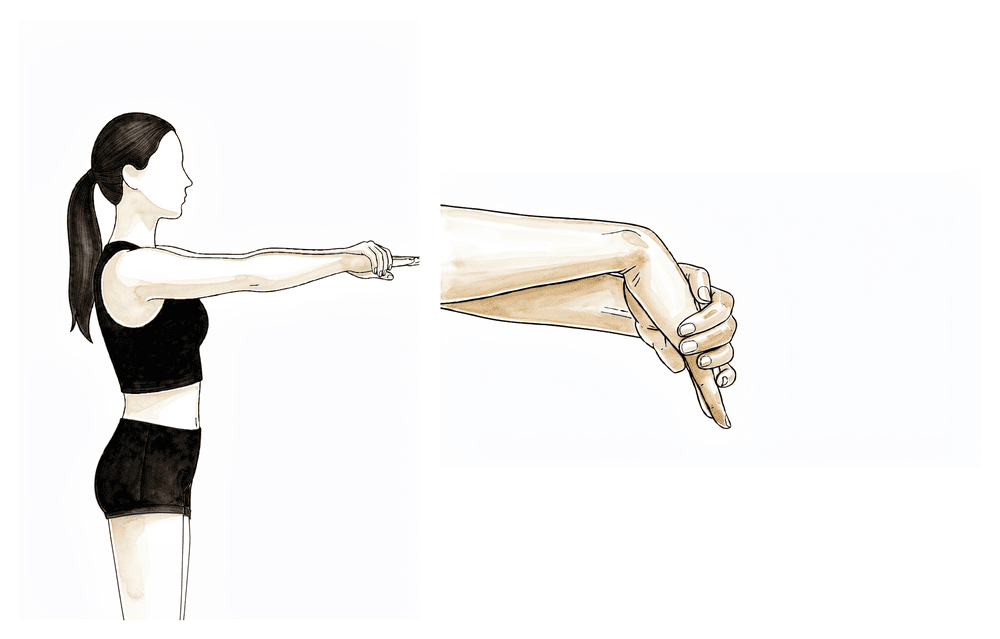
மணிக்கட்டு நீட்டுத் தசை நீட்சி
முழங்கை நேராகவும் உள்ளங்கை கீழ்நோக்கியும் இருக்கும்படி, வலிக்கும் கையை உங்கள் முன்னால் நீட்டிப் பிடியுங்கள். மறு கையால், விரல்கள் தரையை நோக்கிச் சுட்டும்படி மணிக்கட்டை மென்மையாகக் கீழ்நோக்கி வளையுங்கள் — உங்கள் முன்கையின் மேல்பகுதியில் ஒரு சௌகரியமான இழுப்பு உணரும் வரை. முழங்கையை நேராகவே வைத்திருங்கள். முழங்கையை நேராக்குவது மிகவும் கூர்மையாக வலித்தால், முழங்கையைச் சற்று வளைத்த நிலையில் தொடங்கி, வலி குறையக் குறைய முழுமையாக நேராக்கிய நிலைக்கு முன்னேறுங்கள்.
30 வினாடிகள் பிடித்து வைக்கவும், 3 முறை, நாளொன்றுக்கு 2–3 முறை
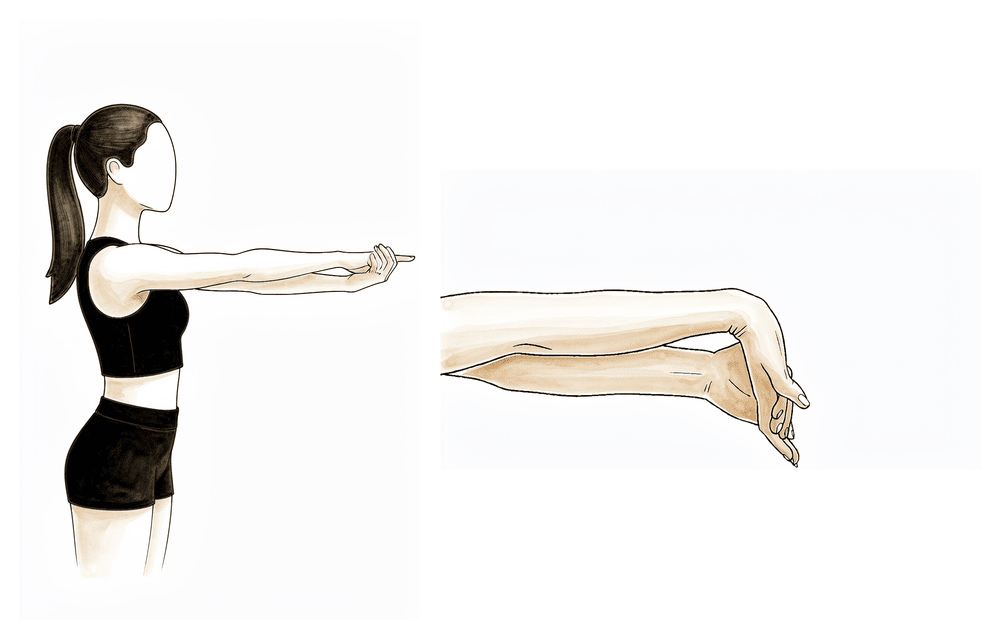
Kieran Hirpara 4.0
மணிக்கட்டு மடக்குத் தசை நீட்சி
முழங்கை நேராகவும் உள்ளங்கை மேல்நோக்கியும் இருக்கும்படி, கையை உங்கள் முன்னால் நீட்டிப் பிடியுங்கள். மறு கையால், விரல்களையும் மணிக்கட்டையும் பின்னோக்கியும் கீழ்நோக்கியும் மென்மையாக இழுங்கள் — உங்கள் முன்கையின் அடிப்பகுதியில் ஒரு சௌகரியமான இழுப்பு உணரும் வரை. முழங்கையை நேராகவே வைத்திருங்கள்.
30 வினாடிகள் பிடித்து வைக்கவும், 3 முறை, நாளொன்றுக்கு 2–3 முறை
Kieran Hirpara 4.0
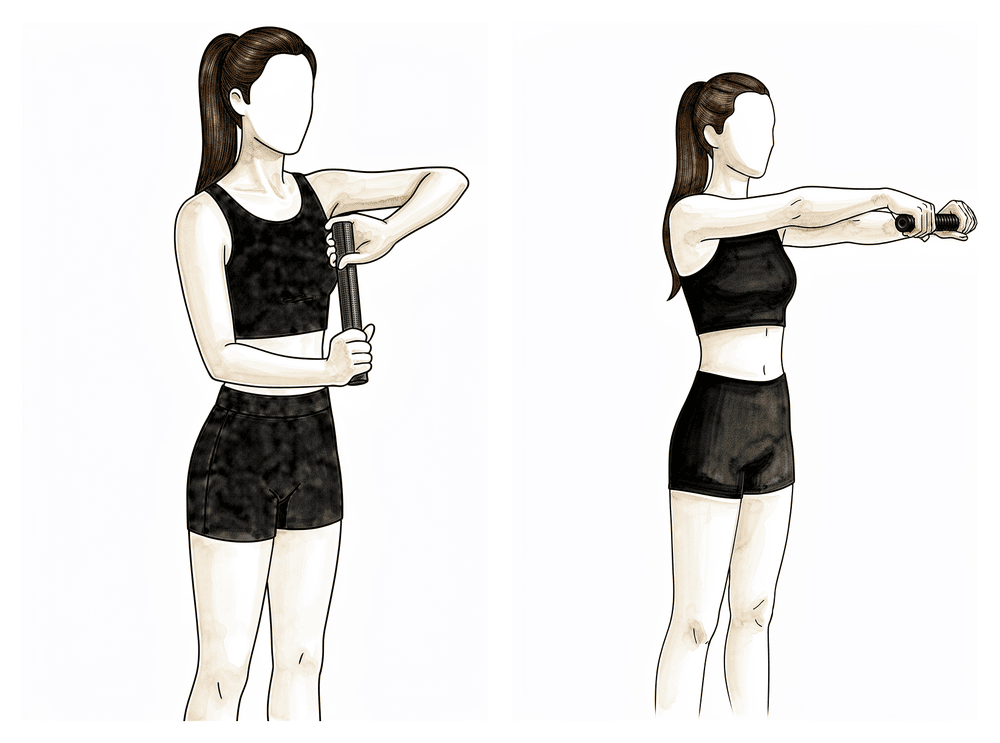
டைலர் ட்விஸ்ட் (Tyler twist; தசை நீளும்போது செய்யும் மணிக்கட்டு நீட்டல், eccentric wrist extension)
மணிக்கட்டைப் பின்னோக்கி வளைத்தபடி, ஒரு நெகிழ்வான ரப்பர் கம்பியை (FlexBar) வலிக்கும் கையில் செங்குத்தாகப் பிடியுங்கள். மறு கையால் கம்பியின் மேல் முனையைப் பிடித்துத் திருகுங்கள். இப்போது அந்தத் திருகலைத் தக்கவைத்தபடி கம்பியை உங்கள் முன்னால் கொண்டு வந்து, வலிக்கும் மணிக்கட்டு 3–4 வினாடிகளில் கட்டுப்பாட்டுடன் மெதுவாக விரியட்டும் — இந்த மெதுவான, கட்டுப்பாடான தளர்த்தலே தசைநாணைக் கட்டியெழுப்பும் பகுதி. திருகல் விரிவது உழைப்பாக உணரப்பட வேண்டும்; ஆனால் கூர்மையான வலியாக இருக்கக் கூடாது. பயிற்சியின்போதும் அதற்குப் பிறகு சிறிது நேரமும் லேசான வலி இருப்பது எதிர்பார்க்கப்படுவதுதான், அது பரவாயில்லை.
15 முறை கொண்ட 3 தொகுப்புகள், நாளொன்றுக்கு ஒரு முறை (முக்கிய வலுப்படுத்தும் பயிற்சி)
Kieran Hirpara 4.0
முன்கைச் சுழற்சி
உங்கள் முழங்கையை விலாவோடு ஒட்டி வைத்து, அதைச் செங்கோணத்தில் மடக்குங்கள். முழங்கையை அப்படியே ஒட்டி வைத்தபடி, உள்ளங்கை மேல்நோக்கி வரும்படி உங்கள் முன்கையை மெதுவாகச் சுழற்றுங்கள்; பிறகு உள்ளங்கை கீழ்நோக்கி வரும்படித் திருப்புங்கள். எளிதாக ஆக ஆக, சுமையைக் கூட்ட ஒரு சுத்தியல் அல்லது டப்பா போன்ற லேசான எடையைப் பிடித்துக்கொள்ளுங்கள்.
ஒவ்வொரு திசையிலும் 10 முறை, நாளொன்றுக்கு 2–3 முறை; முடியும்போது லேசான எடையைச் சேர்க்கவும்
Kieran Hirpara 4.0
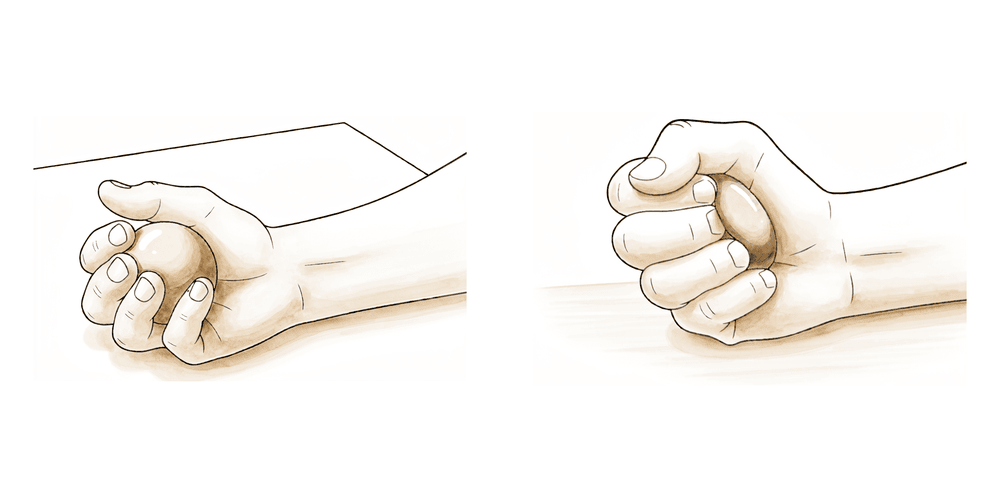
பிடி வலுப்படுத்துதல்
ஒரு மென்மையான பந்தையோ சிகிச்சைப் பிசினையோ (therapy putty) உங்கள் கையில் அழுத்திப் பிடித்து, சிறிது நேரம் அப்படியே வைத்திருந்து, பிறகு தளர்த்துங்கள். உங்கள் தசைநாண் மேலும் தாங்கத் தொடங்கும்போது, அழுத்தத்தின் இறுக்கத்தைப் படிப்படியாகக் கூட்டுங்கள். பிடிப்பது இன்னும் மிகவும் வலித்தால், இதைப் பிறகு, இன்னும் லேசாகத் தொடங்குங்கள் — பிடி வலுப்படுத்தும் பயிற்சி வலுப்படுத்தும் கட்டத்துக்கு உரியது; ஆரம்ப எரிச்சல் தணிந்த பிறகே அது வரும்.
10–15 முறை அழுத்துங்கள், நாளொன்றுக்கு 2–3 முறை; தாங்கும் அளவுக்கு இறுக்கத்தைப் படிப்படியாக அதிகரியுங்கள்
இவை உங்கள் கையேட்டில் உள்ள பயிற்சிகள். இவை மீட்சியின் வரிசையைப் பின்பற்றுகின்றன: எதிர்விசைத் தாங்கியும் ஐசோமெட்ரிக் பிடிப்புகளும் ஆரம்பத்திலேயே வலியைத் தணிக்க உதவுகின்றன, நீட்சிப் பயிற்சிகள் முன்கையை நெகிழ்வாக வைத்திருக்கின்றன, டைலர் ட்விஸ்ட், முன்கைச் சுழற்சி, பிடி வலுப்படுத்தும் பயிற்சி ஆகியவை தசைநாணை மீண்டும் கட்டியெழுப்புகின்றன. டாக்டர் ஹிர்பராவும் உங்கள் சிகிச்சையாளரும் வழிகாட்டும்படி இவற்றைத் தொடங்குங்கள்; முதல் நாளிலிருந்தே இவை அனைத்தையும் செய்தாக வேண்டும் என்று நினைக்க வேண்டாம். எவற்றுடன் தொடங்குவது, வலுப்படுத்தும் பயிற்சிகளை எப்போது சேர்ப்பது என்பதை உங்கள் சிகிச்சையாளர் உங்களிடம் சொல்வார்.
உங்கள் மருத்துவ நெறிமுறை
இந்தப் பக்கத்தின் மீதமுள்ள பகுதி, லேட்டரல் எபிகாண்டிலைட்டிஸுக்கான (lateral epicondylitis; டென்னிஸ் முழங்கை) மருத்துவ மறுவாழ்வு நெறிமுறை. இந்தப் பகுதி உங்கள் இயன்முறை சிகிச்சையாளரிடமோ கை சிகிச்சையாளரிடமோ கொடுக்கப்பட வேண்டியது; ஒவ்வொரு கட்டமும் என்ன நடக்கிறது என்பதற்கான எளிய விளக்கத்துடன் தொடங்குகிறது.
இந்த நெறிமுறைக்கு இரண்டு பிரிவுகள் உள்ளன: ஒன்று அறுவை சிகிச்சையற்ற வழி (ஏறக்குறைய அனைவருக்கும் இதுவே முதல்நிலை); மற்றொன்று, தரமான பழமைவாதச் சிகிச்சையை ஆறு மாதங்களோ அதற்கு மேலோ செய்தும் பலனில்லாமல் ECRB சுத்தம் செய்தலுக்கு (debridement) உட்படும் சிலருக்கான அறுவை சிகிச்சைக்குப் பிந்தைய வழி.
அறுவை சிகிச்சையற்ற வழி
அடிப்படைக் கொள்கை, வலியை வழிகாட்டியாகக் கொண்டு தசைநாணுக்குப் படிப்படியாகச் சுமை கொடுப்பதுதான். நோக்கம், அறிகுறிகள் நீடிக்கும் காலத்தைக் குறைப்பதும் சுமை தாங்கும் திறனை மீட்டெடுப்பதும்; தசைநாணுக்கு ஓய்வு கொடுப்பது அல்ல.
கட்டம் I — கடும் நிலை / வலிக் கட்டுப்பாடு (0–2 வாரங்கள்)
இங்கு கவனம், வலியைத் தணிப்பதிலும் சுமையில்லாத அசைவை மீட்டெடுப்பதிலும் இருக்கிறது. அசைவின்மை கிடையாது; இது ஒப்பீட்டளவிலான ஓய்வே தவிர மாவுக்கட்டு போடுவது அல்ல.
உங்கள் இயன்முறை சிகிச்சையாளருக்கு:
- இலக்குகள்: வலியைத் தணிப்பது; சுமையில்லாத முழு சுய அசைவின் வீச்சை (active range of motion, AROM) மீட்டெடுப்பது.
- சிகிச்சை மேலாண்மை: செயல்பாட்டை மாற்றியமைத்தல், மூட்டுப் பாதுகாப்பு, பணிச்சூழலியல் (ergonomic) ஆலோசனை. பிடிக்கும்போது ECRB தொடங்கும் இடத்தின் சுமையைக் குறைக்க, பொது நீட்டுத் தசைத் திரளின் மேல் விருப்பத்தேர்வாக ஒரு எதிர்விசைத் தாங்கி (counterforce brace); நீட்டும் செயல்களில் கடுமையான வலி இருந்தால் ஒரு மணிக்கட்டு (cock-up) சிம்பைப் பயன்படுத்தலாம். வலியைத் தணிக்கத் துணைச் சிகிச்சைகள்: பனிக்கட்டி, மென்திசு / கருவி துணைகொண்ட மென்திசு அசைவூட்டல் (instrument-assisted soft-tissue mobilisation, IASTM), வலியற்ற மென்மையான AROM, விருப்பத்தேர்வாக உலர் ஊசிமுறை (dry needling), நரம்பு நழுவல் பயிற்சிகள் (nerve glides).
- அடுத்த கட்டத்துக்குச் செல்வதற்கான அளவுகோல்கள்: வலியின்றி முழுச் சுமையில்லாத AROM; வீட்டுப் பயிற்சித் திட்டத்தைச் சுயமாகச் செய்யும் திறன்.
கட்டம் II — கடுமை தணிந்த நிலை / ஆரம்பச் சுமை ஏற்றுதல் (2–4 வாரங்கள்)
தசைநாணுக்குச் சுமை கொடுப்பது மென்மையாகத் தொடங்குகிறது; அத்துடன் அண்மைச் சங்கிலியும் (தோள்பட்டை எலும்பும் சுழற்சி தசைநாண் பட்டையும்) கவனிக்கப்படுகிறது — ஏனெனில் கையின் மேல்பகுதியில் உள்ள பலவீனமே முழங்கையில் அதிகச் சுமையை உண்டாக்குகிறது.
உங்கள் இயன்முறை சிகிச்சையாளருக்கு:
- இலக்குகள்: தசைநாணுக்குச் சுமை கொடுக்கத் தொடங்குவது; அண்மை இயக்கச் சங்கிலியை (proximal kinetic chain) கவனிப்பது.
- பயிற்சிகள்: மணிக்கட்டு நீட்டுத் தசைகளுக்கும் மடக்குத் தசைகளுக்கும் ஐசோமெட்ரிக் (isometric) சுமை (குறைந்த சுமை; வினைபுரியும் தசைநாண் நோயில் ஐசோமெட்ரிக் பயிற்சிகள் நன்கு தாங்கப்படுகின்றன, வலியையும் தணிக்கின்றன); முழங்கை 90° இல் இருக்கும்படி மணிக்கட்டு மடக்குத் தசைகளையும் நீட்டுத் தசைகளையும் படிப்படியாக நீட்டுதல்; அண்மைப் பகுதி வேலை: செரேட்டஸ் ஆன்டீரியர் (serratus anterior), நடு/கீழ் ட்ரப்பீசியஸ் (trapezius), சுழற்சி தசைநாண் பட்டை, தோள்பட்டை எலும்பை நிலைப்படுத்தும் தசைகள்.
- அடுத்த கட்டத்துக்குச் செல்வதற்கான அளவுகோல்கள்: முழு அசைவின் வீச்சு (ROM) தக்கவைக்கப்படுதல்; முழங்கை 90° மடக்கில் இருக்கும்போது நீட்சியைத் தாங்குதல்; எதிர்ப்பக்கக் கையின் பிடி/வலிமையில் ஏறக்குறைய 70%.
கட்டம் III — வலுப்படுத்துதல் / திரும்புதல் (4–6+ வாரங்கள், பெரும்பாலும் 12 வாரங்கள் வரை நீளும்)
இங்குதான் தசைநாண் மீண்டும் கட்டியெழுப்பப்படுகிறது; வேலைக்கும் விளையாட்டுக்குமான சுமை தாங்கும் திறன் மீட்டெடுக்கப்படுகிறது. தசை நீளும்போதும் (eccentric) சுருங்கும்போதும் (concentric) செய்யும் சுமைப் பயிற்சியே இங்கு முக்கியச் சிகிச்சை இயக்கி.
உங்கள் இயன்முறை சிகிச்சையாளருக்கு:
- இலக்குகள்: சுமை தாங்கும் திறனையும் விளையாட்டு/வேலைத் திறனையும் மீட்டெடுப்பது.
- பயிற்சிகள்: மணிக்கட்டு நீட்டலுக்கும் முன்கைச் சுழற்சிக்கும் (pronation/supination) தசை நீளும்போதும் சுருங்கும்போதும் (eccentric–concentric) சுமை கொடுத்தல்; வீட்டில் செய்யும் eccentric பயிற்சிக்கான முன்மாதிரிக் கருவி டைலர் ட்விஸ்ட் (Tyler twist, FlexBar). நீட்சிப் பயிற்சியை முழங்கை நீட்டிய நிலைக்கு முன்னேற்றவும்; அசைவுடன் கூடிய அசைவூட்டல் (mobilisation-with-movement, Mulligan). பிடி வலுப்படுத்துதல் மற்றும் வேலை/விளையாட்டுக்குரிய குறிப்பிட்ட சுமைப் பயிற்சி; விளையாட்டு வீரர்களுக்குப் ப்ளையோமெட்ரிக்ஸ் (plyometrics). நோயாளிக்கு அறிகுறிகள் இல்லாமல் போகும்போது எதிர்விசைத் தாங்கியைப் படிப்படியாகக் குறைக்கவும். விளையாட்டு வீரர்களுக்குக் கருவி மாற்றங்கள் (பிடி அளவு, கம்பி இறுக்கம், நுட்பம்).
- அடுத்த கட்டத்துக்குச் செல்வதற்கான அளவுகோல்கள் (விளையாட்டுக்குத் திரும்புதல்): எதிர்ப்பக்கக் கையின் வலிமையில் ஏறக்குறைய 90%, வலியற்ற செயல்பாடு, தாமே கையாளும் திறன்.
அறுவை சிகிச்சைக்குப் பிந்தைய வழி (ECRB சுத்தம் செய்தல் ± விடுவிப்பு)
தரமான பழமைவாதச் சிகிச்சையை ≥6 மாதங்கள் செய்தும் பலனடையாத ~4–11% பேருக்கு மட்டுமே அறுவை சிகிச்சை ஒதுக்கப்படுகிறது. திறந்த நிர்ஷ்ல் (Nirschl) வகைச் சுத்தம் செய்தலும் ஆர்த்ரோஸ்கோபிக் ECRB சுத்தம் செய்தலும் ஒப்பிடத்தக்க முடிவுகளைத் தருகின்றன. கீழே உள்ள காலவரிசை, லேட்டரல் எபிகாண்டைல் சுத்தம் செய்தலுக்கான Brigham & Women's Standard of Care-ஐப் பின்பற்றுகிறது.
கட்டம் 1 — பாதுகாத்தல் (நாட்கள் 1–7)
முதல் வாரத்தில் சௌகரியத்துக்காக மட்டுமே கைத்தாங்கி (sling) பயன்படுத்தப்படுகிறது.
உங்கள் இயன்முறை சிகிச்சையாளருக்கு:
- சௌகரியத்துக்குக் கைத்தாங்கி; பனிக்கட்டி 20 நிமிடங்கள், நாளொன்றுக்கு 2–3 முறை; கீறலின் மேல் ஒரு முழங்கை மெத்தை (elbow pad).
- வலியற்ற மென்மையான கை, மணிக்கட்டு, முழங்கை AROM; தோள்பட்டையின் சுய அசைவின் வீச்சு; தோள்பட்டை எலும்பைச் சுற்றியுள்ள (periscapular) பயிற்சிகள்.
- நீட்டும் அமைப்புக்கு (extensor mechanism) அழுத்தம் தரும் அன்றாடச் செயல்களைக் (ADLs) குறைக்கவும் (தூக்குதல், முழங்கையை முழுமையாக நீட்டியபடி மணிக்கட்டை மடக்கும் கூட்டு நிலை); நீட்டுத் தசைகளின் சுமையைக் குறைக்க உள்ளங்கை மேல்நோக்கித் தூக்கவும்; கடுமையான வலி இருந்தால் விருப்பத்தேர்வாக மணிக்கட்டுச் சிம்பு.
கட்டம் 2 — ஆரம்ப அசைவு (வாரங்கள் 2–4)
உங்கள் இயன்முறை சிகிச்சையாளருக்கு:
- கைத்தாங்கியை நிறுத்தவும். வலி தாங்கும் அளவுக்குள் செயலற்ற அசைவின் வீச்சையும் (PROM) துணையுடன் கூடிய சுய அசைவையும் தொடங்கவும்.
- மென்மையான வலுப்படுத்துதல்: சுய அசைவும் அதிகபட்சத்துக்குக் குறைவான ஐசோமெட்ரிக் (sub-maximal isometric) பயிற்சிகளும். தழும்பு மேலாண்மையைத் தொடங்கவும்.
கட்டம் 3 — வலுப்படுத்துதல் (வாரங்கள் 5–7)
உங்கள் இயன்முறை சிகிச்சையாளருக்கு:
- எதிர்ப்புடன் கூடிய வலுப்படுத்தும் பயிற்சியை முன்னேற்றவும் (எடைகள் / தெராபேண்ட், Theraband); மணிக்கட்டு நீட்டுத் தசைகளின் சகிப்புத்தன்மைக்கு முக்கியத்துவம் கொடுக்கவும் (குறைந்த சுமை, அதிக மறுசெய்கைகள்). முழு சுய மற்றும் செயலற்ற அசைவின் வீச்சை மீட்டெடுக்கவும்.
- பொது நீட்டு தசைநாணுக்கு எதிர்விசைத் தாங்கியை அறிமுகப்படுத்தவும் (நரம்பு அழுத்தத்தைத் தவிர்க்கக் கற்பித்தலுடன்); மென்மையான குறுக்கிழை மசாஜ்; செயல்பாட்டுக்கான தயாரிப்பைத் தொடங்கவும்.
கட்டம் 4 — செயல்பாட்டு நிலை / திரும்புதல் (வாரங்கள் 8–12)
உங்கள் இயன்முறை சிகிச்சையாளருக்கு:
- குறிப்பிட்ட வேலைக்குரிய செயல்பாட்டுப் பயிற்சி; உயர்நிலை வேலைக்கும் பொழுதுபோக்குச் செயல்பாட்டுக்கும் திரும்புதல்.
- வலியற்ற அன்றாடச் செயல்களுக்கும் வலுப்படுத்தும் பயிற்சிக்கும் தேவைக்கேற்ப எதிர்விசைத் தாங்கியைத் தொடர்ந்து அணியவும்.
வேலைக்கும் செயல்பாடுகளுக்கும் திரும்புதல்
நீங்கள் டென்னிஸ் முழங்கைக்கு அறுவை சிகிச்சை இல்லாமல் சிகிச்சை பெற்றுக்கொண்டிருந்தால், "வேலையிலிருந்து விலகி இருக்கும்" நிலையான காலம் என்று எதுவும் இல்லை; இக்காலம் முழுவதும் நீங்கள் கையைத் தொடர்ந்து பயன்படுத்தலாம் — மிகக் கனமான பிடிப்பு மற்றும் தூக்கும் வேலைகளை மாற்றியமைத்து, அவற்றைச் செய்து முடிக்க எதிர்விசைத் தாங்கியைப் பயன்படுத்திக்கொள்ளுங்கள். நடைமுறை எதிர்பார்ப்பு என்னவென்றால், 6–12 மாதங்களில் முழங்கை தணிந்துவிடும்; பெரும்பாலானோர் (80–90%) ஓர் ஆண்டுக்குள் குணமடைகிறார்கள். இது மெதுவாகச் சரியாகும் தசைநாண் பிரச்சினை; எனவே முன்னேற்றம் நாட்களில் அல்ல, வாரங்களிலும் மாதங்களிலும் அளக்கப்படுகிறது. சுமைப் பயிற்சித் திட்டத்தில் உறுதியாக இருப்பதே உங்களை அங்கே கொண்டு சேர்க்கும்; இடையில் வலி அதிகரிக்கும் தருணங்கள் இயல்பானவை — லேசான வலி அடுத்த நாளுக்குள் தணிந்துவிட்டால், அது ஒரு பின்னடைவு அல்ல.
உங்களுக்கு அறுவை சிகிச்சை நடந்திருந்தால், முதல் வாரத்தில் சௌகரியத்துக்காக மட்டுமே கைத்தாங்கி; முழங்கை தணிந்தவுடன் அது கைவிடப்படுகிறது. 5–7 வாரங்களில் வலுப்படுத்தும் பயிற்சி படிப்படியாக அதிகரிக்கிறது; பெரும்பாலானோர் 8–12 வாரங்களில் வேலைக்கும் பொழுதுபோக்குக்கும் செயல்பாட்டு ரீதியாகத் திரும்புகிறார்கள். கனமான, விளையாட்டுக்குரிய தேவைகள் அந்தக் காலத்துக்குள் படிப்படியாக மீண்டும் அறிமுகப்படுத்தப்படுகின்றன; தசைநாண் சுமையை எவ்வளவு தாங்குகிறது என்பதே இதற்கு வழிகாட்டும்.
விளையாட்டுக்குத் திரும்புவது (இரண்டு வழிகளுக்கும்) நாட்காட்டியை மட்டும் பார்த்து முடிவு செய்யப்படுவதில்லை; உங்கள் மறு கையின் வலிமையில் ஏறக்குறைய 90%-ஐ எட்டுவது, வலியற்ற செயல்பாடு, தாமே கையாளும் நம்பிக்கை ஆகியவையே இதற்கு வழிகாட்டுகின்றன.
உங்கள் நெறிமுறைக்குப் பிறகு
இந்த நெறிமுறை கிளினிக்கின் பொதுவான மீட்சி ஆலோசனைகளுடன் இணைந்து செயல்படுகிறது; அறுவை சிகிச்சைக்குப் பிந்தைய வலியைக் கையாளுதல் பக்கத்தையும், உங்களுக்கு அறுவை சிகிச்சை நடந்திருந்தால் காயப் பராமரிப்பு மற்றும் கை சிகிச்சையின் அடிப்படைகள் பக்கங்களையும் பாருங்கள். மேலே உள்ள கட்டவாரியான திட்டம், டென்னிஸ் முழங்கைக்கான தற்போதைய சிறந்த சான்றுகளைப் (ஓய்வுக்குப் பதிலாகப் படிப்படியான தசைநாண் சுமை) பிரதிபலிக்கிறது; உங்கள் முழங்கை எப்படி முன்னேறுகிறது என்பதைப் பொறுத்து, உங்கள் இயன்முறை சிகிச்சையாளரோ கை சிகிச்சையாளரோ உங்கள் தொடர் மீட்சிக்குத் தனிப்பட்ட முறையில் வழிகாட்டுவார்.
Evidence & references
This is the clinical evidence summary written for health professionals. It is technical, and it lists the research this page was built from. You do not need to read it to understand your treatment or to make a decision about it.
Topic scope: (A) the natural history and stepped non-operative management of lateral epicondylitis (relative rest → progressive tendon loading: isometric → eccentric–concentric; counterforce bracing; controversies around corticosteroid and PRP injection), and (B) post-operative rehabilitation after open or arthroscopic ECRB debridement ± release, reserved for the minority who fail ≥6 months of quality conservative care.
Defining principle: despite the "-itis" suffix, lateral epicondylitis is a degenerative tendinopathy (tendinosis) of the extensor carpi radialis brevis (ECRB) origin, not an inflammatory condition. This reframes treatment away from rest and anti-inflammatory measures and toward progressive tendon loading — settle pain with isometrics, then rebuild load tolerance with eccentric–concentric loading (the Tyler twist / FlexBar). KH's stance: load the tendon, do not immobilise it; corticosteroid injection is avoided as first line because it is better short-term but worse at 6–12 months; surgery is a last resort after ≥6 months of genuine conservative care.
A. NATURAL HISTORY & NON-OPERATIVE MANAGEMENT
Natural history (self-limiting in most)
Lateral epicondylitis is self-limiting in the majority: roughly 80–90% resolve within about one year regardless of treatment, with the conservative literature ranging out to 12–18 months [Coonrad & Hooper 1973; Nirschl 1999]. This high spontaneous-resolution rate is the central methodological challenge of the field — any intervention must beat natural history, a high bar most fail to clear. The goal of therapy is therefore to shorten the symptomatic course and restore load tolerance, not to "cure" a condition that largely settles on its own.
Phased non-operative rehabilitation
First-line for essentially all comers. The therapeutic core is progressive tendon loading guided by pain.
Phase I — Acute / pain control (~0–2 weeks). Relative rest, NOT immobilisation — avoid full wrist/elbow casting (Nirschl). Activity modification, joint protection, ergonomics. Optional counterforce brace over the common extensor mass (offloads the ECRB origin during grip) ± a wrist cock-up splint if acutely painful. Adjuncts: ice, soft-tissue/IASTM, pain-free AROM, optional dry needling, nerve glides. Criterion to progress: full unloaded AROM without pain; independent with home program. Consensus / institutional protocol.
Phase II — Sub-acute / early loading (~2–4 weeks). Begin isometric wrist flexor/extensor loading (minimal load; isometrics are well tolerated and analgesic in reactive tendinopathy). Progressive stretching of wrist flexors/extensors with the elbow at 90°. Add proximal kinetic-chain work (serratus anterior, mid/lower trapezius, rotator cuff, scapular stabilisers — proximal deficits drive distal overload). Criteria to progress: full ROM maintained; tolerates stretch at 90° elbow flexion; ~70% contralateral grip/strength. Moderate (strengthening trials) / Consensus (timeline).
Phase III — Late / strengthening & return (~4–6+ weeks, often to 12 weeks). Eccentric–concentric loading of wrist extension and forearm pronation/supination is the core driver; the Tyler twist (FlexBar eccentric wrist-extension) is the prototypical home tool. Progress stretching to the elbow-extended position; add mobilisation-with-movement (Mulligan). Grip strengthening and task-/sport-specific loading; plyometrics for athletes. Gradually wean the counterforce brace as the patient becomes asymptomatic. Return-to-sport criteria: ~90% contralateral strength, pain-free function, self-management competence. Moderate–High (RCT/SR for exercise & loading) / Consensus (phase timings).
B. POST-OPERATIVE REHABILITATION (open or arthroscopic ECRB debridement ± release/repair)
Surgery is reserved for the ~4–11% who fail ≥6 months (commonly 6–12 months) of quality conservative care. Open Nirschl-type debridement and arthroscopic ECRB debridement give comparable complication and reoperation rates (national database, Arthroscopy 2022); arthroscopy additionally allows intra-articular inspection. The phased timeline below is the Brigham & Women's Standard of Care for lateral epicondyle debridement, cross-checked against community ECRB-release protocols.
| Phase | Window | Sling / support | Motion & strengthening | Notes |
|---|---|---|---|---|
| 1 — Protect | Days 1–7 | Sling for comfort; optional wrist splint if painful | Pain-free hand/wrist/elbow AROM; active shoulder ROM; periscapular work | Ice 20 min 2–3×/day; elbow pad over incision; lift palm-up to offload extensors |
| 2 — Early motion | Weeks 2–4 | Discontinue sling | PROM + active-assisted motion within pain tolerance; sub-maximal isometrics | Begin scar management |
| 3 — Strengthening | Weeks 5–7 | Introduce counterforce brace | Advance resistive strengthening (weights/Theraband); wrist-extensor endurance (light load, high rep); restore full A/PROM | Education to avoid nerve compression; cross-fibre massage |
| 4 — Functional / return | Weeks 8–12 | Counterforce brace as needed | Task-specific functional training; return to work/recreation | Functional return wk 8–12 |
Alternative published timelines (community ECRB-release protocols): wrist splint full-time 0–2 wk with no strengthening; full ROM goal by 4–6 wk; strengthening + transition to counterforce brace
6 wk; full activity ~8–10+ wk. Note: one comparative series found post-op bracing/immobilisation delayed symptom resolution versus PRP (mean time to full ROM 96 days surgery vs 42 days PRP) — reinforcing that early controlled motion, not protection, is the goal.
C. KEY CONTROVERSIES / EVIDENCE QUALITY
- Corticosteroid injection: better short-term, WORSE long-term. The Bisset/Smidt body of work (and the BMJ 2006 mobilisation-with-movement RCT) shows steroid gives early relief but higher recurrence and worse 6–12-month outcomes than physiotherapy or wait-and-see. Some authors now call it "always inadvisable" for lateral elbow (Orthop Trauma Surg Res 2019). Prior injection is associated with eventual surgery (a proxy for severity). Strong (Level-1 RCT).
- PRP / autologous blood: contested. Some Level-1 RCTs (Peerbooms 2010; Gosens 2-yr) show PRP superior to corticosteroid with ongoing 2-year benefit; others (Krogh 2013) found PRP ≈ glucocorticoid ≈ saline (no benefit over placebo). Meta-analyses are heterogeneous. Net: a reasonable second-line for refractory cases, but evidence is inconsistent. Conflicting (Level-1).
- Eccentric vs concentric vs isometric. Pure eccentric (Alfredson-style) is effective but not clearly superior; current view favours eccentric–concentric combined loading, with isometrics for early analgesia. Grip/isometric demands of the elbow differ from the Achilles, so blanket extrapolation of eccentric-only protocols is questioned. Moderate.
- Surgical indication/timing & technique. Reserve for failure of ≥6 months conservative care. Open vs arthroscopic debridement: no significant difference in complication or reoperation rates (national database, Arthroscopy 2022); choice is surgeon-/training-dependent. Repair after debridement vs debridement alone remains unsettled. Surgical incidence is declining, attributed to eccentric-exercise protocols and injections. Moderate.
- Self-limiting nature complicates all evidence: ~80–90% resolve within a year regardless of treatment, so any intervention must beat natural history. Strong (natural-history signal).
D. EVIDENCE STRENGTH FLAGS (summary)
- MODERATE–HIGH (RCT / SR): progressive loading (eccentric / eccentric–concentric) and exercise therapy for non-operative lateral epicondylitis; mobilisation-with-movement (BMJ 2006); the natural-history signal (~80–90% resolve within ~1 year).
- MODERATE (cohorts / database): post-operative ECRB debridement outcomes; equivalence of open vs arthroscopic debridement (no difference in complication/reoperation rates).
- CONSENSUS / institutional (Level-5): the phase timelines themselves derive from Standard-of-Care protocols (Brigham & Women's, Mass General Brigham, Campbell's/Nirschl) — broadly concordant across sources but not trial-derived.
- STRONG (against, Level-1): corticosteroid injection as first-line — better short-term, worse at 6–12 months.
CITATIONS
RAG corpus (180,000+ Orthopaedic articles)
- Bisset L et al. Mobilisation with movement and exercise, corticosteroid injection, or wait and see for tennis elbow: randomised trial. BMJ. 2006. DOI: 10.1136/bmj.38961.584653.AE
- Krogh TP et al. Treatment of lateral epicondylitis with platelet-rich plasma, glucocorticoid, or saline: a randomized, double-blind, placebo-controlled trial. Am J Sports Med. 2013. DOI: 10.1177/0363546512472975
- Peerbooms JC et al. Positive effect of an autologous platelet concentrate in lateral epicondylitis in a double-blind randomized controlled trial. Am J Sports Med. 2010. DOI: 10.1177/0363546509355445
- Gosens T et al. Ongoing positive effect of platelet-rich plasma versus corticosteroid injection in lateral epicondylitis: a double-blind randomized controlled trial with 2-year follow-up. Am J Sports Med. 2011. DOI: 10.1177/0363546510397173
- Ortega-Castillo M, Medina-Porqueres I. Effectiveness of the eccentric exercise therapy in physically active adults with symptomatic shoulder impingement or lateral epicondylar tendinopathy: a systematic review. J Sci Med Sport. 2016. DOI: 10.1016/j.jsams.2015.05.010
- Nirschl RP, Ashman ES. Elbow tendinopathy: tennis elbow. Clin Sports Med. 2003. (Current Concepts — Tendinosis of the Elbow, J Bone Joint Surg Am. 1999. DOI: 10.2106/00004623-199902000-00016)
- Coonrad RW, Hooper WR. Tennis elbow: its course, natural history, conservative and surgical management. J Bone Joint Surg Am. 1973. DOI: 10.2106/00004623-197355060-00002
- Lattermann C et al. Arthroscopic debridement of the extensor carpi radialis brevis for recalcitrant lateral epicondylitis. J Shoulder Elbow Surg. 2010. DOI: 10.1016/j.jse.2010.02.008
Lateral epicondylitis literature (URLs)
- Comparative efficacy and safety of nonsurgical treatment options for enthesopathy of the ECRB: a systematic review and meta-analysis of randomized trials. Am J Sports Med. 2018. https://pubmed.ncbi.nlm.nih.gov/29268037/
- Eccentric, eccentric–concentric, and eccentric–concentric + isometric training in lateral elbow tendinopathy. J Hand Ther. 2017. https://pubmed.ncbi.nlm.nih.gov/28732560/
- Role of strengthening during nonoperative treatment of lateral epicondyle tendinopathy. J Hand Ther. 2021. https://pubmed.ncbi.nlm.nih.gov/33041157/
- Chronic lateral elbow tendinopathy managed with a supervised graded exercise protocol. J Hand Ther. 2023. https://pubmed.ncbi.nlm.nih.gov/36127241/
- Management of lateral epicondylitis. Orthop Traumatol Surg Res. 2019. https://pubmed.ncbi.nlm.nih.gov/30414784/
- No difference in complication or reoperation rates between arthroscopic and open debridement for lateral epicondylitis: a national database study. Arthroscopy. 2022. https://pubmed.ncbi.nlm.nih.gov/34838651/
- Wang D et al. Trends in surgical practices for lateral epicondylitis among newly trained orthopaedic surgeons. Orthop J Sports Med. 2017. https://pubmed.ncbi.nlm.nih.gov/28840148/
- Factors associated with failure of nonoperative treatment in lateral epicondylitis. Am J Sports Med. 2015. https://pubmed.ncbi.nlm.nih.gov/26015443/
Published rehab protocols (patient-guidance — basis for the phase structure)
- Brigham & Women's Hospital — Post-Op Protocol for Lateral Epicondyle Debridement. https://www.brighamandwomens.org/assets/bwh/patients-and-families/rehabilitation-services/pdfs/elbow-lateral-epicondyle-debridement-postoperative-bwh.pdf
- Mass General Brigham Sports Medicine — Rehabilitation Protocol for Medial/Lateral Epicondylitis (non-operative), rev. April 2021. https://www.massgeneral.org/assets/MGH/pdf/orthopaedics/sports-medicine/physical-therapy/rehabilitation-protocol-for-medial-lateral-epicondylitis.pdf
- Beacon Orthopaedics — Lateral Epicondylitis ECRB Surgical Release Protocol. https://www.beaconortho.com/wp-content/uploads/Lateral-Epicondylitis-Release.pdf