

肘关节不稳定 资料
本方案指导您在 Mater Private Hospital Rockhampton 接受 Kieran Hirpara 医生进行的肘关节不稳手术后的康复过程。该方案涵盖两种不同类型的不稳,您的外科医生将告知您适用哪一种:
- (A) 外侧(外侧)损伤: 例如“恐怖三联征”损伤、骨折脱位或外侧副韧带(LCL)修复。这些损伤经过稳定处理,使肘关节不再发生滑脱或脱位。
- (B) 投掷(内侧,内侧)损伤: 尺侧副韧带(UCL)的修复或重建,通常见于过头顶运动的运动员。
整个计划基于一个核心理念:保护下的早期活动,而非固定。 长时间使用石膏或夹板固定是肘关节永久性僵硬的主要原因,因此目标是尽早安全地开始活动。请在首次理疗就诊时携带此页面或其 PDF 文件,以确保您的康复过程协调一致。您的治疗师可能会根据您的康复进展调整计划。
如果您对术后伤口有任何疑虑,请联系诊所。通常,拍摄伤口照片并通过电子邮件发送以供审查会很有帮助。
预期情况
肘关节由关节内侧和外侧的韧带固定。当这些韧带受损(由脱位、骨折脱位或反复投掷动作引起)时,关节可能变得不稳定。手术旨在修复或重建受损结构,使关节恢复正常的对位。
Hirpara 医生的方法避免了使用笨重的外部铰链支具。如果手术时修复结构在整个活动范围内均保持稳定,您只需佩戴轻便的悬吊带以提供舒适感,并在安全体位内尽早开始活动肘关节。如果稳定性需要更多保护,可在手术时安装内部关节稳定器:这是一种小型内部铰链,从内部保持肘关节正确复位,同时仍允许您尽早弯曲和伸直肘部。由于保护是内部的,您仍然可以避免使用外部限角支具。如果使用,该内部装置通常在韧带愈合后移除,大约在四到六个月时。
关于伤口、肿胀和疤痕管理,请参阅诊所的伤口护理指南。
在此康复过程中,最重要的单一习惯是在安全范围内保持活动,同时尊重外科医生要求您避免的体位。以下练习是您的起点。
注意事项与限制
需要保护的位置取决于您的具体损伤类型。您的外科医生和治疗师将为您确认具体方案。
对于外侧(外侧面)损伤(恐怖三联征 / 外侧副韧带):
- 应保持前臂掌心向下(旋前)进行活动;此体位可使关节复位并保护外侧修复部位。
- 应在手臂位于身体前方时进行锻炼,或若医生要求,可仰卧并将手臂伸向天花板,以便重力帮助维持关节稳定。
- 不应让手臂向外侧下垂(避免肩关节外展),或在早期通过手臂承重;此时重力会拉扯修复部位。
- 不应在外科医生允许之前(约16周)将肘关节完全伸直的同时使前臂掌心向上(旋后);此体位可能导致关节再次脱位。
- 不应将肘关节推压或拉伸至疼痛状态,并在最初几个月内避免承重及接触性负荷。
对于投掷(内侧,内侧面)损伤(尺侧副韧带):
- 应按照指示保持前臂偏向掌心向上(旋后)或中立位。
- 不应在早期使肩关节进行外旋(外旋)负荷;这会牵拉内侧修复部位。通常需避免此动作直至约6周。
您的锻炼
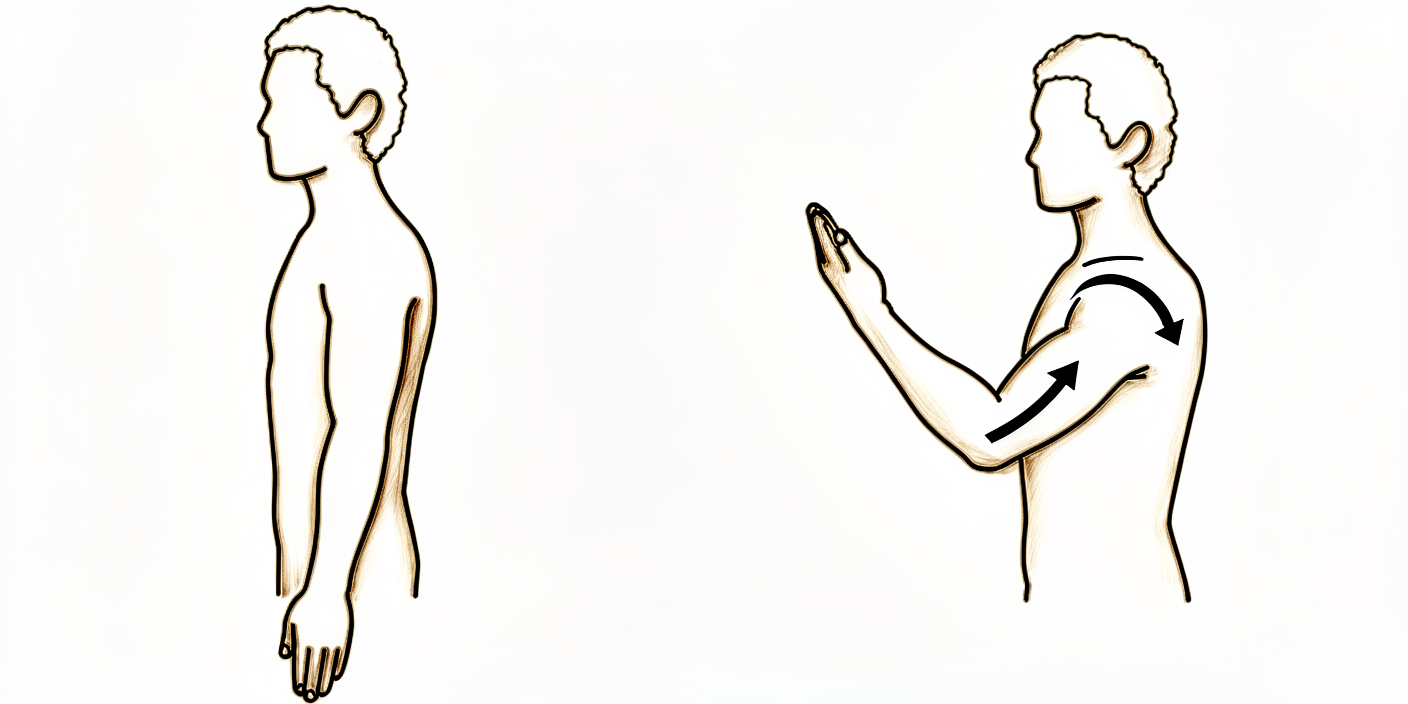
Kieran Hirpara 4.0
主动肘关节屈曲
轻柔地弯曲肘部至舒适程度,然后伸直至外科医生和治疗师允许的限度。保持前臂处于指示的方向——对于外侧损伤,这通常意味着掌心向下(旋前)。仅依靠自身肌肉活动;不要强行活动关节。
10–15 次,每日数次
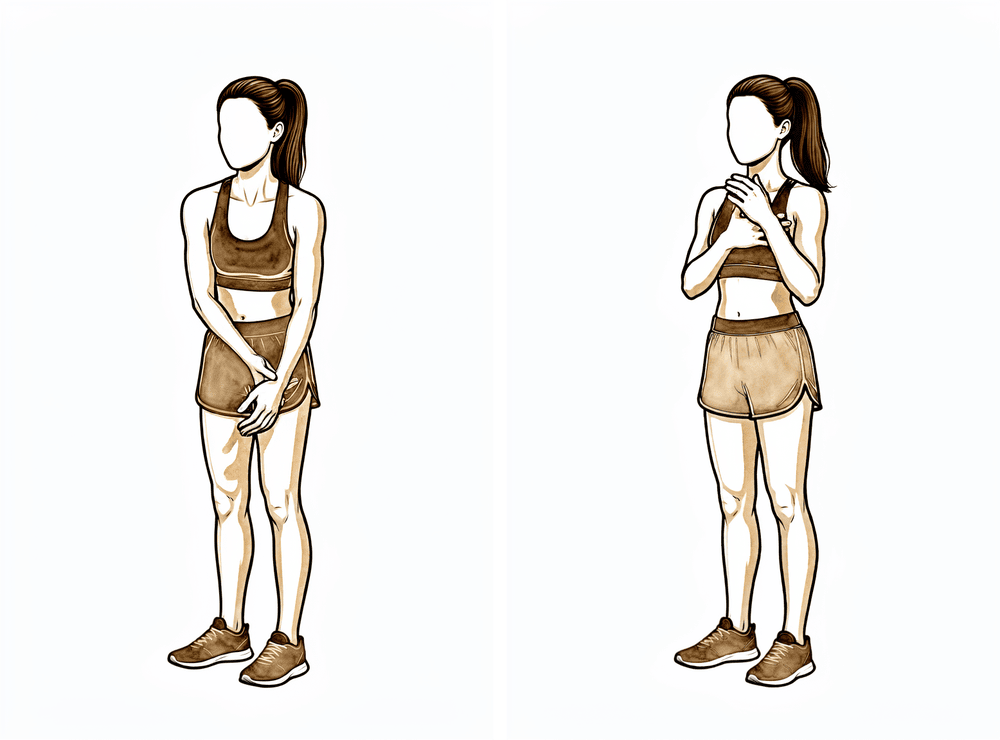
Kieran Hirpara 4.0
辅助肘关节屈曲
当治疗师允许时,用您的另一只手轻轻帮助您的肘部弯曲,使其比自主活动时的角度稍大一些。仅拉伸至舒适的程度——切勿拉伸至疼痛——并缓慢放松。
保持 10–15 秒,5–10 次,遵医嘱
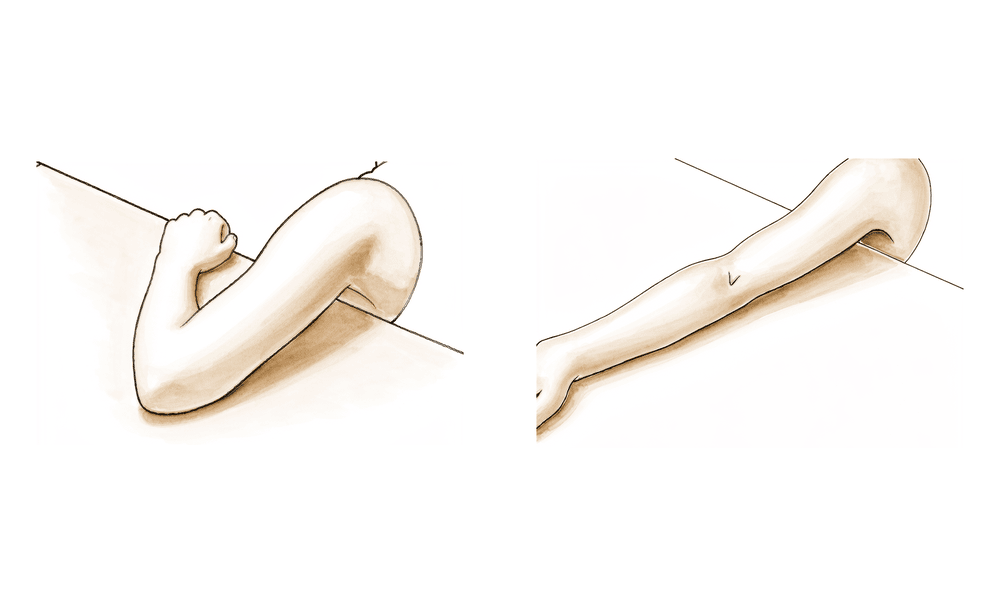
Kieran Hirpara 4.0
肘关节伸直(伸展至舒适位置)
在外科医生设定的活动范围内,将肘关节伸直至舒适程度。对于外侧损伤,伸直时保持掌心向下。在外科医生允许之前,不要将完全伸直与掌心向上的旋转动作结合进行。
10–15 次,每日数次
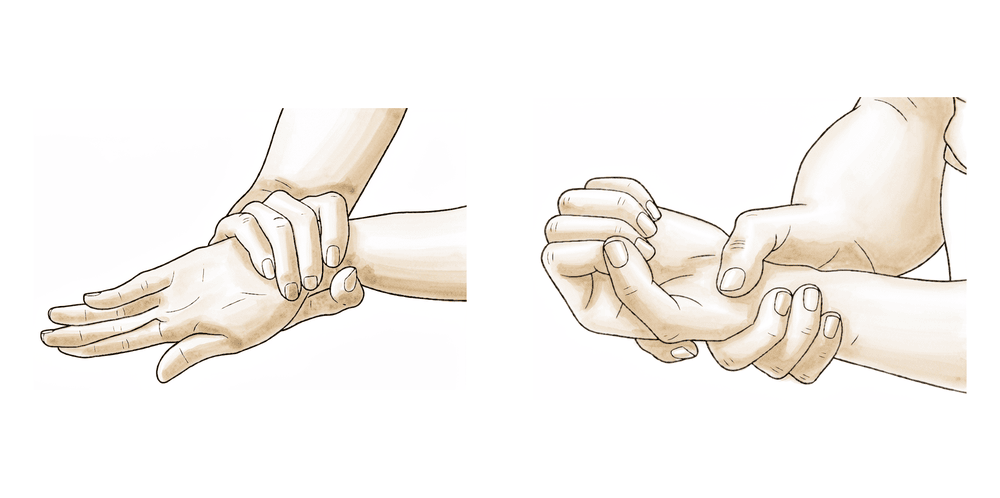
Kieran Hirpara 4.0
前臂旋转(掌心向上 / 掌心向下)
将肘部贴紧体侧并弯曲至约90°,在您被允许的活动范围内,轻轻将手掌向上翻转,然后向下翻转。您的安全方向取决于您的损伤情况——外侧损伤倾向于手掌向下(旋前);内侧投掷损伤倾向于手掌向上(旋后)。请遵循您的外科医生和治疗师设定的方向。
每个允许方向各10次,每天数次
Kieran Hirpara 4.0
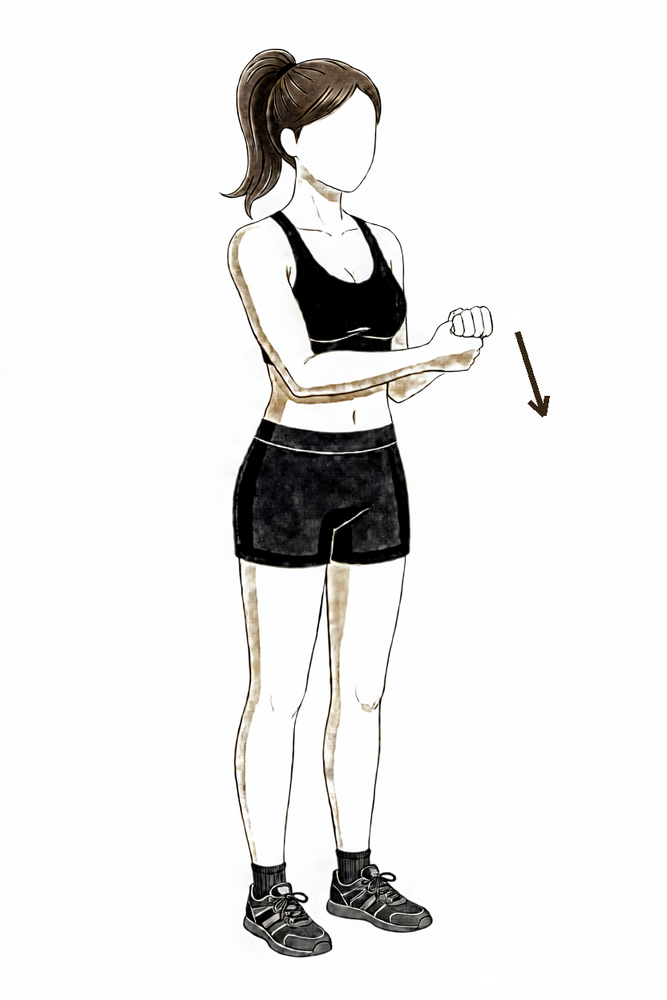
肘部肌肉等长收缩——伸肘
保持肘部静止,轻轻施加压力,如同试图将其伸直,以对抗另一只手或固定表面。肘部实际上不应发生移动。此举可在不增加愈合中韧带负荷的情况下激活肌肉。
保持5秒,重复10次,每日一次或两次——仅在获得许可后
Kieran Hirpara 4.0
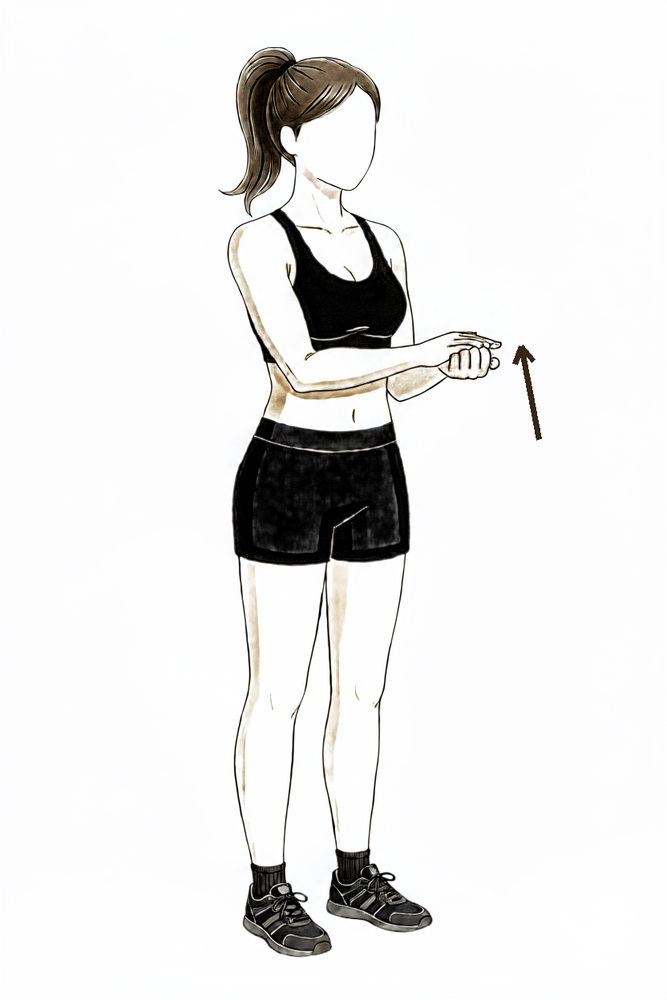
肘部肌肉等长收缩——屈曲
保持肘部静止,用另一只手轻轻施加阻力,如同试图弯曲肘部一样。肘部不应发生移动。保持用力舒适——这是肌肉激活,而非锻炼。
保持5秒,重复10次,每日一次或两次——仅在获得许可后
Kieran Hirpara 4.0
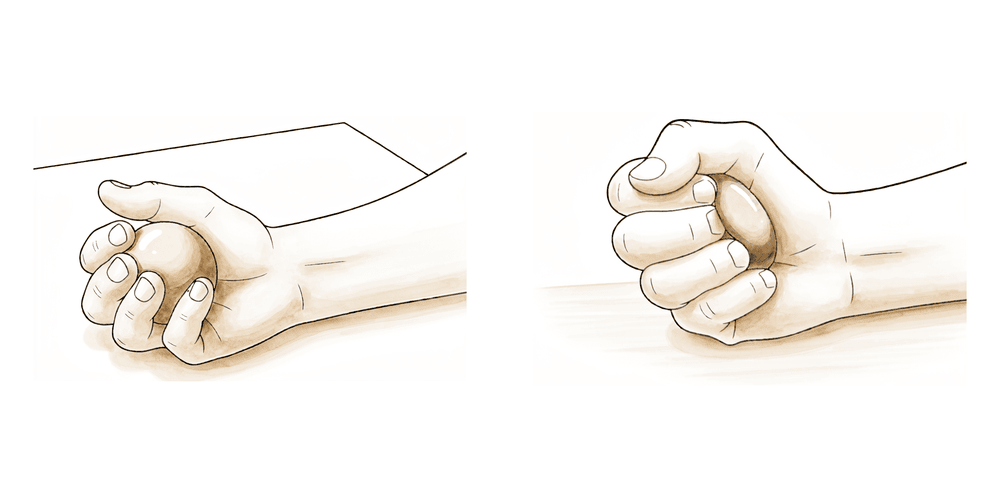
握力强化
用手挤压软球或治疗用橡皮泥,短暂保持后松开。这可在保护肘关节的同时,保持手部及前臂的力量。
10–15 次挤压,每天 2–3 次
这些是手册中的锻炼动作,旨在恢复安全活动,并在保护肘关节的同时,保持手部、前臂和肩部的功能。仅在Hirpara医生和治疗师的指导下开始并逐步增加这些锻炼;安全的前臂位置和关节活动范围取决于您的具体伤情。
您的临床方案
本页其余部分为物理治疗师或手治疗师的临床方案。由于两种损伤的保护方式不同,方案分为两条路径。每个阶段均以标准作为门槛:只有达到里程碑标准后方可进入下一阶段,而非仅依据日历时间。
在治疗前,请检查患者的X光片、手术报告及既往病史,并与主刀医生沟通,确认手术所达到的稳定性、安全活动范围及前臂旋转情况,以及是否植入了内部关节稳定器。Hirpara医生不使用外部铰链支具:对于全范围稳定的修复,采用简单吊带固定并允许在舒适范围内早期活动;当需要保护稳定性时,内部关节稳定器在内部维持复位,同时允许在舒适范围内进行伸展。
方案 A — 恐怖三联征 / 骨折脱位 / 尺侧副韧带(LUCL)修复
目标: 获得稳定且同心复位的肘关节,并尽早开始活动;防止后外侧旋转性再半脱位。
早期阶段全程关键注意事项:
- 对于孤立性外侧损伤,保持前臂旋前(可拉紧外侧结构并使桡骨头-桡骨小头关节对合)。若双侧柱均进行了修复,则保持前臂中立位;仅当肘关节屈曲至约 90° 时,才允许旋后。
- 避免内翻应力和肩关节外展: 重力会对外侧修复处施加内翻负荷。进行主动关节活动时,手臂应置于身体前方,或采取仰卧位过头动作(以减轻重力影响),尤其是当修复较为薄弱时。
- 在约 16 周之前,禁止在完全伸直位进行旋后(此动作会重现轴移现象)。
- 在 8–16 周内禁止负重 / 闭链负荷。
第 0–2 周:早期活动。 使用简单吊带以提供舒适感。立即开始手指、手腕和肩关节的主动关节活动。从第 2–3 天起,开始肘关节主动及主动辅助关节活动,以舒适为度,前臂保持旋前,手臂支撑于身体前方(若修复较为薄弱,则采取仰卧位过头动作,使重力压迫关节)。若已置入关节内稳定器,应尽早进展至完全舒适的伸直位;该装置可保护复位,且不使用外部支具。
第 2–6 周:恢复活动范围。 进展至完全舒适的屈曲和伸直(全程以舒适为度进行伸直;若存在内固定稳定器,则允许此动作)。保持旋前倾向;避免内翻负荷。进展标准: 被动活动范围完全恢复,体格检查或 X 线显示无再半脱位,疼痛 ≤3/10。
第 6–12 周:强化训练。 一旦临床及影像学显示愈合(约第 6 周),开始渐进性强化训练;若出现挛缩迹象,引入静态渐进式夹板。继续避免内翻负荷。若使用了内固定稳定器,通常需保留至韧带愈合。
第 12–20 周及以后:高级训练 / 回归。 渐进性抗阻训练;回归重体力劳动。接触性运动和过头运动在约 6–9 个月时进行(且在移除任何内固定稳定器之后)。继续避免内翻负荷下的强化训练。
B 组——投掷(内侧)UCL 修复 / 重建
这是一种慢性过载导致的内侧问题。Hirpara 医生的偏好是不使用外部铰链支具:缝线带内部支具增强(修复)或肌腱移植物(重建)提供保护,且康复方案针对投掷动作。前臂偏向旋前/中立位;在约第 6 周之前避免抗阻肩关节外旋,因为该动作会对移植物产生外翻负荷。
内部支具增强修复(加速方案,与不使用外部支具的方法相匹配):
- 早期在舒适范围内的保护性活动,第 0–4 周(约第 6 周达到全范围活动)。
- 约第 3 周开始投掷者 Ten 计划;约第 6 周开始增强式训练。
- 约第 11 周开始间歇性投掷计划;约 5–7 个月时恢复运动。
重建(移植物)方案,如采用(较慢):
- 约第 6 周达到全范围活动;第 14–16 周开始间歇性投掷;投球 mound 不早于 6 个月;竞技性恢复运动通常为 9–16 个月。
重返工作与活动
您恢复的速度取决于所受的损伤类型以及工作或运动的要求。
- 外侧损伤(恐怖三联征 / 尺侧副韧带): 在安全体位范围内,可较早恢复轻度的文书工作和自理任务。通常在肘关节临床愈合且X线显示愈合后,约6周开始进行强化训练。接触性运动和过头运动通常需推迟至约 6–9 个月,若安装了内部关节稳定器,则需在其取出后进行。在外科医生许可之前,避免手臂承重或向侧方施加负荷。
- 投掷损伤(尺侧副韧带): 对于采用内部支架增强的修复术,结构化的间歇性投掷计划通常在11周左右开始,约在 5–7 个月时重返运动。重建术后,重返竞技性投掷的速度较慢,通常为 9–16 个月。
当您能够舒适、安全地控制脱出吊带的手臂,且外科医生在复查时确认适宜后,即可恢复驾驶。您的治疗师将逐步推进您的强化训练以及针对运动或工作特定的练习,以实现您的个人目标。
方案实施后
本方案与诊所的通用康复建议并行使用;请参阅术后疼痛管理和伤口护理。您的持续康复将由物理治疗师或手部治疗师根据您的肘部进展情况及所患损伤类型进行个体化指导。本方案的面向临床医生的证据摘要与本页面一同保存。
Evidence & references
This is the clinical evidence summary written for health professionals. It is technical, and it lists the research this page was built from. You do not need to read it to understand your treatment or to make a decision about it.
Topic scope: Post-operative rehabilitation after surgery for elbow instability, in two distinct tracks: (A) complex lateral instability — "terrible triad" / fracture-dislocation and lateral (ulnar) collateral ligament [LCL/LUCL] repair & reconstruction for posterolateral rotatory instability (PLRI); and (B) overhead-throwing ulnar (medial) collateral ligament [UCL] reconstruction & repair ("Tommy John").
Defining principle: the crux of every track is protected motion, not immobilisation. Restore enough stability to permit early range of motion (within ~1 week), because prolonged immobilisation is the dominant cause of disabling flexion contracture and stiffness. Dr Hirpara's stance: he does not use an external hinged brace. A repair that is stable through-range at surgery is managed with a simple sling for comfort plus early motion to comfort within positional precautions. Where stability needs protecting, he implants an internal joint stabiliser (an internal hinge) that holds the elbow reduced from the inside while permitting full flexion and extension to comfort — so the patient still moves early without an external arc-limiting brace. The device is typically removed once the ligaments have healed (~4–6 months). The published external-hinged-brace extension-block arcs below are retained as reference for what they represent biomechanically, not as Dr Hirpara's management.
(A) Terrible triad / complex fracture-dislocation / LCL (LUCL) repair & reconstruction
Forearm-rotation rule (the key precaution)
- Lateral-sided (LCL/LUCL) injury → keep the forearm PRONATED. Pronation tightens the lateral structures and seats the radiocapitellar joint, protecting the lateral repair. Terminal extension is performed pronated; supination near full extension reproduces the pivot-shift and is avoided.
- Medial-sided (MCL/UCL) injury → keep the forearm SUPINATED (Rockwood & Green; Green's Operative Hand Surgery).
- If both columns are repaired (many terrible triads), the forearm is held neutral.
- Early supination, when allowed, is done only with the elbow flexed to ~90° (flexion stabilises the ulnohumeral joint and protects the lateral reconstruction).
Phased timeline
- Week 0–2 — Immediate post-op / early motion. Posterior splint at ~90° flexion in injury-appropriate forearm rotation for 7–14 days in the published protocols; the practical aim is early motion. Begin digit/wrist/shoulder AROM immediately and gentle elbow AROM/AAROM in the surgeon-defined stable arc within days (Brigham fracture-dislocation guideline starts elbow/forearm AROM at day 2–3). A supine/overhead protocol is an option where the lateral repair is tenuous — gravity compresses and stabilises the ulnohumeral joint (Green's; Lee 2013).
- Week 2–6 — Protected motion / restore the arc. Published external-hinged-brace protocols open an extension block ~10°/week, forearm pronated (Denver/Eichinger: 30° at wk2 → 20° wk3 → 10° wk4 → 0° wk5), reaching full extension by ~week 5–6. Dr Hirpara replaces this external brace with a simple sling (through-range stable repair) or an internal joint stabiliser permitting extension to comfort. Precautions: avoid varus stress and shoulder abduction; avoid combined full-extension-with-supination for up to ~16 weeks; no weight-bearing/closed-chain for 8–16 weeks.
- Week 6–12 — Intermediate / strengthening. Full PROM, joint mobilisations. Strengthening starts ~week 6 once clinical and radiographic healing is confirmed (Brigham PRE 6–8 wk; Rockwood & Green). Static-progressive splinting if a contracture is developing (Müller 2013).
- Week 12–20+ — Advanced / return. Progressive resistance; avoid varus-loaded strengthening. Contact/overhead sport often delayed to ~6–9 months for reconstruction (Green's: unrestricted use ≥6 months for graft incorporation; Eichinger: up to 9 months).
Nonoperative (stable terrible triad) caveat: if the joint is concentrically reduced with a stable arc to ≥30° of extension (no radial-head block, small coronoid), nonoperative early-motion management is reasonable (Rockwood & Green / Chan criteria; Najd Mazhar 2017).
(B) UCL reconstruction / repair — throwing athlete ("Tommy John")
Rehabilitation is uniformly described in 4 phases (Brotzman-Wilk lineage; ASMI/Andrews; Mass General). The forearm is biased toward supination/neutral (medial-sided injury); no shoulder external-rotation loading early (it valgus-loads the graft).
- Phase I — Week 0–3. Posterior splint at 90° week 1, then progressive ROM. Wrist AROM, gripping, submax shoulder isometrics (no ER), submax biceps isometrics from week 1–2.
- Phase II — Week 4–6/8. Progress to full ROM by ~week 6. Light wrist/forearm strengthening, rotator-cuff isotonics; resisted shoulder ER avoided until ~week 6 to protect the graft.
- Phase III — Week 6/9–12/13. Progressive elbow/forearm strengthening, eccentrics from ~wk9, Thrower's Ten, plyometrics ~wk9 if appropriate.
- Phase IV — Week 14–26+. Interval throwing program ~week 14–16; long-toss ramp 45→60 ft, +30 ft increments to 180 ft; mound throwing ≥6 months; return to competitive throwing ~6 months for return-to-throw, but full competitive RTS typically 9–16 months (≥12 months a common criterion). ~83–97% RTS in throwers.
Internal-brace–augmented UCL REPAIR (accelerated track) — the recent shift
For acute/avulsion tears with good tissue, UCL repair with internal brace allows a markedly accelerated protocol (Dugas/ASMI; SLU/JOSPT 2019):
- Mobilise early to comfort; full/unrestricted ROM by ~wk4, brace off by wk6.
- Thrower's Ten from ~wk3; plyometrics from ~wk6.
- Interval throwing as early as ~wk11; return to sport ~5–7 months (vs ≥9–12+ for reconstruction). Dugas 2025 (AJSM) head-to-head: repair ~2–3 weeks accelerated for ROM/strengthening and ~5–9 weeks accelerated for starting the interval throwing program, with comparable outcomes in appropriately selected athletes.
Phased-timeline summary
| Phase / window | Track A — lateral (terrible triad / LCL) | Track B — throwing (UCL, internal-brace repair) |
|---|---|---|
| Weeks 0–2 | Sling for comfort; elbow AROM/AAROM to comfort from day 2–3, forearm pronated, arm supported in front / supine-overhead | Early protected motion to comfort; submax shoulder (no ER) + biceps isometrics; grip/wrist work |
| Weeks 2–6 | Restore full comfortable arc; extension to comfort (internal stabiliser permits); maintain pronation, avoid varus | Progress to full arc by ~wk6; Thrower's Ten from ~wk3 |
| Weeks 6–12 | Strengthening once healed (~wk6); static-progressive splint if contracture | Plyometrics from ~wk6; progressive strengthening |
| Weeks 12–20+ | Progressive resistance; contact/overhead sport ~6–9 mo | Interval throwing ~wk11; RTS ~5–7 mo (reconstruction: 9–16 mo) |
Key controversies
- Early vs protected motion (complex instability). Strong consensus favours early motion (≤7 days), BUT the two 2024 systematic reviews (Ahmed Kamel, JSES; Larwa, Shoulder & Elbow) found no RCT and high heterogeneity (immobilisation 1–76 days, weighted mean ~42–47). "Early" is biomechanically favoured, not Level-I proven; over-aggressive motion risks re-subluxation in a marginally stable repair.
- Brace necessity & utility. A hinged orthosis is the published standard, but Manocha/King (JHS 2018) showed it adds little stability with the arm overhead (gravity already compresses the joint), supporting overhead/supine rehab over brace reliance for lateral injuries (Lee 2013). This underpins Dr Hirpara's no-external-brace approach.
- Forearm-rotation dogma. Pronation-for-lateral / supination-for-medial is biomechanically grounded and widely taught, but Selley 2025 found forearm rotation at graft tensioning did not change postoperative medial gapping — questioning how rigidly rotation must be controlled in UCL cases.
- Accelerated vs conservative UCL return-to-throw. Time-to-RTS varies 4–16 months with no consensus threshold; Erickson 2017 found earlier RTS did not raise revision risk in MLB pitchers, undercutting strict "wait ≥12 months" dogma.
- Internal brace enabling faster rehab. The biggest recent shift: suture-tape/internal-brace augmentation gives superior time-zero biomechanics and supports repair (not reconstruction) in selected throwers with a 5–9-week-faster throwing timeline. Durability in elite pitchers and mid-substance tears is still maturing (Level III–IV).
Evidence strength flags
- (A) Complex instability / LCL: LOW–MODERATE. No RCTs; guidance is biomechanical + expert-consensus + Level III/IV case series and two 2024 systematic reviews. Internal-joint-stabiliser data (Orbay/Mighell lineage; Dunning/Morrey biomechanics) are device-specific case series — Consensus / Moderate.
- (B) UCL throwing: MODERATE. Large case series, multiple systematic reviews, and concordant institution-standard protocols (Brigham/Brotzman-Wilk, Mass General, ASMI/Andrews) for the phased arc and interval-throwing timeline. Internal-brace augmentation is newer (Level III–IV, growing).
- Rehabilitation protocols themselves: CONSENSUS / WEAK — phase timings derive from published institutional protocols, not rehab RCTs.
Citations
RAG corpus (180,000+ Orthopaedic articles)
- Szekeres M, Chinchalkar SJ, King GJ. Optimizing Elbow Rehabilitation After Instability. Hand Clin. 2008.
- Wilk KE, Arrigo CA. Rehabilitation of Elbow Injuries. Clin Sports Med. 2020.
- Ahmed Kamel S, Shepherd J, Al-Shahwani A, et al. Postoperative mobilization after terrible triad injury: systematic review and single-arm meta-analysis. J Shoulder Elbow Surg. 2024;33(3):e116–e125.
- Larwa J, Buchanan TR, Janke RL, et al. Characteristics of rehabilitation protocols following operative treatment of terrible triad elbow injuries and the influence of early motion: systematic review and meta-analysis. Shoulder Elbow. 2024.
- Najd Mazhar F, Jafari D, Mirzaei A. Evaluation of functional outcome after nonsurgical management of terrible triad injuries of the elbow. J Shoulder Elbow Surg. 2017;26(8):1342–1347.
- Manocha RH, King GJ, Johnson JA. In Vitro Kinematic Assessment of a Hinged Elbow Orthosis Following Lateral Collateral Ligament Injury. J Hand Surg Am. 2018.
- Lee AT, Schrumpf MA, Choi D, et al. The influence of gravity on the unstable elbow. J Shoulder Elbow Surg. 2013;22(1).
- Dunning CE, et al. (Morrey lineage). Ligamentous Repair and Reconstruction for Posterolateral Rotatory Instability of the Elbow. 2006. (LCL/LUCL stabiliser biomechanics.)
- Müller AM, Sadoghi P, Lucas R, et al. Effectiveness of bracing in the treatment of nonosseous restriction of elbow mobility: systematic review/meta-analysis of 13 studies. J Shoulder Elbow Surg. 2013. (Static-progressive stretch for stiffness.)
- Selley RS, Lawton CD, Owusu-Akyaw K, et al. Forearm Rotation at the Time of Elbow UCL Reconstruction Graft Tensioning Does Not Affect Postoperative Medial Elbow Joint Gapping. Orthop J Sports Med. 2025.
- Erickson BJ, Cvetanovich GL, Frank RM, et al. Do Clinical Results and RTS Rates After UCL Reconstruction Differ Based on Graft Choice and Surgical Technique? Orthop J Sports Med. 2016.
- Erickson BJ, Chalmers PN, Bach BR, et al. Length of time between surgery and RTS after UCL reconstruction in MLB pitchers does not predict need for revision. J Shoulder Elbow Surg. 2017.
- Kemler BR, Rao S, Willier DP, et al. Rehabilitation and Return to Sport Criteria Following UCL Reconstruction: A Systematic Review. Am J Sports Med. 2021.
- Griffith R, Bolia IK, Fretes N, et al. RTS Criteria After Upper Extremity Surgery, Part 2: UCL of the Elbow. Orthop J Sports Med. 2021.
- Dugas JR, Froom RJ, Mussell EA, et al. Clinical Outcomes of UCL Repair With Internal Brace Versus UCL Reconstruction in Competitive Athletes. Am J Sports Med. 2025.
- Dugas JR, Looze CA, Capogna B, et al. UCL Repair With Collagen-Dipped FiberTape Augmentation in Overhead-Throwing Athletes. Am J Sports Med. 2019;47(5).
- Jackson GR, Opara O, Tuthill T, et al. Suture Augmentation in Orthopaedic Surgery Offers Improved Time-Zero Biomechanics and Promising Short-Term Clinical Outcomes. Arthroscopy. 2023.
- Cain EL, Dugas JR, Wolf RS, et al. Elbow Injuries in Throwing Athletes: A Current Concepts Review. Am J Sports Med. 2003.
- Erickson BJ, Bach BR, Verma NN, et al. Treatment of Ulnar Collateral Ligament Tears of the Elbow. Orthop J Sports Med. 2017.
- Rockwood and Green's Fractures in Adults. 2019. — long-arm splint 7–10 d; lateral injury → forearm pronated, medial → supinated; avoid shoulder abduction/varus for lateral injury; strengthening ~6 wk.
- Green's Operative Hand Surgery. 2021. — supination only with elbow maximally flexed; overhead/supine protocol option; isometric strengthening 8–10 wk; unrestricted use ≥6 mo.
Published protocols (literature URLs)
- Brigham & Women's Hospital — Elbow Fracture/Dislocation Post-Op ORIF Hand Therapy Guideline (2021). https://www.brighamandwomens.org/assets/BWH/patients-and-families/rehabilitation-services/pdfs/elbow-fracture-orif-hand-therapy-protocol.pdf
- Brigham & Women's Hospital — UCL of the Elbow Reconstruction Using Autogenous Graft Protocol (Brotzman-Wilk modification). https://www.brighamandwomens.org/assets/BWH/patients-and-families/rehabilitation-services/pdfs/elbow-ulnar-collateral-ligament-reconstruction-protocol-bwh.pdf
- Massachusetts General Hospital Sports Medicine — Rehabilitation Protocol for UCL Reconstruction (rev. Nov 2018). https://www.massgeneral.org/assets/MGH/pdf/orthopaedics/sports-medicine/physical-therapy/rehabilitation-protocol-for-UCL.pdf
- Saint Louis University Sports Medicine / JOSPT 2019 — Rehabilitation s/p UCL Repair with Internal Brace. https://www.slu.edu/medicine/orthopaedic-surgery/sports-medicine/-pdf/ucl-repair-guidelines-final.pdf
- Eichinger MD — Rehabilitation Guidelines for Elbow Lateral Collateral Ligament Repair (2018). https://www.josefeichingermd.com/pdf/rehab-for-lateral-collateral-ligament-repair-3-4-18.pdf
- Denver Shoulder — Rehabilitation Protocol: Lateral Collateral Ligament Repair (extension block 30°→20°→10°→0° wk2–5, forearm pronated; supination only at 90° flexion). https://www.denvershouldersurgeon.com/pdf/lcl-repair-protocol.pdf
- Orthopaedic Medical Group of Tampa Bay — Elbow Dislocation Rehab Protocol. https://www.omgtb.com/wp-content/uploads/pdfs/elbow-dislocation-rehab.pdf





