

伸肌腱修复 资料
本方案指导您在 Mater Private Hospital Rockhampton 的 Kieran Hirpara 医生处接受伸肌腱(手指或手背用于伸直手指的肌腱之一)手术修复后的康复过程。该方案涵盖手指、手及手背(外科医生所称的 IV 至 VII 区)的修复。本方案不适用于锤状指(指尖处的修复)或中央腱/纽扣畸形(中间关节处的修复);这些情况遵循不同的康复计划。本方案首先介绍您的居家锻炼计划,随后是为您手部治疗师撰写的结构化临床方案。请在首次治疗就诊时携带此页面或其 PDF 文件,以确保您的康复过程协调一致。您的治疗师可能会根据康复进展调整计划。
如果您对术后伤口有任何疑虑,请联系诊室。拍摄伤口照片并通过电子邮件发送以供审阅通常很有帮助。
预期情况
伸肌腱修复术是将断裂的肌腱在手指或手背处重新缝合。保护该修复部位的传统方法是将手部固定数周,但这往往导致手指僵硬且恢复缓慢。相反,您的康复将采用一种巧妙的现代方法,称为相对运动康复(Merritt 法)。
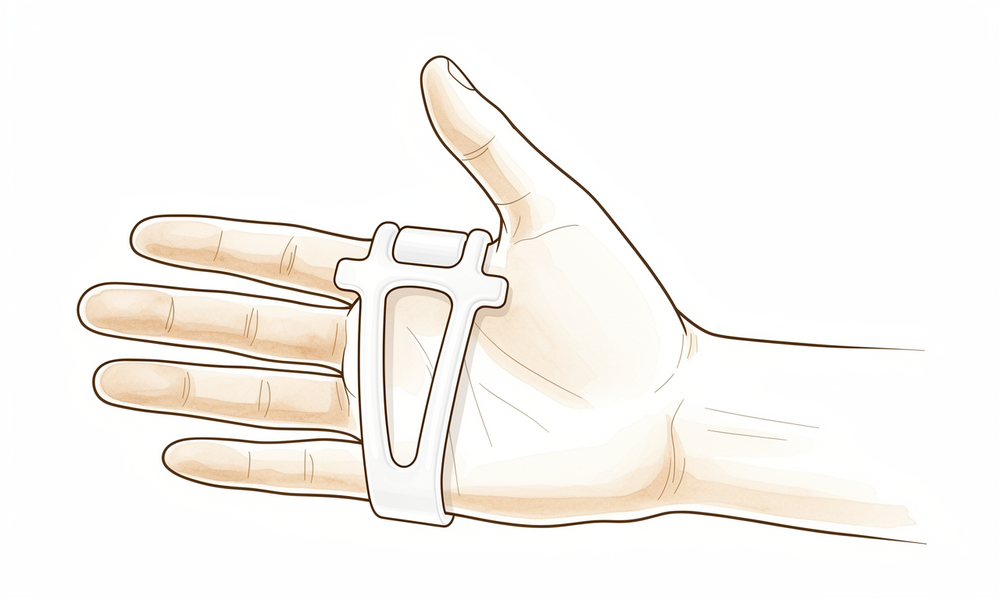
关键在于佩戴一种名为轭式夹板的小型夹板,横跨手背佩戴。它使修复手指的主要指间关节比两侧手指的关节更伸直约 15 至 20 度。这一微小差异能悄然减轻愈合肌腱的负荷,使您可以立即开始轻柔地在舒适范围内使用手部,而无需等待数周保持固定。早期以这种受保护的方式活动可保持肌腱滑动,防止其粘连,而角度偏移则防止其过度牵拉。
对于大多数修复(手指和手背常见的区域),仅佩戴轭式夹板即可满足需求。对于某些修复(靠近手腕、修复强度较弱或需要额外保护的情况),前几周还需额外佩戴腕部夹板。您的手部治疗师会告知您是否也需要佩戴腕部夹板。
随后,计划将分阶段逐步展开:轭式夹板需全天佩戴约六周,并从第五周左右开始逐步停用;中间几周加入腕部和手指的联动运动;强化训练从约八周开始;一旦修复牢固,完全恢复活动约在十至十二周。
注意事项与限制
- 全天候佩戴您的Yoke夹板,持续约前六周,包括进行锻炼和日常活动时,仅在您的手部治疗师指导下移除或逐步停用。您的手部治疗师会告知您是否还需要佩戴腕部夹板。
- 从一开始,在夹板保护下对患手进行轻度日常使用,以舒适为限。前几周请勿进行任何提重物、强力抓握或抗阻活动。
- 在获得许可前(通常在八周左右),请勿开始进行抓握或捏持力量的强化训练。
- 早期请勿用力握紧全拳或强行弯曲手指;仅按所示的轻柔、可控范围活动。
- 保持较小指间关节的活动,以防僵硬;轻柔的被动伸直有助于实现这一点。
关于伤口、肿胀及瘢痕管理,请参阅本诊所的伤口护理指南。
您的练习
Kieran Hirpara 4.0
佩戴相对运动(轭式)夹板
修复后的手指被固定在一个名为轭式夹板(或相对运动夹板)的小型夹板中。它使修复手指的大指关节(即指掌关节,MCP,手指与手掌连接处)比相邻手指更伸直约15至20度。这一微小差异可减轻愈合中肌腱的张力,从而让您能够立即使用手部。请全天佩戴该夹板约六周——包括进行锻炼和日常活动时——仅在您的手部治疗师指导下取下。您的手部治疗师会告知您是否还需要佩戴腕部夹板。
持续佩戴约6周,自第5周起在指导下逐步撤除
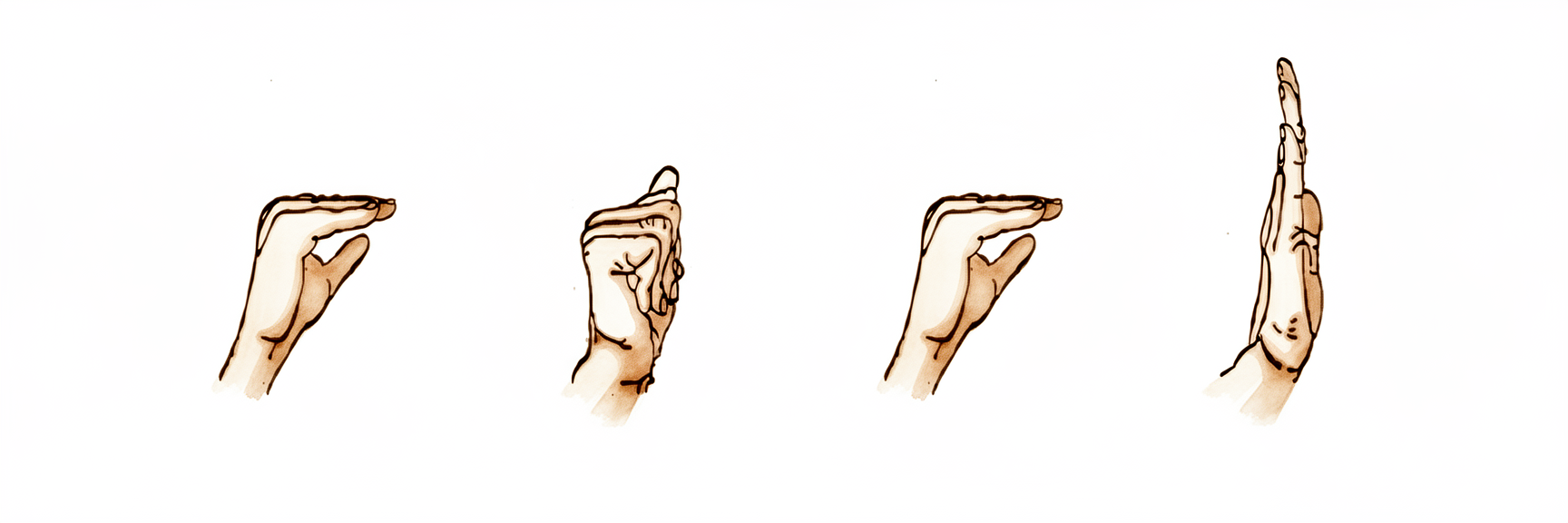
掌指关节屈曲、手指伸直(内在肌阳性)
保持夹板佩戴,在掌指关节(手指与手掌连接处)进行屈曲,同时保持其余指节伸直——形成平坦的“桌面”或“搁板”形状。然后恢复伸直。在舒适范围内平滑活动。这能使修复后的肌腱以安全、受控的量滑动,防止其粘连,同时避免对其施加牵拉应力。
10次,白天每隔几小时进行一组
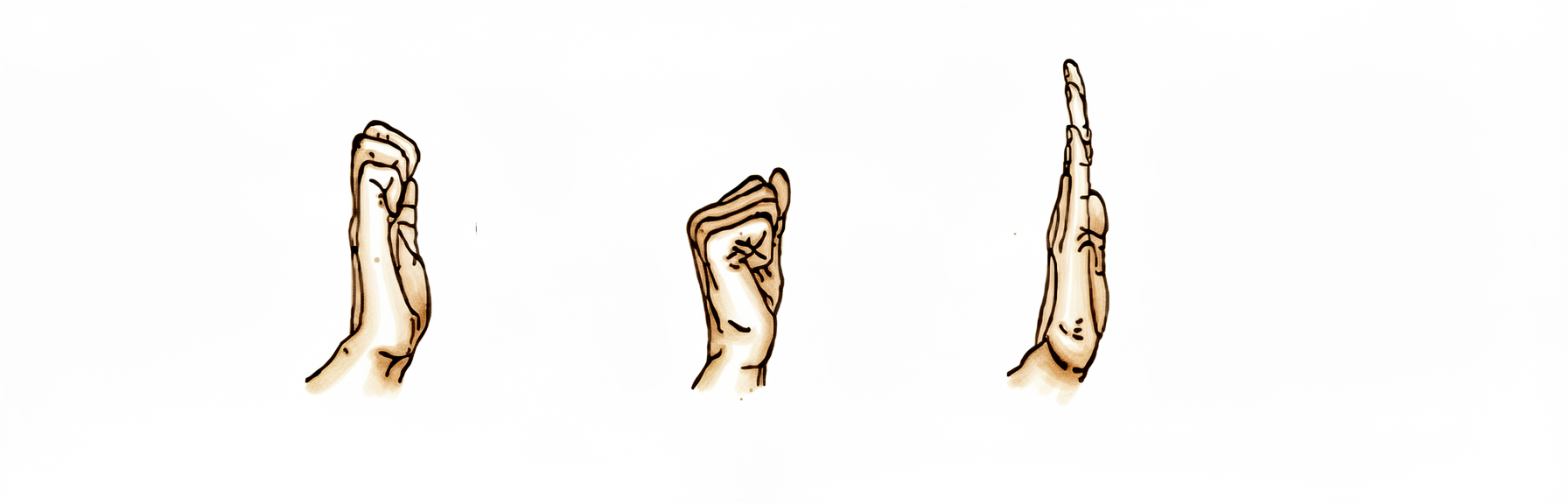
掌指关节伸直、手指屈曲(内在肌阴性 / 钩状)
保持夹板佩戴,将掌指关节(大指关节)保持伸直,仅将手指的近端指间关节和远端指间关节(小指关节)屈曲成钩状(爪形),然后再将其伸直。此动作可使修复后的肌腱在其另一活动范围内移动,同样以安全且受控的方式进行。请保持在舒适范围内,切勿强行用力。
10次,白天每隔几小时进行一组
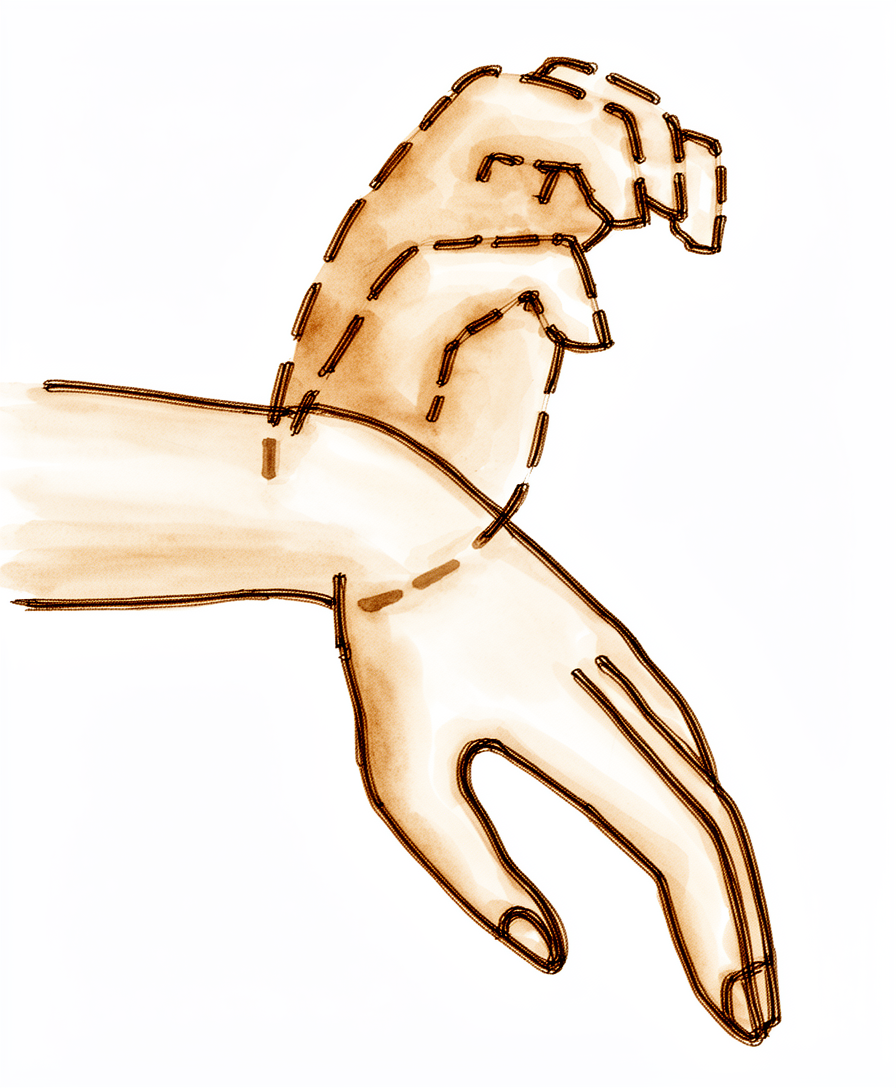
腕指联动运动(腱固定效应)
后期练习——由您的手部治疗师在术后约三至六周时添加。轻轻将手腕向后背伸,让手指自然放松张开,随后让手腕向前掌屈,同时手指轻轻闭合。手腕与手指作为一对协同运动。此动作能自然且安全地滑动伸肌腱,通常在修复部位强度增强后开始进行。
10次,每日2至3次(约3至6周起,遵医嘱)
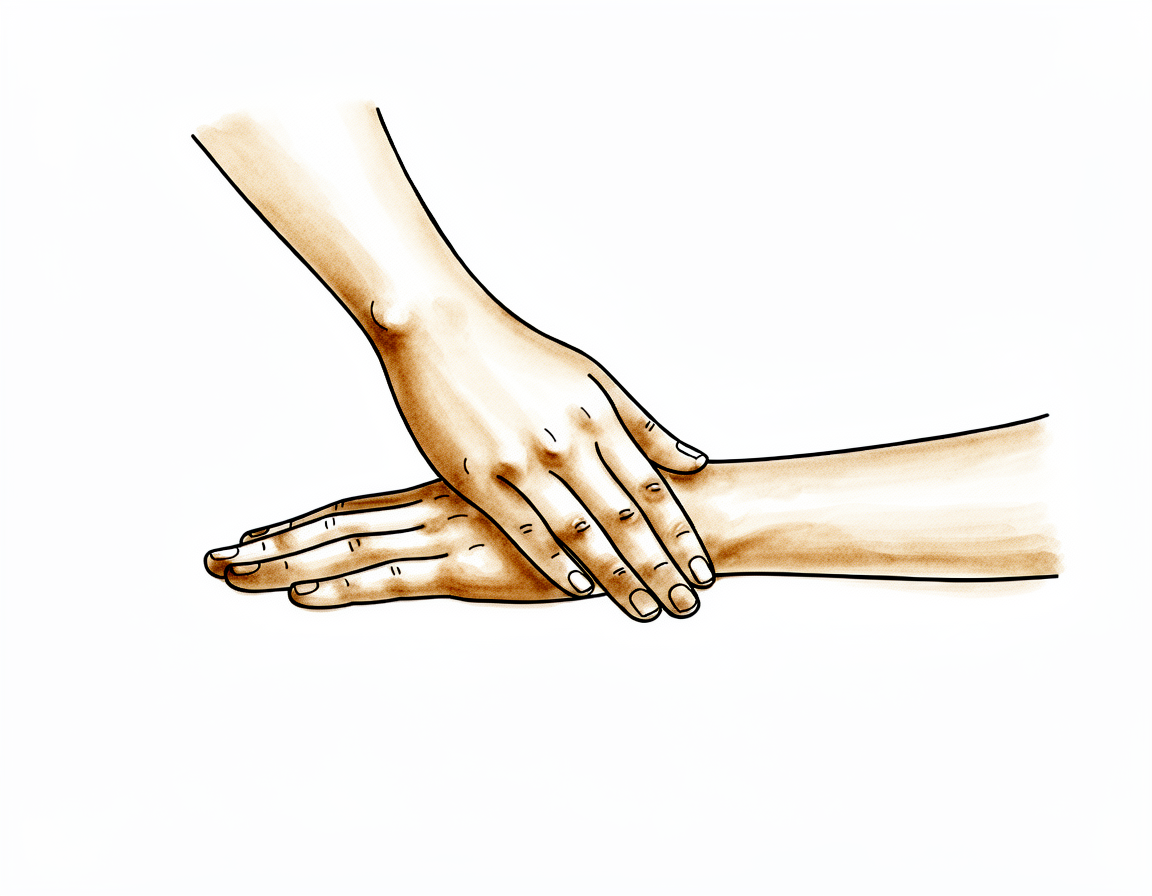
Kieran Hirpara 4.0
被动手指伸直
用另一只手轻柔地支撑并伸直修复手指的小关节,帮助其达到完全伸直,切勿强行用力。这有助于防止肌腱愈合期间手指僵硬于弯曲位置。动作需轻柔且无痛,并严格遵循手部治疗师的指导。
保持数秒,每日5至10次,按指导进行
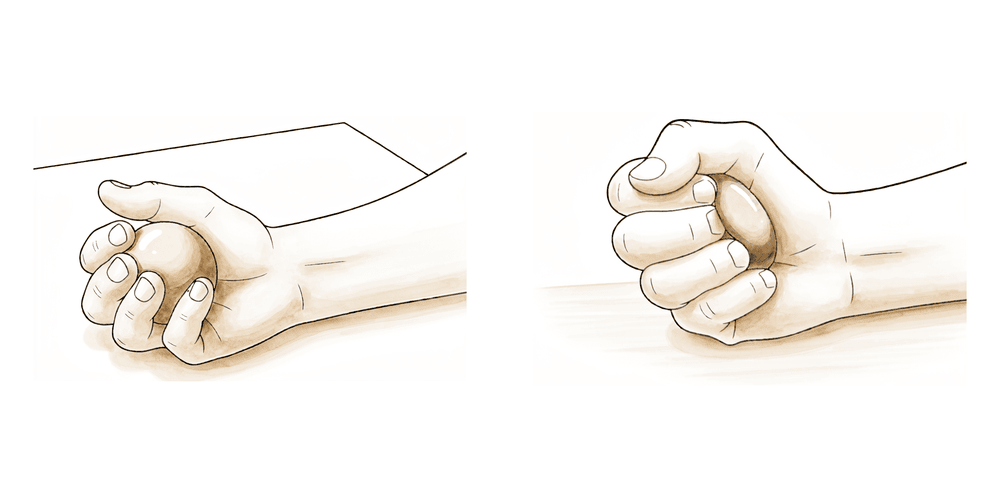
Kieran Hirpara 4.0
握力/捏力强化训练(自第8周起)
后期练习——仅在术后约八周后,且经手部治疗师确认可进行强化训练时方可开始。用整只手挤压软球或橡皮泥,并用拇指与手指捏压,力度在数周内逐步递增。此练习旨在修复牢固后重建抓握与捏握力量。未获许可前,切勿开始抗阻抓握训练。
10至15次挤压,每天2至3次(仅在约8周后开始)
这些是您的手册中的练习。仅在Hirpara医生和您的手部治疗师的指导下开始,并保持在您被允许的范围内和限制内。早期练习是在佩戴轭式夹板的情况下进行的:轻柔的指关节弯曲和手指屈曲,使修复后的肌腱以安全、可控的量滑动,而不会对其造成过度牵拉。耦合的手腕和手指运动以及握力/捏力强化属于后期阶段,在您被明确允许之前不应开始。停止任何导致手指或手背剧烈疼痛的动作。
您的临床方案
本页其余部分为伸肌腱修复(IV 至 VII 区)后采用相对运动伸展(RME)的分阶段康复临床方案。本节内容应提供给您的手部治疗师,每个阶段均以通俗易懂的语言解释当前发生的情况。修复部位由轭式夹板保护,该夹板使修复手指的 MCP 关节比相邻手指多伸展 15 至 20 度,通过四头肌腱效应(quadriga effect)和腱联合(juncturae tendineae)卸载主动伸肌的滑动,因此立即进行主动运动是安全的。
在治疗前,请查阅患者的手术报告及既往病史,并与主刀医生沟通关于修复的分区、涉及的肌腱、修复强度以及是否需要补充腕部矫形器。Hirpara 医生针对 V 至 VI 区的默认方案为仅使用轭式夹板(相对运动伸展夹板,修复手指的 MCP 关节比邻近手指多伸展 15–20°)。对于 VII 区、修复强度较弱或不依从的患者,需增加腕部矫形器(约 20–25° 伸展,前约 3 周)。本方案仅适用于背侧伸肌腱 IV–VII 区修复,不适用于锤状指(I–II 区)或中央滑车/纽扣畸形(III 区)。
第一阶段 — 轭式支具(± 腕部夹板),即刻主动使用(第 0 至 3 周)
前 3 周通过轭式支具保护修复部位,同时患者立即开始主动使用手部。相对 15–20° 伸展偏移可减轻修复部位的负荷,因此从一开始就鼓励进行受控的主动滑动。允许在夹板内进行轻度功能性使用;禁止提重物或抗阻抓握。
致手部治疗师:
健康教育与注意事项 - 佩戴 轭式 / 相对运动伸展夹板:修复手指的 MCP 关节保持比相邻手指 多伸展 15–20°;需 全天佩戴 - 仅针对 VII 区 / 修复强度较弱 / 依从性较差的患者,在前 ~3 周加用 腕部矫形器(约 20–25° 伸展)(V–VI 区的默认方案为仅使用轭式支具) - 鼓励在夹板内轻度使用手部;禁止提重物、强行抓握或抗阻作业 - 避免强行复合握拳;保持活动范围受控
管理 - 伤口:按医嘱进行外科敷料处理;监测感染迹象 - 水肿:抬高患肢、轻柔的手指泵运动、必要时冰敷 - 练习(在夹板内,每 ~2 小时一次):主动 内在肌阳性(MCP 屈曲伴 IP 伸展)和 内在肌阴性 / 钩状(MCP 伸展伴 IP 屈曲);每日进行 被动 IP 伸展 以防止 IP 关节僵硬 - 伤口愈合后开始瘢痕管理
晋级标准 - 伤口趋于稳定;未出现伸肌滞后;在夹板内能舒适地进行受控主动运动(约 3 周时)
第二阶段——腕部支具移除,Y型支具继续使用,耦合运动(第3至6周)
大约三周后,任何辅助性腕部支具均停止使用(Y型支具继续全天佩戴)。增加腕指耦合(腱止)运动以及复合主动屈伸运动,以受控且对修复安全的方式增加肌腱滑动范围。
致您的手部治疗师:
评估 - 主动和被动活动度(MCP和IP)、伸肌滞后、疼痛及肿胀;伤口/瘢痕检查
教育与注意事项 - 停止使用辅助性腕部支具(如曾使用);全天继续使用Y型支具 - 逐步增加运动幅度;仍禁止抗阻抓握或强化训练
管理 - 练习:增加腕指耦合运动(腱止)和复合主动屈伸;继续内在肌协同/拮抗滑动及被动IP伸展;在Y型支具内进行轻度功能性使用 - 愈合后继续瘢痕按摩
进展标准 - 复合主动活动度逐步改善(通常在约6至8周时达到完全复合活动);无伸肌滞后;疼痛趋于稳定
第三阶段——逐步脱离支具、强化训练、恢复活动(第6至12周)
从第5至6周左右开始逐步脱离支具。一旦修复牢固,从第8周左右开始进行渐进性握力和捏力强化训练,并在第10至12周逐步过渡至完全活动。
致您的手部治疗师:
评估 - 完整的主动和被动关节活动度(ROM)、伸肌滞后、与对侧相比的握力/捏力;根据需要进行功能性及工作特异性测试
教育与注意事项 - 从第5周左右开始逐步脱离支具,在关节活动度和控制能力允许的情况下,于第6周左右完全去除 - 从第8周开始引入渐进性握力/捏力强化训练(不得早于此时) - 逐步增加阻力,在第10至12周过渡至完全活动
管理 - 练习:从第8周开始进行分级握力和捏力强化训练(球/橡皮泥挤压、捏力);渐进性阻力;继续任何残留的活动度和指间关节(IP)伸展训练 - 一旦关节活动度和力量接近对称且实现功能性恢复,考虑出院 - 如果伸肌滞后持续存在、关节活动度停滞或预后不佳,考虑转回主治医生
恢复完全活动的标准 - 无痛的完整关节活动度,无显著伸肌滞后;握力/捏力接近对称;约第10至12周
恢复工作与活动
在佩戴Y型支具的情况下,鼓励从治疗初期开始进行手部轻度日常使用(如进食、书写、穿衣、轻度自我护理),以舒适为限,前提是不涉及提举、强力抓握或抗阻作业。强化训练约从第八周开始,当修复牢固且您的活动度和力量恢复后,通常在第十至第十二周即可恢复完全无限制的活动。这一判断由Hirpara医生和您的手部治疗师共同评估,而非仅依据日历时间。
驾驶: 佩戴Y型支具时进行手部轻度使用是可以接受的,因此驾驶并非绝对禁止,但您必须能够安全地抓握方向盘并控制车辆,包括在紧急情况下。对大多数人而言,这意味着在逐步停用Y型支具期间(约第六周)恢复驾驶;如果您能舒适地控制车辆,则可以更早恢复,具体安全时机将由您的外科医生确认。
您的方案之后
本方案与本诊所的一般康复建议配合使用:请参阅 术后疼痛管理、伤口护理 和 疤痕管理。上述分阶段计划反映了使用相对运动伸指进行伸肌腱修复后已发表的康复指南,您的持续康复将由 Hirpara 医生和您的手部治疗师根据您的手部进展情况提供个性化指导。
Evidence & references
This is the clinical evidence summary written for health professionals. It is technical, and it lists the research this page was built from. You do not need to read it to understand your treatment or to make a decision about it.
Topic scope: post-operative rehabilitation after primary repair of an extensor tendon on the dorsum of the finger, hand or wrist — zones IV to VII — managed by relative-motion extension (RME / Merritt yoke splint, the ICAM family of regimens). This is a tendon repair (a construct that must heal under controlled load), but the relative-motion approach lets that load be applied immediately and actively rather than after weeks of immobilisation. This page does not cover mallet finger (zones I–II) or central-slip / boutonnière repair (zone III), which follow different regimens.
Defining principle of the rehab here: a yoke (relative-motion) splint holds the repaired digit's MCP joint 15–20° more extended than its neighbours. By the quadriga effect and the juncturae tendineae, this small relative offset offloads the repaired tendon — it reduces the active extensor excursion demanded of the healing repair (from roughly 12 mm of excursion in normal active extension to about 6 mm within the splint). That residual ~6 mm is enough to keep the tendon gliding and prevent adhesions, but too little to rupture the repair — which is why immediate active motion is safe. The single common branch point is whether a supplementary wrist orthosis (~20–25° extension, first ~3 weeks) is added for zone VII, weaker repairs, or non-compliant patients; the yoke alone is the default for zones V–VI.
A. PROCEDURE / REPAIR OUTCOMES (relative-motion vs immobilisation)
Extensor tendon repair on the back of the hand is reliable; the principal modern question is how to rehabilitate it — protected immobilisation versus an early-active programme such as relative-motion extension — not whether repair works.
- The mechanism that makes immediate active motion safe is well established. The 15–20° relative MCP-extension offset offloads the repair via the quadriga effect and the juncturae tendineae, cutting active extensor excursion from ~12 mm (normal) to ~6 mm within the splint — enough to prevent adhesions, too little to rupture. Cadaveric and mechanistic work underpins this rationale [Merritt, Wong & Lalonde 2020]. Strong (mechanistic + cadaveric).
- Relative-motion regimens match or improve on traditional early-active and immobilisation pathways. A randomised controlled trial in zones V–VI found relative-motion extension delivered earlier return of hand function and higher patient satisfaction with equivalent total active motion (TAM) versus the comparator early-active programme [Collocott RCT 2020]. A systematic review reported earlier return to work with equivalent range of motion and complication rates [Collocott review 2017]. Moderate–strong (1 RCT + SR; RME studies of generally lower methodological quality).
- Yoke-alone (no wrist splint) is supported for the common zones. Case series of relative-motion extension without a supplementary wrist orthosis for zones IV–VI report no ruptures, supporting yoke-alone as the default for these zones with the wrist orthosis reserved for zone VII / weaker / non-compliant repairs [Hirth 2021; Howell ICAM]. Moderate.
- The functional gain over immobilisation is large and practical. Early-active relative-motion programmes report return to work at roughly 17–25 days, versus the 3–4 months typical of immobilisation regimens — the headline advantage that has driven adoption [Collocott review 2017; Howell ICAM]. Moderate.
B. REHABILITATION / THERAPY EVIDENCE
The central rehab questions are (1) immobilise or move early, (2) is a wrist splint needed in addition to the yoke, and (3) how long must the splint stay on. The evidence favours early relative motion, supports yoke-alone for zones V–VI, and suggests splint duration can be shorter than the traditional six weeks without penalty.
- Early active motion via relative-motion extension is the modern default. The original technique description [Merritt 2014] and the clinical scheduling / yoke construction work [Lutz 2015] established a reproducible programme: immediate active intrinsic-plus and intrinsic-minus motion in the yoke, progressing to coupled (tenodesis) motion, weaning, then strengthening. Moderate (technique + cohort).
- A supplementary wrist splint is optional, not mandatory. Yoke-alone case series for zones IV–VI report no ruptures; the wrist orthosis (~20–25° extension, first ~3 weeks) is added selectively for zone VII, weaker repairs, or poor compliance [Hirth 2021; Howell ICAM]. Moderate (selective use).
- Splint duration may be shortened. A comparison of 4-week versus 6-week splinting found no difference in outcome, suggesting the traditional six-week full-time period can be safely abbreviated in selected patients [Svens 2015]. This page keeps full-time wear ~6 weeks (weaned from ~wk 5) as the conservative default while acknowledging the shorter option. Moderate (1 comparative study).
- The field is moving toward wider use of relative motion. A recent international consensus endorses broader application of relative-motion rehabilitation, including beyond its original zone V–VI indication [Tang consensus 2025]. Consensus.
Recovery trajectory (expected, evidence-anchored)
| Phase | Window | Splint / restraint | Hand use / therapy focus | Strength / load | Notes |
|---|---|---|---|---|---|
| I — Yoke (± wrist splint), immediate active use | Week 0–3 | Yoke full-time (repaired MCP 15–20° more extended); wrist orthosis ~20–25° ext only for zone VII / weak / non-compliant | Active intrinsic-plus (MCP flex, IPs straight) and intrinsic-minus / hook every ~2 h; passive IP extension daily; light use in the splint | Light functional use only; no lifting / resisted grip | Relative offset offloads repair (~12 mm → ~6 mm excursion); active motion is safe from day one |
| II — Wrist splint off, yoke continues | Week 3–6 | Discontinue any wrist splint; yoke continues full-time | Add coupled wrist-and-finger (tenodesis) motion + composite active flexion/extension; light functional use; scar massage once healed | Still no resisted grip | Composite active ROM building; watch for extensor lag |
| III — Wean yoke, strengthen, return | Week 6–12 | Yoke weaned from ~wk 5, off ~wk 6 | Progress full active motion; commence grip/pinch strengthening from week 8 | Graded strengthening from wk 8 → full activity ~10–12 wk | Return to work as early as ~17–25 days reported; full unrestricted activity ~10–12 wk |
(Phase windows mirror the precautions and recovery structure in the patient protocol; they are typical guides, not trial-derived deadlines. Splint duration may be safely shortened toward 4 weeks in selected patients.)
C. KEY CONTROVERSIES / EVIDENCE QUALITY
- Relative motion vs traditional immobilisation / other early-active regimens. One RCT (zones V–VI) and a systematic review favour relative-motion extension for earlier hand function, earlier return to work, higher satisfaction, with equivalent TAM and complications — though RME studies are generally of lower methodological quality, so the effect size is moderately rather than strongly certain. Moderate–strong.
- Wrist splint: needed or not? Yoke-alone gives good results with no ruptures in zone IV–VI series; the supplementary wrist orthosis is selective (zone VII / weaker / non-compliant). The defensible default is yoke-alone for the common zones — hence the page wording that the hand therapist will advise if a wrist splint also applies. Moderate.
- How long to splint. Traditional full-time wear is ~6 weeks; a 4-vs-6-week comparison showed no difference, so duration can be individualised and potentially shortened. Moderate.
- The 15–20° offset itself. The specific relative-extension increment is consensus-derived (it must offload enough to protect but leave enough excursion to glide); it rests on sound mechanism rather than a dose-finding trial. Consensus.
- Extending relative motion beyond zones V–VI (e.g. to sagittal-band injury and selected boutonnière/central-slip cases). The 2025 consensus endorses wider use, but evidence outside the core zones is weak–moderate, which is why this page deliberately scopes to zones IV–VII and excludes zone III. Weak–moderate.
D. EVIDENCE STRENGTH FLAGS (summary)
- STRONG: the mechanism — relative 15–20° MCP-extension offset offloads the repair (quadriga + juncturae tendineae; ~12 mm → ~6 mm active excursion) making immediate active motion safe (mechanistic + cadaveric).
- MODERATE–STRONG: relative-motion extension is at least as good as other early-active-motion regimens (1 RCT zones V–VI: earlier hand function, higher satisfaction, equal TAM; SR: earlier return to work, equal ROM/complications) — tempered by the lower methodological quality of RME studies.
- MODERATE: wrist-splint-optional (yoke-alone, no ruptures in zone IV–VI series); 4-vs-6-week splint duration (no difference); return to work ~17–25 days vs 3–4 months for immobilisation.
- CONSENSUS: the specific 15–20° offset increment; broader application of relative motion (Tang 2025).
- WEAK–MODERATE: extension of the technique to sagittal-band / boutonnière (central-slip) injuries outside the core zones.
CITATIONS
RAG corpus (180,000+ Orthopaedic articles)
- Merritt WH. Relative motion splint: active motion after extensor tendon injury and repair. J Hand Surg Am. 2014. DOI: 10.1016/j.jhsa.2014.03.015
- Merritt WH, Wong AL, Lalonde DH. Recent developments are changing extensor tendon management (relative motion / quadriga mechanism). Plast Reconstr Surg. 2020. DOI: 10.1097/prs.0000000000006556
- Lutz K, et al. Relative motion extension splinting for extensor tendon repair — clinical schedule and yoke. Hand Clin. 2015. DOI: 10.1016/j.hcl.2014.12.006
- Collocott SJF, et al. Relative motion flexion versus relative motion extension / early active motion after extensor tendon repair (zones V–VI): a randomized controlled trial. J Hand Ther. 2020. DOI: 10.1016/j.jht.2018.10.003
- Collocott SJF, Kelly E, Ellis RG. A systematic review of relative-motion orthoses for the management of extensor tendon repairs. Hand Ther. 2017. DOI: 10.1177/1758998317729713
- Svens B, et al. Four-week versus six-week immobilisation comparison after extensor tendon repair. J Hand Ther. 2015. DOI: 10.1016/j.jht.2014.07.006
- Hirth MJ, et al. Relative-motion approaches in extensor tendon rehabilitation. J Hand Ther. 2021. DOI: 10.1016/j.jht.2019.12.016
- Tang JB, et al. International consensus on relative-motion rehabilitation and extensor tendon management. J Hand Surg (Eur Vol). 2025. DOI: 10.1177/17531934251363138
Extensor tendon rehabilitation literature (URLs)
- Howell JW, Merritt WH, Robinson SJ. Immediate Controlled Active Motion (ICAM) following zone 4–7 extensor tendon repair. J Hand Ther / PMC. https://www.ncbi.nlm.nih.gov/pmc/articles/PMC3574475/





