

腕部腱鞘囊肿切除术 资料
本方案指导您在 Mater Private Hospital Rockhampton 接受 Kieran Hirpara 医生进行腕部腱鞘囊肿(一种从腕关节长出的充满液体的囊肿)切除术后的康复过程。方案首先介绍您的居家锻炼计划,随后是专为您的手部治疗师编写的结构化临床方案;请在首次治疗就诊时携带此页面或其 PDF 文件,以确保您的康复过程协调一致。您的治疗师可能会根据您的康复进展调整计划。
如果您对术后伤口有任何疑虑,请联系诊室。通常,拍摄伤口照片并通过电子邮件发送以供审阅会很有帮助。
预期情况
腕部腱鞘囊肿是一种气球状、充满液体的囊肿,通过狭窄的蒂部与腕关节囊内壁相连。大多数出现在腕背侧(背侧腱鞘囊肿);部分出现在腕掌侧拇指侧(掌侧腱鞘囊肿)。手术中,Hirpara 医生会连同蒂部一起切除囊肿,直至腕关节囊,既切除肿块也切除根部,因为遗留蒂部是腱鞘囊肿复发的主要原因。手术可采用开放方式(通过小切口)或关节镜(微创)器械进行。
由于没有进行修复或重建(仅切除了囊肿),因此没有需要保护数周的愈合肌腱或韧带。因此,康复方案为早期活动计划,其全部目的是尽快恢复腕部活动:
- 僵硬是此手术后最常见的问题,远比囊肿复发更常见。腱鞘囊肿切除术后若腕部休息过久,可能导致活动度丧失。
- 因此,固定时间保持最短:使用软敷料,有时配合轻便腕部支具仅用于舒适,仅持续数天至一两周。随后尽早进行腕部各方向的活动。
未接受手术的手指从第一天起即可完全活动。随着伤口稳定,逐步恢复腕部活动,然后逐渐重建抓握力和负重能力。大多数人约在四至六周后恢复日常活动。
注意事项与限制
- 从第一天起,请保持手指、拇指和肘部的充分活动;只有手腕需要逐步适应。
- 仅在医嘱规定的时间内佩戴软敷料或舒适支具(通常为几天至一至两周)。其目的是提供舒适感,而非长期固定手腕;此处的目标是早期活动,而非休息。
- 在被告知伤口已愈合封闭之前,切勿浸泡伤口或弄湿敷料;请保持清洁干燥。
- 最初几周请避免通过手腕进行强力抓握、提举和承重,并应逐步恢复这些活动,而非一次性进行。
- 如果您患有掌侧(手腕前侧)腱鞘囊肿,囊肿可能紧邻桡动脉(可在手腕前侧触及的脉搏);如果您注意到手部出现异常肿胀、发冷或颜色改变,请立即告知医护人员。
- 在复查确认您已舒适地控制方向盘且不再佩戴任何支具之前,切勿驾驶。
关于伤口、肿胀和瘢痕管理,请参阅本诊所的伤口护理指南。
您的锻炼
Kieran Hirpara 4.0
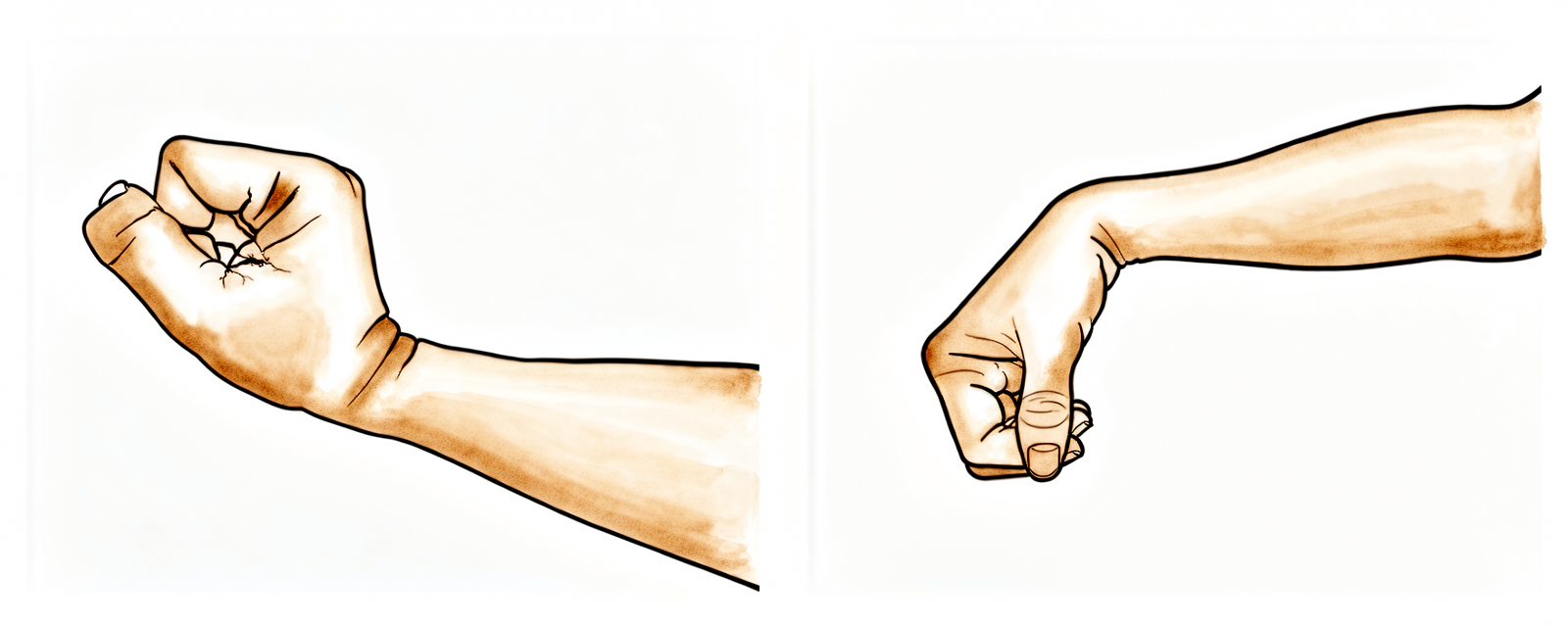
腕部活动(所有方向)
轻柔地朝各个方向活动您的手腕——向后弯曲(背伸)、向前弯曲(掌屈)以及向两侧倾斜(尺偏和桡偏)——在每个方向上活动到舒适的最大范围。这是术后早期最重要的练习,因为该手术后手腕容易僵硬,早期活动可保持其柔韧性。动作要缓慢,保持在舒适范围内;不应出现剧烈疼痛。
每个方向10次,每天4-5次,从最初几天开始
Kieran Hirpara 4.0
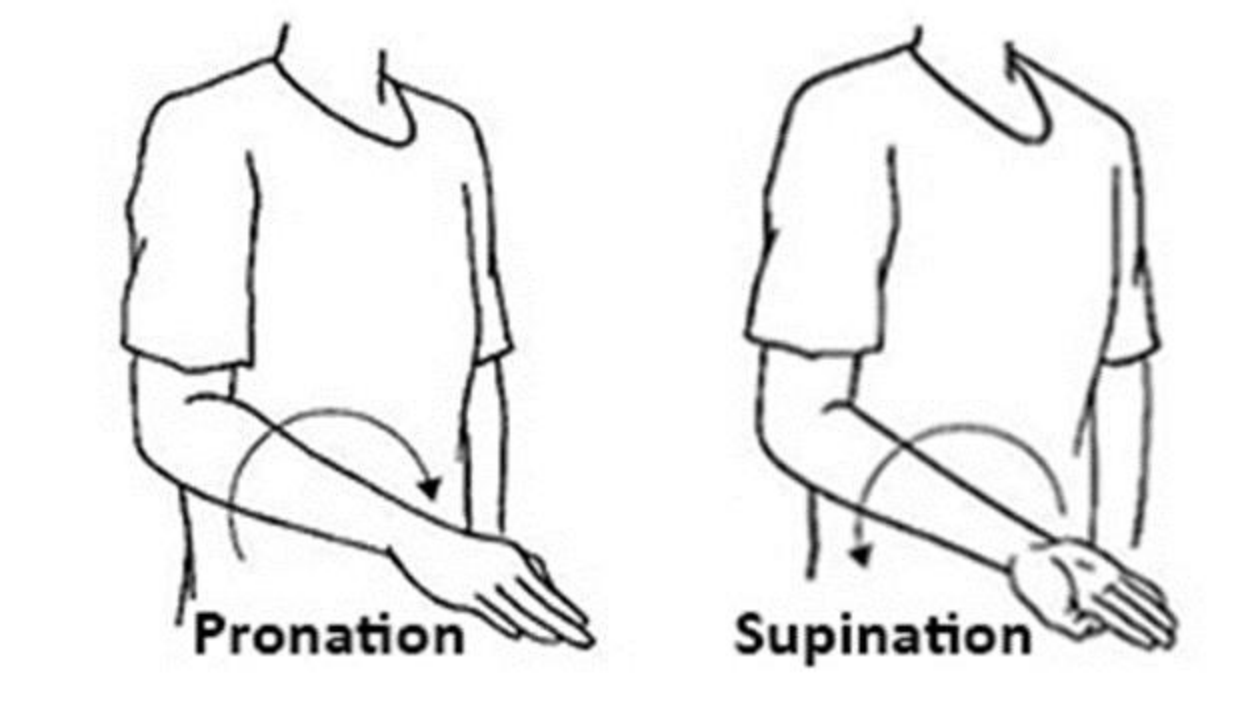
前臂旋转(掌心向上 / 掌心向下)
将肘部贴紧身体一侧,弯曲成直角。缓慢地将手掌向上转向天花板,然后向下转向地板。保持肘部静止,使动作仅来自前臂。这有助于在伤口愈合期间保持前臂和手腕自由转动。
每个方向10次,每天3-4次
Kieran Hirpara 4.0
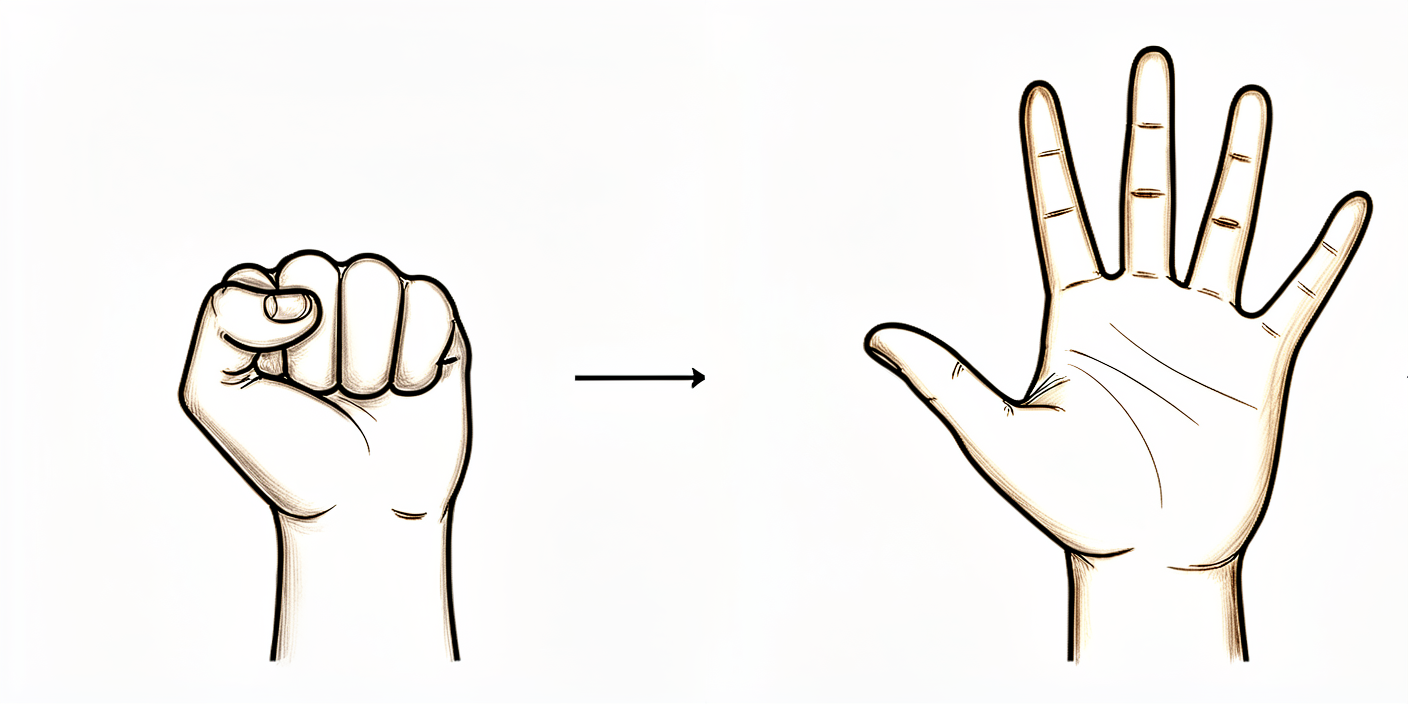
手指运动
请缓慢地握紧拳头,使指尖卷曲至掌心,然后张开手掌,将手指完全伸直。手指未接受手术,因此从第一天起就应充分活动——这能防止手部僵硬,并有助于肿胀消退。
10次,每天数次,从第一天开始
Kieran Hirpara 4.0
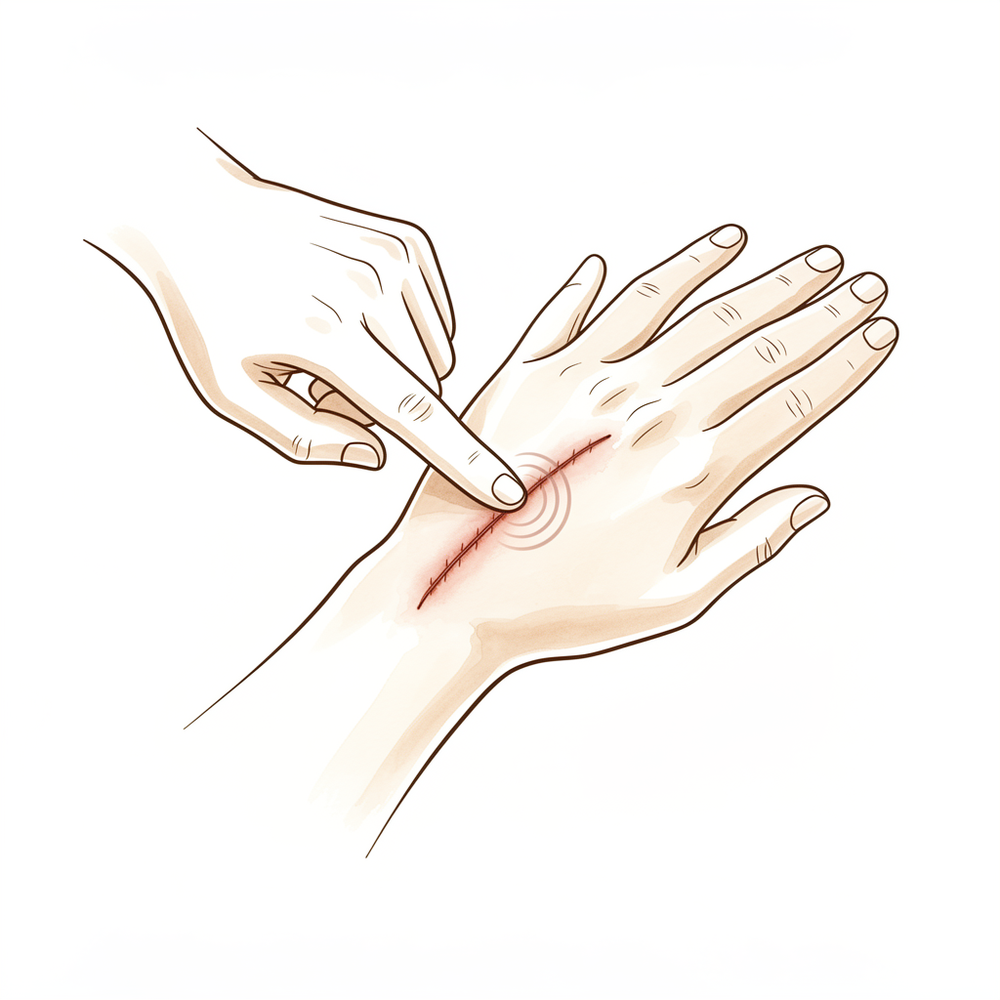
瘢痕按摩
待伤口完全愈合且敷料移除后(通常约两周),用指尖取少量无添加润肤霜,以小而有力的圆圈动作在瘢痕上按摩数分钟。此举可保持瘢痕柔软、活动度良好,并防止其与下方组织粘连,从而避免限制腕部活动。切勿在未愈合或渗液的伤口上开始此操作。
每天两次,每次几分钟,待伤口完全愈合后
Kieran Hirpara 4.0
握力强化
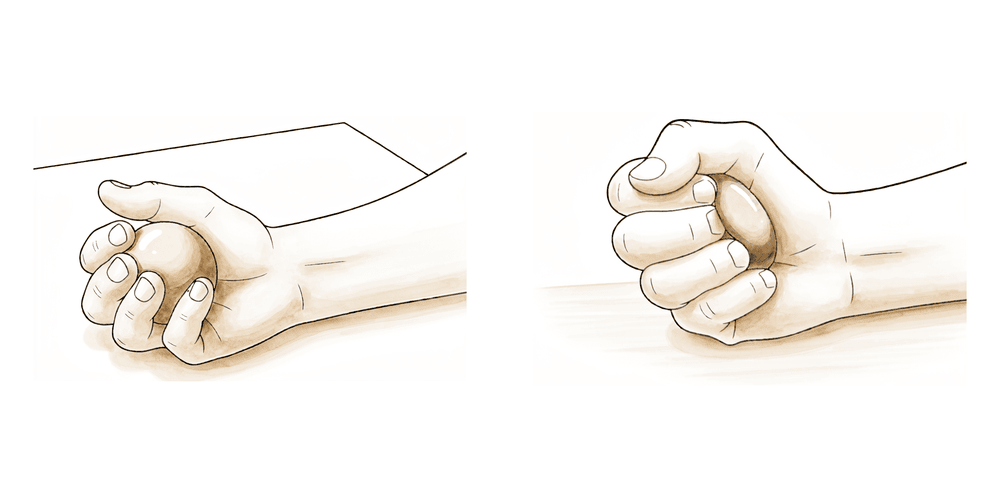
后期锻炼,通常在伤口愈合且活动舒适后,约三至四周开始。用手掌挤压软球或治疗用橡皮泥,保持几秒钟,然后放松。循序渐进地增加强度。这有助于恢复术后数周内常出现的握力下降。
10-15 挤压,每天 2-3 次,从大约 3-4 周开始
这些是您的手册中的锻炼项目。请按照Hirpara医生和手部治疗师的指导开始进行。早期锻炼(腕部各方向活动、前臂旋转和手指活动)是此次康复的核心,并在最初几天内开始,因为早期活动腕部可以防止术后通常出现的僵硬。疤痕按摩在伤口完全愈合后开始,随着舒适度允许,稍后加入握力强化训练。这些锻炼都不应引起剧烈疼痛;如有不适,请减轻强度。
您的临床方案
本页其余部分为腕部腱鞘囊肿切除术后康复的分阶段临床方案。本节内容应提供给您的手部治疗师,每个阶段均以通俗易懂的语言解释当前正在发生的情况。这是一项切除术,而非修复术:没有需要保护的构建物,因此主导原则是在最小化固定的基础上,尽早进行腕部全平面主动活动,以防止切除术后僵硬,这是该手术后最常见的并发症。
在治疗前,请查阅患者的手术报告及既往病史,并与主刀医生就囊肿位置(背侧 vs 掌侧)、手术入路(开放 vs 关节镜)、背侧/掌侧关节囊的完整性以及任何并发发现进行沟通。Hirpara 医生会将囊肿连同其蒂部一直切除至关节囊。对于掌侧腱鞘囊肿,请注意桡动脉的邻近关系。没有需要保护的弧度,也没有需要卸载的构建物;唯一有意的限制措施是在软组织稳定期间,短暂避免重度抓握/负重。
第一阶段 — 最小化固定与早期活动(第0天至约14天)
第一阶段旨在保护伤口的同时,尽早启动腕部活动。固定时间刻意保持短暂(使用软敷料,仅在必要时佩戴轻便腕托以提供舒适感),并在最初几天内开始腕部各方向的主动活动。系统综述证据表明,两周或更短时间的有限固定,甚至完全不固定,并不会显著改变预后,而长时间休息则有导致僵硬的风险。
致您的手部治疗师:
教育与注意事项 - 软敷料,可选配轻便腕托仅用于舒适;应在数天内而非数周内逐步撤除 - 避免长时间刚性固定:任何夹板固定时间应限制在≤2周(通常为几天) - 在伤口愈合封闭前保持清洁干燥;从第一天起即进行全范围的手指、拇指及肘关节主动活动 - 掌侧入路病例:注意桡动脉;如有血管相关顾虑,请立即报告
管理 - 伤口:按医嘱使用外科敷料;监测感染迹象 - 水肿:抬高患肢、轻柔手部泵动、必要时冰敷 - 练习:在舒适范围内,于最初几天内开始腕部各平面(屈曲/伸展、桡偏/尺偏)的主动全范围活动;前臂主动/被动旋前–旋后;手指和拇指全范围主动活动;轻柔肩部活动
晋级标准 - 伤口愈合;水肿消退;腕部活动范围改善且舒适;夹板(如使用)在约2周时停用
第二阶段 — 恢复全范围活动度与瘢痕管理(第2至4周左右)
大约两周后,拆除敷料,伤口愈合。重点在于在僵硬形成之前恢复完整且对称的腕关节活动度,并开始瘢痕处理,以保持瘢痕的活动性,防止其牵拉腕关节。
致您的手部治疗师:
评估 - 主动和被动腕关节活动范围(与对侧比较);前臂旋转;水肿;伤口/瘢痕复查
宣教与注意事项 - 在所有平面上追求腕关节全范围活动度;如有早期活动度丧失,立即通过主动和轻柔的被动练习加以纠正 - 伤口完全愈合后开始瘢痕管理(按摩、使用硅胶/保湿剂,必要时进行脱敏) - 鼓励进行轻度的功能性手部使用;推迟进行重度抓握和负重
管理 - 练习:逐步过渡到腕关节全范围主动活动和轻柔的被动活动;继续前臂旋转练习;开始瘢痕按摩和脱敏;在本阶段末期,根据舒适度引入轻度的橡皮泥/抓握练习
晋级标准 - 腕关节全范围或接近全范围无痛活动;瘢痕愈合且活动良好;准备进行分级负重
第三阶段——强化训练与活动恢复(约第4至6周及以后)
一旦运动功能恢复,抓握力和负荷将逐步重建。对于大多数患者,普通活动通常在4至6周左右恢复;较重的体力需求则遵循基于标准的渐进过程。
致您的手部治疗师:
评估 - 抓握力和捏力与对侧比较;腕关节活动度(ROM);对分级负荷的反应;视情况进行的职业/工作特异性功能测试
教育与注意事项 - 在舒适度允许的范围内,逐步推进抓握力和腕关节强化训练(使用治疗泥、球、分级阻力) - 逐步重新引入通过腕关节的提举和承重活动;完全恢复应以症状为导向,而非以日历时间为准
管理 - 练习:渐进性抓握/捏力和腕关节强化训练;分级负荷和任务特异性工作;继续任何残留的活动度和瘢痕处理 - 一旦活动度完全恢复、力量接近对称且功能已恢复,可考虑出院 - 如果腕关节僵硬停滞不前,或出现复发性肿胀,可考虑转诊回主治医生
恢复完全活动的标准 - 腕关节活动度完全且无痛;抓握力接近对称;在任务和工作特异性负荷下感到舒适
恢复工作与活动
鼓励从术后初期即在舒适范围内进行轻度的日常手部活动(如进食、书写、轻度自我护理),且手指应从第一天起即可完全活动。若优势手未受累,通常几天至一周左右即可从事案头工作及轻体力劳动;涉及重度抓握、提举或反复用力腕部活动的岗位所需时间更长,需在最初几周内逐步恢复。已发表的系列研究报告指出,腱鞘囊肿切除术后仅需短暂停工(约两周左右),但具体时长因手术侧别及工作需求而异。
由于您必须能够舒适地操控方向盘且未佩戴任何支具,请在术后最初几天安排他人协助交通出行;待复查时确认您感觉舒适且安全后,方可恢复驾驶。大多数人约在四至六周时即可恢复日常活动;随着活动度和抓握力的恢复,较重的体力劳动和体育运动应逐步恢复,其进度应以腕部实际恢复情况为准,而非仅依据日历时间。
您的方案之后
本方案与本诊所的一般康复建议配合使用:请参阅术后疼痛管理、伤口护理和疤痕管理。上述分阶段计划反映了腕部腱鞘囊肿切除术后已发表的指南,其重点在于早期活动以防止僵硬;您的持续康复将由Hirpara医生和您的手部治疗师根据您腕部的恢复情况进行个体化指导。
Evidence & references
This is the clinical evidence summary written for health professionals. It is technical, and it lists the research this page was built from. You do not need to read it to understand your treatment or to make a decision about it.
Topic scope: post-operative rehabilitation after surgical excision of a wrist ganglion — removal of the cyst together with its capsular stalk down to the wrist joint, performed open or arthroscopically, for a dorsal (scapholunate-origin) or volar (radiocarpal/scaphotrapezial) ganglion. This is an excision, not a reconstruction: nothing is repaired or tightened, so the rehab is an early-motion pathway built around minimal immobilisation, prompt wrist movement in all planes, and scar care — not months of protected healing.
Defining principle of the rehab here: ganglion excision removes a cyst and its stalk; it does not create a construct that needs protecting. The most frequent adverse outcome is therefore not failure of any repair but wrist stiffness / loss of motion, which prolonged immobilisation makes worse. So the deliberate stance is minimal immobilisation (soft dressing ± brief comfort splint, ≤2 weeks) followed by early active wrist motion in every plane, with the only restraint a short window of heavy-grip/load avoidance while the soft tissues settle. The principal branch points are (1) dorsal vs volar (volar ganglia sit adjacent to the radial artery and carry a higher neurovascular-complication profile) and (2) open vs arthroscopic access (similar recurrence; arthroscopic may have a gentler early course). Importantly, the recurrence and outcome literature is far better developed than the rehabilitation literature, which is largely expert-consensus and low-level.
A. PROCEDURE OUTCOMES (open vs arthroscopic; dorsal vs volar)
Ganglion excision is a reliable, low-morbidity operation. The principal outcome debate is over recurrence and over access (open vs arthroscopic), not over whether excision works.
- Excision markedly out-performs aspiration for durable cure. Pooled across treatments, mean recurrence is roughly 6% arthroscopic, ~20–21% open, ~59% aspiration; surgical excision confers a large reduction in recurrence versus aspiration. Reported open-excision recurrence is wide (0–31%), the lowest classic series (Angelides & Wallace) reporting <1% with meticulous stalk excision [Zoller 2023 JAAOS review; Gant 2011 review]. Moderate (reviews of heterogeneous series).
- Removing the stalk down to the capsule is the key technical determinant of recurrence. Leaving the capsular stalk behind is the main reason a ganglion recurs; stalk resection is repeatedly advocated as the critical step [Gant 2011; Rizzo 2004]. Mechanistic / consensus.
- Open and arthroscopic excision give similar recurrence. A retrospective comparison and a systematic review found no significant difference once low-quality/high-bias studies are excluded (pooled ~8% arthroscopic vs ~10% open); a prospective randomised dorsal-ganglion trial (Kang) reported 11% vs 9%. Arthroscopic access may offer a cosmetic/early-recovery edge but is not proven superior for recurrence [Konigsberg 2023 HAND; Crawford 2018 SR; Gant 2011 citing Kang]. Moderate (SR + retrospective + one RCT).
- Wrist stiffness is the most common complication after carpal ganglion excision, ahead of recurrence; other risks are infection, scar problems, neurovascular injury and (rarely) injury to the scapholunate ligament [Gant 2011]. Moderate (review).
- Volar ganglia carry a distinct neurovascular risk. They are adherent to / immediately adjacent to the radial artery; radial-artery injury during volar excision is described as "quite common," and an MRI-based study identifies anatomical position as a risk factor for operation-related complications after arthroscopic volar ganglionectomy [Rocchi 2008; Oh 2025 BMC; operative-technique texts]. Moderate (cohort + anatomical).
B. REHABILITATION / THERAPY EVIDENCE
The central rehab questions are (1) should the wrist be immobilised afterwards, and (2) does a particular therapy regimen change the outcome. The best available evidence — a systematic review of post-excision immobilisation — answers that brief or no immobilisation is appropriate, with early motion the means of preventing the dominant complication (stiffness). There is no high-level trial evidence for any specific exercise protocol; rehab content is consensus.
- Limited or no immobilisation does not worsen outcome — and protects against stiffness. A systematic review and surgeon survey of dorsal ganglion excision found practice split roughly evenly between rigid splinting and soft dressings; immobilisation durations ranged from 48 hours to 2 weeks (open) and 5 days to 3 weeks (arthroscopic). The explicit conclusion: "limited immobilization of 2 weeks or less or no immobilization after surgery does not meaningfully affect patient outcome." Prolonged rigid immobilisation is the avoidable driver of stiffness (one 2-week bulky-dressing series reported 11.5% with ≥20° ROM loss, versus normal ROM in 100% of a short-immobilisation series) [Wong 2023 HAND SR]. Moderate (systematic review of low-level studies).
- Early active wrist motion in all planes is the core of the programme. Because there is no repair to protect and stiffness is the commonest problem, the consensus is to move the wrist early through flexion/extension and radial/ulnar deviation, with full finger and forearm motion from day one. The adhesion/stiffness-prevention rationale is mechanistic and consensus rather than trial-proven. Weak–moderate (mechanism strong, outcome data absent).
- Recovery is usually quick and time off work short. Series report on the order of ~2 weeks off work after open wrist ganglion excision (longer for volar than dorsal, and longer than aspiration), with most patients back to ordinary activity by ~4–6 weeks [Suen 2013 citing Dias 2007]. Moderate (cohort).
- Recurrent ganglia are re-excisable with good function, and physical therapy is routinely recommended in re-excision series — underlining that therapy here is supportive (motion + scar), not a construct-protecting protocol [re-excision outcome series]. Low (small series).
Recovery trajectory (expected, evidence-anchored)
| Phase | Window | Restraint | Hand use / therapy focus | Strength / load | Notes |
|---|---|---|---|---|---|
| I — Minimal immobilisation & early motion | Days 0–~14 | Soft dressing ± comfort splint only (≤2 wk) | Full finger/thumb/elbow ROM from day 1; active wrist ROM in all planes within the first few days; forearm rotation; elevation for oedema | Light functional use only | Brief or no immobilisation does not worsen outcome; prolonged rest → stiffness |
| II — Restore full motion & scar care | Week ~2–4 | None routine (splint weaned) | Drive to full wrist ROM; scar massage once wound healed; desensitisation | Light grip/putty toward end | Stiffness is the complication to pre-empt; address early ROM loss promptly |
| III — Strengthening & return | Week ~4–6+ | Restrictions lifted | Progress grip/pinch + wrist strengthening; task-specific loading | Graded grip and load to symmetry | Most back to ordinary activity ~4–6 wk; manual/volar cases a little longer |
(Phase windows mirror the precautions in the patient protocol; they are typical guides, not trial-derived deadlines.)
C. KEY CONTROVERSIES / EVIDENCE QUALITY
- To splint or not. Practice is genuinely split, but the systematic-review evidence is that limited (≤2 weeks) or no immobilisation does not change outcome — and that prolonged rigid immobilisation is the avoidable cause of stiffness. This page's brief-immobilisation, early-motion default reflects that finding. Moderate (SR of low-level data).
- Open vs arthroscopic. Similar recurrence once bias is accounted for; arthroscopic may give a cosmetic/early-recovery edge. Choice is largely surgeon/patient preference. Moderate.
- What drives recurrence. Incomplete stalk excision, not rehab, is the main recurrence determinant; no mobilisation regimen has been shown to affect recurrence. Consensus / mechanistic.
- Stiffness is the real enemy, not the cyst coming back. Wrist stiffness is the commonest complication; framing recovery around early motion (rather than protective rest) is the evidence-aligned stance. Moderate.
- Volar ganglia are different. Radial-artery proximity raises the neurovascular-complication profile of volar excision; this is an operative/anatomical caution rather than a rehab variable, but it shapes early monitoring. Moderate.
- Rehab evidence is thin. Recurrence and procedure outcomes are well studied; the specific exercise programme is expert-consensus with no controlled trials. The defensible position is a simple early-motion + scar home programme with selective hand therapy. Weak / consensus.
D. EVIDENCE STRENGTH FLAGS (summary)
- STRONG (RCT / SR): none specific to rehab. (Procedure-side: superiority of excision over aspiration for recurrence is robust across reviews.)
- MODERATE: systematic-review evidence that ≤2-week or no immobilisation does not worsen outcome (Wong 2023); similar recurrence open vs arthroscopic (Crawford SR, Konigsberg, Kang RCT); stiffness as the commonest complication; volar radial-artery risk; short time off work.
- WEAK / CONSENSUS: the specific early-motion, all-plane wrist ROM + scar therapy programme (mechanistically rationalised — stiffness prevention — with no controlled outcome trials); exact phase timings (typical, not trial-derived).
CITATIONS
RAG corpus (180,000+ Orthopaedic articles)
- Gant J, Ruff M, Janz BA. Wrist ganglions. J Hand Surg Am. 2011;36(3):510–512. DOI: 10.1016/j.jhsa.2010.11.048
- Zoller SD, Benner NR, Iannuzzi NP. Ganglions in the Hand and Wrist: Advances in 2 Decades. J Am Acad Orthop Surg. 2023;31(2). DOI: 10.5435/JAAOS-D-22-00105
- Rizzo M, Berger RA, Steinmann SP, et al. Arthroscopic resection in the management of dorsal wrist ganglions: results with a minimum 2-year follow-up period. J Hand Surg Am. 2004;29(1):59–62. DOI: 10.1016/j.jhsa.2003.10.018
- Konigsberg MW, Tedesco LJ, Mueller JD, et al. Recurrence Rates of Dorsal Wrist Ganglion Cysts After Arthroscopic Versus Open Surgical Excision: A Retrospective Comparison. Hand (N Y). 2023;18(1). DOI: 10.1177/15589447211003184
- Crawford C, Keswani A, Lovy AJ, et al. Arthroscopic versus open excision of dorsal ganglion cysts: a systematic review. J Hand Surg Eur Vol. 2018;43(6). DOI: 10.1177/1753193417734428
- Mathoulin C, Gras M. Arthroscopic Management of Dorsal and Volar Wrist Ganglion. Hand Clin. 2017;33(4). DOI: 10.1016/j.hcl.2017.07.012
- Oh W, Kim H, Kim D, et al. Anatomical location of volar wrist ganglion in preoperative MRI is a risk factor for operation-related complications after arthroscopic ganglionectomy. BMC Musculoskelet Disord. 2025;26(1). DOI: 10.1186/s12891-025-08766-x
- Gray J, Zuhlke T, Eizember S, et al. Dry Arthroscopic Excision of Dorsal Wrist Ganglion. Arthrosc Tech. 2017;6(2). DOI: 10.1016/j.eats.2016.09.018
Wrist ganglion excision & post-operative care literature (URLs)
- Wong CR, Karpinski M, Hatchell AC, et al. Immobilization of the Wrist After Dorsal Wrist Ganglion Excision: A Systematic Review and Survey of Current Practice. Hand (N Y). 2023;18(2):254–263. DOI: 10.1177/15589447211014631. https://pmc.ncbi.nlm.nih.gov/articles/PMC10035098/
- Suen M, Fung B, Lung CP. Treatment of Ganglion Cysts. ISRN Orthop. 2013;2013:940615. DOI: 10.1155/2013/940615. https://pmc.ncbi.nlm.nih.gov/articles/PMC4045351/
- Rocchi L, Canal A, Fanfani F, et al. Articular ganglia of the volar aspect of the wrist: arthroscopic resection compared with open excision — a prospective randomised study. Scand J Plast Reconstr Surg Hand Surg. 2008;42(5):253–259. DOI: 10.1080/02844310802210897. https://pubmed.ncbi.nlm.nih.gov/18791910/
- Ganglions — Treatment & Management (recurrence by treatment modality; surgical technique). Medscape Reference. https://emedicine.medscape.com/article/1243525-treatment





