

Gout in the Hand, Wrist and Elbow Info In-depth
Reviewed by Dr Kieran Hirpara, Specialist Orthopaedic Surgeon Last reviewed
What you're feeling
Gout often announces itself overnight. A joint (sometimes the base of the thumb, a knuckle, the wrist, or the point of the elbow) becomes intensely painful over just a few hours. It looks hot, red and swollen, and is so tender that even the weight of a bedsheet feels unbearable. This is a flare, and the first one frequently lands in the foot, but the hand and wrist are common sites too.
Between flares the joint may feel completely normal, which is why people often dismiss the first attack. Over months and years, though, gout can leave firm lumps under the skin, around the finger joints, the knuckles, or over the elbow. These are called tophi. They can be chalky or white beneath the skin, and as they grow they can make the hand stiff, weaken your grip, and make fine tasks like buttoning a shirt difficult. Some people also notice numbness or tingling in the fingers if a lump presses on a nerve at the wrist.
What's actually happening
Gout is a whole-body problem that shows up in your joints. Your body makes a waste product called uric acid (urate). When there is too much of it in the blood, it can form tiny, sharp crystals that settle inside joints and the soft tissues around them, including in the hand and wrist.
Your immune system treats those crystals as invaders and attacks them, and that reaction is the sudden, severe inflammation you feel as a flare. If the high urate level is left unchecked for years, the crystals build up into the firm deposits (tophi). Over time these deposits can wear away bone, damage tendons, and occasionally press on a nerve. The important point is that the flares and the lumps are two faces of the same thing: too much urate in the body. Control the urate, and you control the disease.
What we can do about it
Treatment has two separate halves, and both matter.
Settling the attack. A flare is calmed with anti-inflammatory medication, usually an anti-inflammatory tablet (an NSAID), colchicine, or a short course of steroids. These work best when started early, so it is worth having a plan agreed with your doctor before the next one strikes.
Lowering the urate for good. This is what actually cures gout over time. A daily tablet, most commonly allopurinol, gradually brings your blood urate down below a target level. Held there long enough, the crystals slowly dissolve, the flares stop, and the tophi shrink. Diet and lifestyle help (less beer and spirits, fewer sugary drinks, staying a healthy weight, good hydration), but for most people the daily tablet does the heavy lifting.
Surgery is only occasionally needed, for a large tophus that is breaking through the skin, interfering with a tendon, or pressing on a nerve (for example causing carpal tunnel symptoms). Even then, the medical treatment to lower urate still has to continue afterwards.
What to expect
Gout is one of the few forms of arthritis we can genuinely get on top of. If your urate is kept below target for the long term, flares become rare and then stop, and existing lumps gradually melt away. It is a slow process: months to years, and the urate-lowering tablet is usually for life, because stopping it lets the crystals reform.
The cost of that wait is real: the more tophus builds up in the hand, the more it limits what the hand can do, so getting the urate down early protects your grip and your function. People who stick with treatment do very well.
When to see someone
- A first hot, swollen, painful joint: see a doctor promptly. A joint infection can look identical to gout and is an emergency, so the two need to be told apart.
- Repeated attacks, or attacks that are becoming more frequent: this is the signal to start urate-lowering treatment.
- Lumps appearing around the joints, or a lump that breaks through the skin or leaks chalky material.
- Numbness, tingling or weakness in the hand: a deposit may be pressing on a nerve and is worth assessing.
In more depth
Advanced reading: the deeper science (optional)
This section goes further than you need for your own treatment decisions. Gout is worth the extra reading because it is one of the few rheumatological conditions with a genuine cure — and one of the most poorly treated, because the cure works on a timescale that feels wrong when you are in pain.
What gout actually is: urate crystals
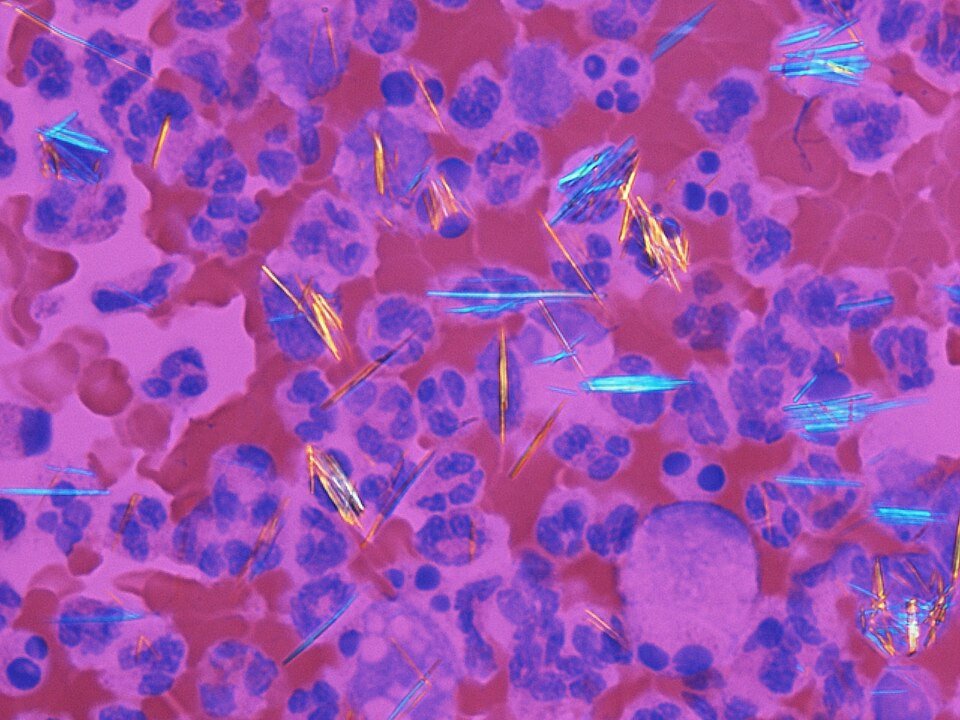
Uric acid is a normal waste product made when the body breaks down substances called purines (from cells and some foods). When the level of urate in the blood stays high, it comes out of solution and forms tiny, needle-like monosodium urate (MSU) crystals in and around joints. Crystals form more readily where it is cooler, which is a large part of why the big toe, the body's coolest and most peripheral joint, is the classic first target.
It is a genuinely destructive condition at that joint, not merely a painful one. Pooling 5,478 patients, acute arthritis of the first metatarsophalangeal joint is highly prevalent in gout and has substantial measured impact on pain and disability, with demonstrable effects on the structure and function of the joint itself [1].
The inflammasome: why an attack is so sudden and fierce
An attack begins when immune scavenger cells (macrophages) engulf MSU crystals. The crystals trip an internal alarm complex called the NLRP3 inflammasome, which switches on an enzyme (caspase-1) that releases a powerful inflammatory messenger, interleukin-1β (IL-1β). IL-1β floods the joint with inflammation, producing the rapid, intense redness, heat, swelling and pain of an acute attack within hours. Attacks are self-limiting over days as the response burns out.
That mechanism explains something clinically important: the attack is the immune reaction to crystals, not the crystals themselves. Settling the attack and removing the crystals are different problems requiring different drugs on different timescales.
The number that decides everything
Long-term treatment has one measurable objective: get serum urate below the concentration at which crystals can form, and keep it there. International practice targets a serum urate below 0.36 mmol/L (6 mg/dL), and below 0.30 mmol/L (5 mg/dL) where tophi are present, because at those levels existing crystals dissolve rather than merely stopping accumulating.
Treating to that target, rather than prescribing a fixed dose and hoping, is what the evidence supports. In a randomised controlled trial of 183 people, escalating the allopurinol dose monthly until the target was reached produced a significant reduction in the proportion of people having flares and in mean tophus size over 24 months, and was well tolerated [2].
The same principle at a service level: a UK randomised trial of nurse-led care built around patient education and a treat-to-target urate strategy achieved markedly better urate control than usual care, with fewer flares and greater tophus resolution at two years [3].
Two things follow. A dose of allopurinol that has never been titrated against a blood test is not really treatment, and "my gout is under control" means a number, not an absence of attacks this month.
Why it gets abandoned in the first months
Starting urate-lowering treatment can trigger attacks. As crystals dissolve they shed material that the inflammasome reacts to, so the early months of a cure can be worse than the disease appeared to be. This is the single commonest reason people stop treatment and conclude it does not work, when in fact the flare is evidence that it is working. It is why treatment is started at low dose, escalated gradually, and usually covered with anti-inflammatory prophylaxis for the first months.
Two things an upper-limb surgeon watches for
Gout is not confined to the foot, and in the arm it can mimic surgical pathology. There are reported cases of gouty tenosynovitis at the distal biceps insertion producing partial tendon tearing, presenting as what looks like a straightforward biceps rupture in someone whose gout history turns out to be the explanation [4]. It is rare, but it is the kind of diagnosis that is only made by the person who thought of it.
More reassuringly, one common worry is not borne out. Pooling 684,964 people, gout was not associated with an increased risk of fracture, and urate-lowering drugs prescribed early showed neither adverse nor beneficial effect on fracture risk [5].
References for the advanced reading
- Stewart S, Dalbeth N, Vandal AC, Rome K. The first metatarsophalangeal joint in gout: a systematic review and meta-analysis. BMC Musculoskelet Disord. 2016;17(1).
- Stamp LK, Chapman PT, Barclay ML, Horne A, Frampton C, Tan P, et al. A randomised controlled trial of the efficacy and safety of allopurinol dose escalation to achieve target serum urate in people with gout. Ann Rheum Dis. 2017;76(9):1522-8.
- Doherty M, Jenkins W, Richardson H, Sarmanova A, Abhishek A, Ashton D, et al. Efficacy and cost-effectiveness of nurse-led care involving education and engagement of patients and a treat-to-target urate-lowering strategy versus usual care for gout: a randomised controlled trial. Lancet. 2018;392(10156):1403-12.
- Fairhurst RJ, Schwartz AM, Rozmaryn LM. Gouty tenosynovitis of the distal biceps tendon insertion complicated by partial tendon rupture. Hand (N Y). 2016;12(1):NP1-NP5.
- Liu F, Dong J, Zhou D, Kang Q, Xiong F. Gout is not associated with the risk of fracture: a meta-analysis. J Orthop Surg Res. 2019;14(1).





