
How Muscles Work and Heal Info In-depth
Reviewed by Dr Kieran Hirpara, Specialist Orthopaedic Surgeon Last reviewed
Muscles are the body's engines: they turn the brain's instructions into movement and force, and they make up much of your body weight. Unlike cartilage, muscle has a genuine ability to repair and even rebuild itself, thanks to a reserve of dedicated stem cells. But that repair has limits: a small strain heals well, while a large tear or a long-neglected injury can heal with scar and never quite recover. This page explains, in plain language, what muscle is and how it mends; then, for the curious, it goes deeper into how a muscle actually contracts and why some injuries leave lasting weakness.
What muscle is and what it does
A muscle is a bundle of long, thread-like cells (muscle fibres) packed together like the strands of a rope and anchored to bone by tendons. When the brain sends a signal down a nerve, the muscle fibres shorten, pulling on the tendon and moving the joint. That is the whole job: convert an electrical signal and chemical energy into pulling force.
Muscle is richly supplied with blood, which is why it bleeds and bruises when torn, but also why it has a far better capacity to heal than poorly-supplied tissues like cartilage.
How muscle heals
After a strain or tear, muscle heals in overlapping stages:
- Bleeding and inflammation (first days). The injury bleeds and swells; clean-up cells move in. This is the painful, bruised phase.
- Regeneration (first weeks). Reserve stem cells wake up and build new muscle fibre to bridge the gap (genuine new muscle, not just scar).
- Remodelling (weeks to months). The new fibre matures and re-aligns with use, and strength gradually returns.
The catch is that regeneration and scarring compete. A small, clean injury regenerates well. A large tear lays down fibrous scar (and sometimes fat) faster than new muscle can form, and scar is weaker and less elastic than muscle. That is why big tears, and tears left too long, can leave permanent weakness.
What helps muscle recover
- Early, graded movement. Gentle movement and then progressive loading guide the new muscle to rebuild and align; prolonged complete rest causes wasting and stiffness.
- Not overdoing it early. Loading a fresh tear too hard re-injures it and feeds scarring.
- Good general health. Adequate protein, not smoking, and well-controlled diabetes all support repair.
- Timely treatment of big tears. Some complete tears (for example certain tendon-muscle ruptures) do best repaired promptly, before the muscle retracts and wastes.
In more depth
Advanced reading: the deeper science (optional)
This section steps up to a more detailed, student-level explanation. It isn't needed to understand a muscle injury, but if you're curious about how a muscle actually generates force and why some injuries don't fully recover, read on.
Muscle as living tissue
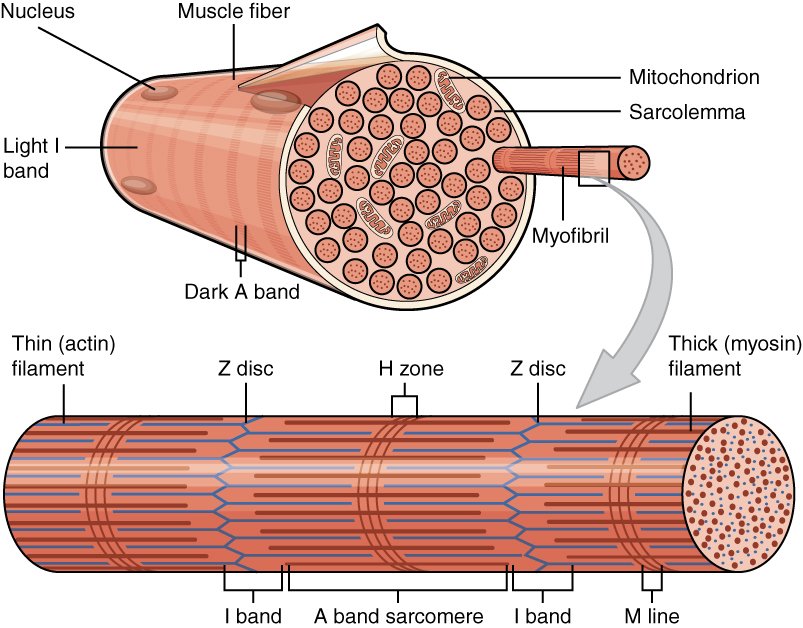
A whole muscle is built as a hierarchy, like a cable of cables: the muscle contains bundles (fascicles) of long muscle fibres, each fibre is a single large cell packed with thread-like myofibrils, and each myofibril is a chain of tiny contractile units called sarcomeres. The sarcomere is where force is made. It is a precise, repeating arrangement of two interleaved filaments: thick filaments of a protein called myosin and thin filaments of actin.
Each fibre belongs to a motor unit: one nerve cell and all the muscle fibres it controls. Fine movements (like the hand) use small motor units; powerful movements use large ones. Fibres also come in types: slow-twitch (fatigue-resistant, for endurance and posture) and fast-twitch (powerful but quick to tire).
How a muscle contracts
Contraction is the sliding-filament mechanism. When a nerve signal arrives at the neuromuscular junction (the synapse where nerve meets muscle; see how nerves work), it releases a chemical that makes the muscle fibre fire its own electrical impulse. That impulse triggers a flood of calcium inside the fibre, which uncovers binding sites on the actin filaments. The myosin heads then grab the actin and ratchet it inwards (like a tug-of-war team pulling a rope hand over hand), so the thick and thin filaments slide past each other and the sarcomere shortens. Multiply that across billions of sarcomeres and the whole muscle contracts. It all runs on ATP, the cell's energy currency; when ATP runs low the muscle fatigues.
How muscle heals: satellite cells versus scar
Muscle's repair secret is the satellite cell, a reserve stem cell tucked against each muscle fibre. After injury, satellite cells activate, multiply, and fuse to form new muscle fibre. Healing runs in three phases: destruction (bleeding and inflammation), regeneration (satellite cells rebuild fibre), and remodelling (the new fibre matures with loading).
But regeneration is in a tug-of-war with fibrosis. Inflammatory and signalling molecules, especially one called TGF-β1, drive fibroblasts to lay down collagen scar. In a small injury, regeneration wins. In a large or repeatedly-injured one, scar (and sometimes fat) wins, producing a patch that is mechanically inferior to true muscle. This is why severe muscle injuries recover incompletely.
Fatty infiltration and the rotator cuff
A clinically important version of this plays out in the rotator cuff of the shoulder. When a cuff tendon tears and is left, the attached muscle slowly retracts, wastes, and is replaced by fat (fatty infiltration). That fatty, atrophied change is largely irreversible even if the tendon is later repaired, and a muscle that has degenerated will never fully regain its strength. It is one of the main reasons surgeons care about the timing of certain tendon repairs: fixing it before the muscle degenerates gives a far better result.
Use it or lose it: atrophy and adaptation
Muscle is constantly tuned to demand. Load it progressively and it hypertrophies: the fibres enlarge and strengthen (with satellite cells donating nuclei to support the bigger fibre). Unload it (bed rest, a cast, or a cut nerve) and it atrophies rapidly, losing size and strength within weeks. Muscle cut off from its nerve (denervation) wastes fastest of all and, if the nerve doesn't recover in time, the muscle is eventually replaced by fat and fibrous tissue. This is why rehabilitation and keeping muscles active during recovery matter so much.
What helps and harms muscle healing
- Graded loading is the key stimulus for regeneration and re-alignment; too much too soon re-tears and scars.
- Blood supply is good in muscle, which is why it heals better than cartilage or the inner parts of tendons.
- Smoking, diabetes, ageing, and corticosteroids impair repair and accelerate wasting.
- Time and the size of the injury decide the ceiling: small strains recover fully; large tears and degenerated muscle do not.
See also
- How nerves work and heal — the nerve and motor end plate that drive muscle
- How tendons work and heal — how muscle's pull reaches the bone
- Smoking and musculoskeletal healing — why smoking slows muscle repair