

Liberação do túnel radial Folheto
Este protocolo orienta sua recuperação após a liberação do túnel radial realizada pelo Dr. Kieran Hirpara no Mater Private Hospital Rockhampton. Ele descreve o que esperar nas semanas seguintes à cirurgia e apresenta o programa de exercícios contido no folheto pós-operatório. Leve esta página ou seu arquivo PDF à sua primeira sessão de fisioterapia ou terapia da mão, para que a reabilitação seja devidamente coordenada. O terapeuta poderá ajustar o plano conforme a evolução da sua recuperação.
Caso tenha alguma dúvida ou preocupação quanto à ferida cirúrgica, entre em contato com o consultório. Geralmente, é útil tirar uma foto da ferida e enviá-la por e-mail para análise.
O que esperar
Os cuidados com a ferida são explicados nas orientações de cuidados com feridas fornecidas pelo consultório. À medida que a ferida cicatriza, o nervo liberado pode aderir aos tecidos circundantes; os exercícios de deslizamento abaixo são muito importantes para manter o nervo em movimento livre e evitar que ele fique “preso”.
Às vezes, a ferida pode tornar-se sensível. Isso é normal, e pode ser prevenido ou minimizado iniciando-se diariamente a dessensibilização: batendo e esfregando suavemente sobre a ferida (ou sobre o curativo), logo após a cirurgia. Esse tipo de “retroalimentação sensorial” ajuda o nervo a normalizar sua resposta ao toque e à textura.
Após a cicatrização completa da ferida, comece a massagem da cicatriz: faça movimentos circulares firmes sobre a incisão. Consulte as orientações de cuidados com feridas para obter mais informações sobre o manejo da cicatriz.
É importante ter expectativas realistas quanto à recuperação. O nervo radial precisa se deslocar e esticar um pouco durante os movimentos normais do braço; portanto, manter seu movimento desde cedo evita que ele adira aos tecidos em cicatrização [1]. Mesmo assim, o alívio da dor após a liberação do túnel radial costuma ser gradual, e não imediato; para algumas pessoas, o alívio é apenas parcial. Na verdade, esse procedimento é menos previsível do que outras cirurgias de liberação nervosa: a síndrome do túnel radial é difícil de diagnosticar com certeza e frequentemente se sobrepõe à epicondilite lateral, razão pela qual os resultados variam. Estudos de longo prazo indicam bons resultados em cerca de dois terços dos pacientes no total, sendo os melhores resultados observados naqueles com sintomas exclusivos do túnel radial [2][3]. A recuperação tende a ser mais lenta e incompleta quando há também epicondilite lateral, mais de uma compressão nervosa no mesmo braço ou quando o caso envolve pedido de indenização trabalhista [2][4]. O programa de deslizamento do nervo e a dessensibilização gradual são os aspectos da reabilitação que mais dependem de você; a prática diária e constante oferece ao nervo a melhor chance de se recuperar.
Precauções e limitações
É recomendado o uso funcional leve da mão para tarefas cotidianas, como cuidados pessoais, alimentação, vestuário, escrita e digitação. Além disso, as restrições são simples: não se deve levantar pesos, agarrar objetos, suportar cargas ou utilizar máquinas que produzam vibração (por exemplo, ferramentas elétricas ou cortadores de grama) nas 6 semanas seguintes à cirurgia; além disso, a condução de veículos deve ser evitada nas primeiras 2–3 semanas.
Para o seu fisioterapeuta:
Objetivos
- Evitar que o nervo liberado adira à ferida em processo de cicatrização (programa de deslizamento do nervo)
- Reduzir a sensibilidade da ferida por meio de dessensibilização gradual
- Manter a amplitude de movimento do punho, antebraço e cotovelo
- Permitir o uso funcional leve da mão em atividades da vida diária
Manejo
- Dessensibilização diária: toques suaves ou fricção sobre a ferida (curativo), iniciando imediatamente após a cirurgia
- Massagem da cicatriz (círculos firmes sobre a incisão) após a cicatrização completa da ferida
- Programa de exercícios domiciliares conforme os cartões abaixo: alongamento da flexão/extensão do punho; alongamento da supinação/pronação do punho; flexão/extensão do cotovelo; deslizamentos do nervo radial
- Prefira técnicas de deslizamento suave do nervo em vez de tensões agressivas na amplitude máxima: essas técnicas permitem maior deslocamento do nervo com muito menos esforço, sendo mais bem toleradas em nervos recém-descompressos [1][5]
- A mobilização do nervo pode ser considerada como complemento ao programa; a evidência científica sobre mobilização neural em condições relacionadas a nervos é favorável, porém com graus variados de certeza; portanto, a progressão deve ser guiada pelos sintomas [6]
Precauções
- Utilizar a mão apenas para atividades funcionais leves (cuidados pessoais, alimentação, vestuário, escrita, digitação)
- Não levantar pesos, agarrar objetos, suportar cargas ou usar máquinas vibratórias (ex.: ferramentas elétricas, cortadores de grama) nas 6 semanas após a cirurgia
- Evitar dirigir nas primeiras 2–3 semanas
- Os deslizamentos e alongamentos do nervo devem ser suaves e praticamente indolores; evite forçar o movimento até limites que reproduzam a dor nervosa pré-operatória
Estes são os exercícios descritos no folheto pós-operatório, a serem iniciados após a cirurgia e continuados em casa conforme orientação do seu fisioterapeuta ou terapeuta da mão. O número de repetições, o tempo de manutenção e a frequência estão indicados em cada cartão.
Os seus exercícios
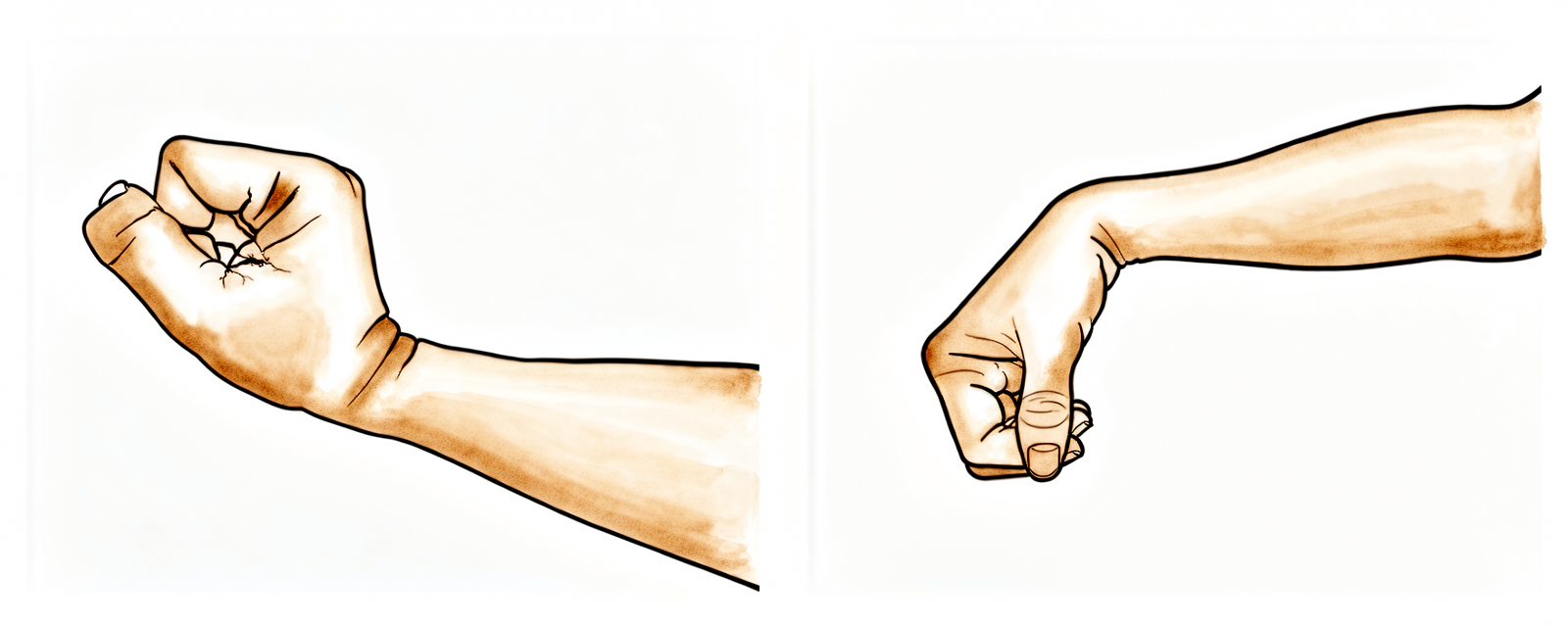
Kieran Hirpara 4.0
Alongamento para flexão/extensão do punho
Apoie o cotovelo numa mesa e balance levemente o punho para trás e para frente (ou apoie-o na borda de uma mesa ou poltrona, conforme ilustrado). Quando se sentir mais à vontade, use a outra mão na palma para empurrar o punho para trás e depois para frente, mantendo os dedos soltos. Mantenha cada alongamento por 15 segundos; repita 5 vezes em cada direção.
10 repetições, 4–5 vezes por dia
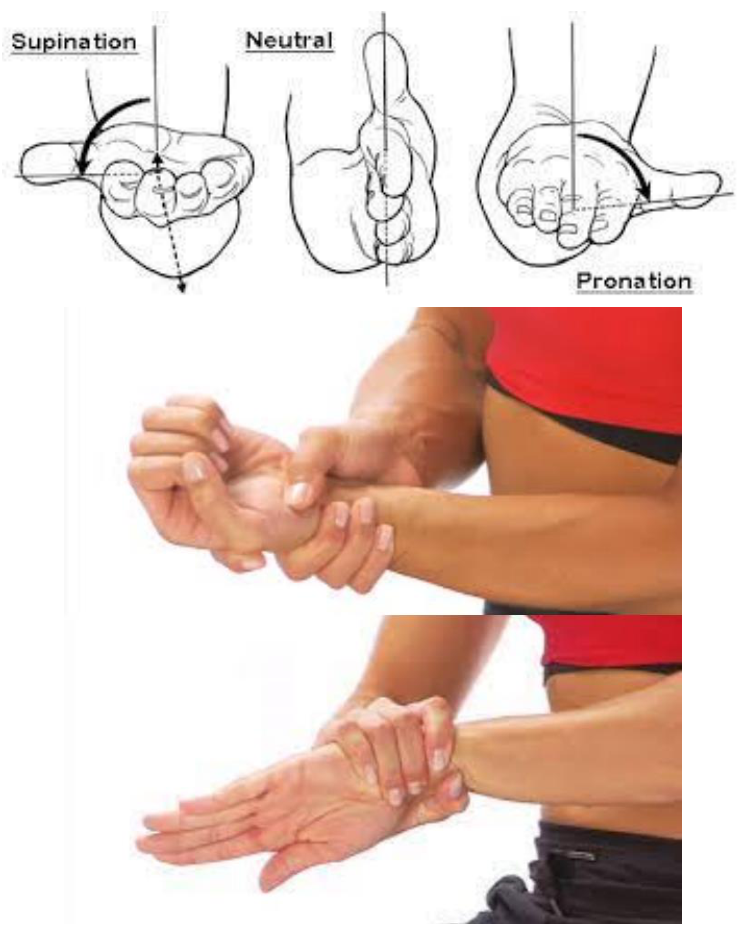
Kieran Hirpara 4.0
Alongamento de supinação/pronação do punho
Dobre o cotovelo ao lado do corpo, com a palma da mão voltada para o teto. Gire a mão de modo que a palma fique voltada para cima e mantenha essa posição por 15 segundos; depois, gire a palma para baixo e mantenha por mais 15 segundos. Repita esse processo 5 vezes. À medida que se sentir mais à vontade, use a outra mão — segurando pelo PULSO, não pela mão — para pressionar suavemente a mão na direção de cada posição, até sentir um alongamento.
5 repetições, 4 vezes ao dia, 5–7 dias por semana.
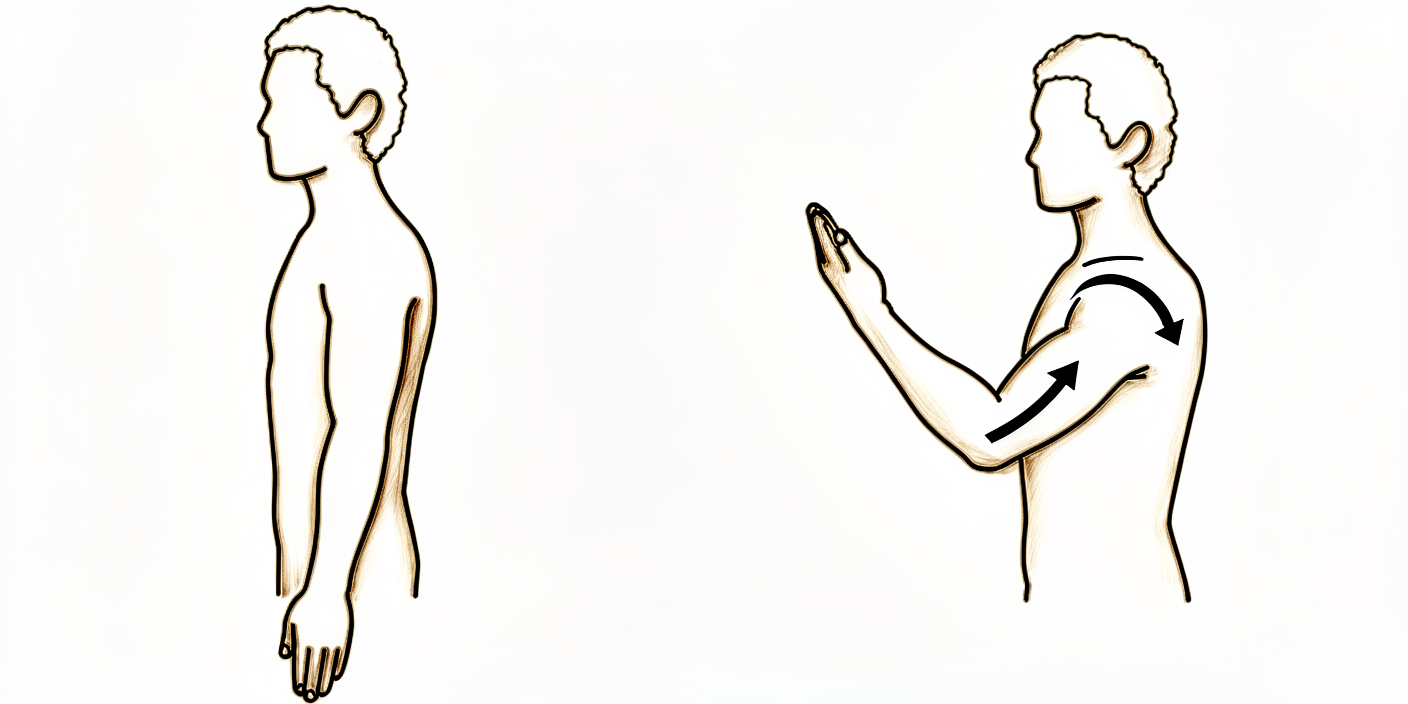
Kieran Hirpara 4.0
Flexão/extensão do cotovelo
Com o braço ao lado do corpo, estique suavemente o antebraço e o cotovelo o máximo que puder. Mantenha esse alongamento na amplitude máxima por 3–5 segundos. Repita o movimento na direção oposta, dobrando o antebraço para cima e tentando tocar o ombro com a mão.
10 repetições, 2 vezes ao dia, diariamente.
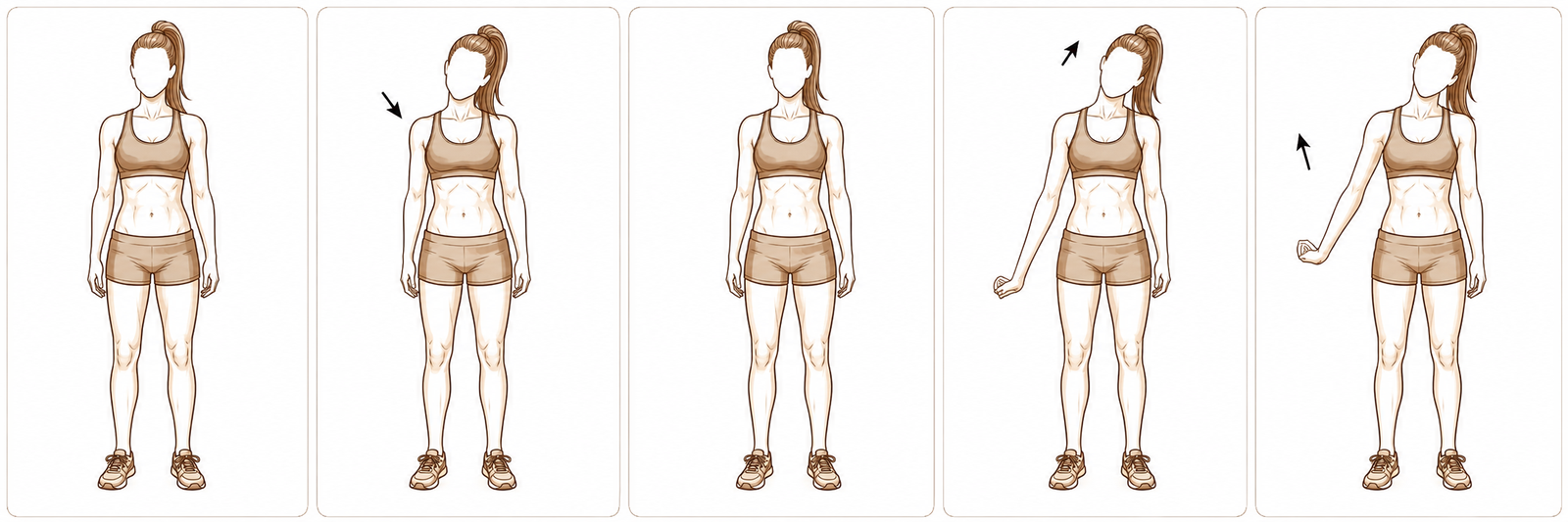
Kieran Hirpara 4.0
Deslizamentos do nervo radial
Fique de pé com os braços soltos ao longo do corpo. Abaixe o ombro e estique os dedos em direção ao chão. Rote o braço para dentro (com o polegar voltado para o corpo) e flexione o punho, com a palma da mão voltada para cima. Incline suavemente a cabeça para o lado oposto ao que está alongando, depois levante o braço para cima e para longe do corpo. Mantenha cada posição por 3 a 5 segundos.
5–8 repetições, 2–4 vezes ao dia, 6–7 dias por semana
Este programa de exercícios foi elaborado em colaboração com Sarah Farrell, Bacharel em Terapia Ocupacional (BOccThy) e Terapeuta de Mão Credenciada (AHT).
Após seguir este protocolo
Este protocolo complementa as orientações gerais de recuperação fornecidas pelo consultório; consulte controle da dor pós-operatória, cuidados com a ferida e noções básicas sobre a fisioterapia da mão. Quanto à própria cirurgia e à condição que ela trata, veja liberação do túnel radial e síndrome do túnel radial.
Referências
[1] Wright TW, Glowczewskie F, Cowin D, Wheeler DL. Movimento e tensão do nervo radial no cotovelo e no punho durante os movimentos dos membros superiores. J Hand Surg Am. 2005;30(5):990–996. https://pubmed.ncbi.nlm.nih.gov/16182056/ [2] Lee JT, Azari K, Jones NF. Resultados a longo prazo da liberação do túnel radial — o efeito da presença concomitante de cotovelo de tenista, múltiplas síndromes de compressão e questões relacionadas à indenização trabalhista. J Plast Reconstr Aesthet Surg. 2008;61(9):1095–1099. https://www.sciencedirect.com/science/article/abs/pii/S1748681507004044 [3] Sotereanos DG, Varitimidis SE, Giannakopoulos PN, Westkaemper JG. Resultados do tratamento cirúrgico da síndrome do túnel radial. J Hand Surg Am. 1999;24(3):566–570. https://pubmed.ncbi.nlm.nih.gov/10357537/ [4] Naam NH, Nemani S. Síndrome do túnel radial. Orthop Clin North Am. 2012;43(4):529–536. (Síndrome do Túnel Radial, StatPearls.) https://www.ncbi.nlm.nih.gov/books/NBK555937/ [5] Coppieters MW, Butler DS. Os “deslizadores” realmente deslizam e os “tensionadores” realmente tensionam? Uma análise das técnicas neurodinâmicas e considerações sobre sua aplicação. Man Ther. 2008;13(3):213–221. https://pubmed.ncbi.nlm.nih.gov/17398140/ [6] Basson A, Olivier B, Ellis R, Coppieters M, Stewart A, Mudzi W. A eficácia da mobilização neural no tratamento de condições neuromusculoesqueléticas: uma revisão sistemática e meta-análise. J Orthop Sports Phys Ther. 2017;47(9):593–615. https://pubmed.ncbi.nlm.nih.gov/28704626/
Evidence & references
This is the clinical evidence summary written for health professionals. It is technical, and it lists the research this page was built from. You do not need to read it to understand your treatment or to make a decision about it.
Topic scope: post-operative rehabilitation after surgical decompression / neurolysis of the posterior interosseous nerve (deep branch of the radial nerve) in the radial tunnel of the proximal forearm, performed for radial tunnel syndrome (RTS). This is an elbow / proximal-forearm topic — anatomically and clinically distinct from carpal-tunnel and cubital-tunnel decompression. Like other nerve decompressions it is an early-motion pathway (early elbow/forearm/wrist motion, radial-nerve glides, oedema and scar care). The scope deliberately foregrounds the diagnostic controversy and the more variable, lower success rates that distinguish RTS release from the better-validated carpal-tunnel and cubital-tunnel operations.
Defining principle of the rehab here: a decompressed nerve does not create a healing construct that needs months of protection — it needs early, gentle movement to stop it adhering to the operative bed and to restore its glide. So the rehab is an early-motion programme: light functional hand use from day 1, radial-nerve sliders, graded desensitisation and (once healed) scar massage; heavier loading deferred to ~6 weeks. But two honesty caveats sit over the whole topic. First, RTS is a contested diagnosis — there is no confirmatory imaging or electrodiagnostic test, it is a diagnosis of exclusion, and a substantial body of opinion regards it as a variant of recalcitrant lateral epicondylitis. Second, outcomes after release are more variable and on average lower than carpal- or cubital-tunnel release — good results cluster around two-thirds overall, and fall further with co-existing tennis elbow, multiple compression sites, or a workers'-compensation context. Patient expectations should be set accordingly.
A. THE DIAGNOSTIC CONTROVERSY (read first — it frames everything)
RTS is among the most contested entities in upper-limb surgery, and the rehab brief is incomplete without it:
- No confirmatory test. Electromyography and nerve-conduction studies are characteristically normal in RTS (compression is intermittent/dynamic and predominantly of a motor nerve carrying few pain fibres), and MRI is frequently negative — denervation oedema in supinator/extensors is suggestive but inconsistent, and a normal scan does not exclude the diagnosis. RTS is therefore a clinical diagnosis of exclusion, resting on point tenderness ~4 cm distal to the lateral epicondyle (over the radial tunnel rather than the epicondyle), pain on resisted supination / resisted long-finger extension, and — for some surgeons — temporary relief from a diagnostic local-anaesthetic block at the radial tunnel.
- Overlap with lateral epicondylitis (tennis elbow). The two coexist frequently and share the lateral-elbow pain territory. A recognised school of thought holds that "RTS" is often severe, recalcitrant lateral epicondylitis rather than a discrete compression neuropathy. Importantly, routine PIN release added to lateral-epicondylitis surgery has not been shown to improve outcomes, so the diagnosis should be secure before a decompression is planned.
- Practical consequence. Surgery is a last resort after prolonged failed conservative care (activity modification, splinting, anti-inflammatories, sometimes a steroid injection), and is best reserved for patients with proximal-forearm pain and no better explanation. This uncertainty is the single most important reason post-operative expectations must be framed honestly.
B. RELEASE OUTCOMES (variable — and why)
- Headline success ~two-thirds. Across the older long-term series, roughly 67% good, 15% fair, 18% poor after radial tunnel decompression — markedly more variable than carpal- or cubital-tunnel release. A 2008 long-term series (Lee, Azari, Jones) and a 1999 series (Sotereanos et al.) both document this spread; the Sotereanos cohort reported good/excellent results in only ~39% by objective assessment (though ~64% by patient self-rating), underscoring how outcome depends on the metric used.
- Co-existing lateral epicondylitis lowers success. Success falls to roughly 40% when tennis elbow coexists, versus far higher with isolated RTS.
- Multiple compression sites and workers'-compensation context lower success — reported ~58% success in compensation cases vs ~73% without. These are the same modifiers named in the patient protocol.
- 2025 systematic review (Raymond et al., HAND). 11 studies, 401 limbs (381 patients). Outcomes were heterogeneous; a dorsal approach between ECRB and EDC was associated with the most favourable Roles-and-Maudsley scores and satisfaction. The review's central message is that the overall evidence is low-grade (observational), the diagnosis non-standardised, and the effectiveness of conservative treatment essentially untested — a "tendency" toward benefit rather than proof.
- Resorption-style "spontaneous improvement" does not apply here — unlike calcific tendinitis, RTS does not self-resolve through a biological cycle; conservative care manages symptoms rather than curing a deposit.
C. SURGICAL APPROACH (shapes the early rehab)
- What is done. Complete neurolysis of the radial nerve at its bifurcation, decompressing the deep branch (PIN) and superficial sensory branch, releasing the arcade of Frohse (the proximal supinator edge), the leash of Henry (radial recurrent vessels), the ECRB fascial edge, and the distal supinator border. Any constrictive bands or vessels are divided.
- Approaches. Dorsal (Thompson, between ECRB/EDC or the brachioradialis–ECRL interval), volar/anterior (Henry), or transmuscular. Anatomical studies map the trade-offs; the dorsal ECRB–EDC interval performed best in the 2025 review. The superficial radial branch matters — it is a recognised source of post-operative dysaesthesia if irritated.
- Rehab implication. A muscle-splitting/dorsal exposure through the extensor mass means early gentle forearm rotation and wrist motion are encouraged but heavy resisted supination/extension is deferred; the incision sits over a mobile, frequently sensitive area, so desensitisation and scar care carry real weight here.
D. POST-OP THERAPY ROLE (nerve/tendon glides, oedema, scar)
The decompressed nerve must glide, not adhere. The mechanical rationale is well quantified: the radial nerve translates and stretches a measurable amount across the elbow and wrist during ordinary arm motion (Wright et al. 2005), so early motion is what keeps it free of the healing bed.
- Early motion, immediately. Early active elbow, forearm and wrist movement within pain limits from the first post-op days; most protocols use no rigid splinting (or a removable splint for comfort/night only).
- Radial-nerve glides — favour "sliders" over "tensioners". Sliding (slider) neurodynamic techniques achieve substantially greater nerve excursion at much lower nerve strain than end-range tensioners — preferable around a freshly decompressed nerve. Neural-mobilisation evidence across neuromusculoskeletal conditions is supportive but of variable certainty, so progression is symptom-guided and essentially pain-free; mechanism work (e.g., the MONET protocol) is still maturing.
- Oedema and desensitisation. Graded desensitisation (tapping/rubbing over the dressing) from day 1 normalises touch and pre-empts a sensitive scar — particularly relevant given superficial- radial-branch proximity.
- Scar management once healed. Massage, pressure, and silicone are advocated to loosen skin–tissue adhesions and aid remodelling, started once the wound is closed/sutures out.
- Strengthening deferred. Light functional ADL use throughout; resisted strengthening of wrist/ elbow and fine-motor work introduced from ~6 weeks. Heavy work and vibration tools avoided to ~6–8 weeks.
Phased post-op timeline (maps to the patient protocol phases)
| Phase | Window | Splint | Motion / nerve work | Load / strengthening | Notes |
|---|---|---|---|---|---|
| I — Protect & glide | Day 0–2 wk | None, or removable for comfort/night | Early pain-free active elbow/forearm/wrist ROM; radial-nerve sliders; desensitisation from day 1 | Light functional ADL use only (self-care, feeding, dressing, writing, typing) | Stop the nerve adhering; settle the wound. No lifting/gripping/weight-bearing/vibration tools. Driving limited first 1–2 wk |
| II — Restore motion | 2–6 wk | Off | Progress full active + gentle assisted ROM; continue sliders; scar massage once healed | Still no resisted loading; ADL use continues | Sensitivity/dysaesthesia common and usually settles; keep glides gentle |
| III — Strengthen & return | ~6 wk onward | Off | Full ROM goal; sliders as needed | Begin graded wrist/elbow strengthening + fine-motor work from ~6 wk; advance work/heavy tasks thereafter | Vibration tools/heavy work resume ~6–8 wk. Pain relief is often gradual and may be partial — counsel accordingly |
E. COMPLICATIONS / DOWNSIDES
- Incomplete or no pain relief — the dominant "complication," tied directly to diagnostic uncertainty; relief is frequently gradual and sometimes partial.
- Superficial-radial-branch dysaesthesia / scar sensitivity — recognised; desensitisation and careful technique mitigate it.
- Transient PIN weakness (finger/thumb extension) from retraction — usually recovers.
- Adhesion/recurrence of symptoms if early glide is neglected.
- Standard wound risks (infection, haematoma) — uncommon.
F. KEY CONTROVERSIES / EVIDENCE QUALITY
- Does RTS exist as a discrete entity? Genuinely contested. No confirmatory test; substantial opinion equates much of it with recalcitrant lateral epicondylitis. This is the defining controversy and must shape consent and expectation-setting. Unresolved — expert opinion divided.
- Patient selection drives outcome more than technique. Isolated RTS does best; coexisting tennis elbow, multiple compressions, and compensation context predict worse results. Moderate (consistent across cohorts).
- Approach choice. A dorsal ECRB–EDC interval was favoured in the 2025 SR, but the evidence is observational and confounded by diagnostic heterogeneity. Weak–moderate.
- The rehab protocol itself is consensus/expert — drawn from surgeon and hand-therapy guidance (early motion, sliders, desensitisation, scar care), not from a rehab RCT. Phase timings are typical, not trial-derived. Weak / consensus.
- Conservative-treatment efficacy is essentially untested — the 2025 SR notes no usable trials of non-operative care, so "failed conservative management" before surgery rests on practice convention. Weak.
G. EVIDENCE STRENGTH FLAGS (summary)
- STRONG: the mechanical rationale for early nerve glide — quantified radial-nerve excursion/ strain across elbow and wrist (Wright et al. 2005); slider-vs-tensioner excursion/strain physiology.
- MODERATE: patient-selection modifiers of outcome (lateral epicondylitis, multiple compressions, workers' compensation lower success); ~two-thirds overall good-result rate from long-term cohorts; dorsal-approach signal from the 2025 systematic review (low-grade studies).
- WEAK / CONSENSUS: the existence and diagnostic criteria of RTS (no confirmatory test; overlap with lateral epicondylitis); the post-operative rehabilitation protocol (surgeon/ hand-therapy guidance, no rehab RCT); neural-mobilisation certainty (supportive but variable); efficacy of conservative care (essentially untested).
CITATIONS
RAG corpus (180,000+ Orthopaedic articles)
- Posterior Interosseous Nerve Compression in the Forearm, AKA Radial Tunnel Syndrome. HAND. 2022. DOI: 10.1177/15589447221122822
- Radial Tunnel Syndrome: Emphasis on the Superficial Branch of the Radial Nerve. J Hand Surg Eur. 2009. DOI: 10.1177/1753193408099832
- Anatomical Study of the Surgical Approaches to the Radial Tunnel. J Hand Surg Am. 2015. DOI: 10.1016/j.jhsa.2015.03.009
- MR Imaging Features of Radial Tunnel Syndrome: Initial Experience. Radiology. 2006. DOI: 10.1148/radiol.2401050028
- Management of Lateral Epicondylitis: Current Concepts. J Am Acad Orthop Surg (JAAOS). 2008. DOI: 10.5435/00124635-200801000-00004
- Uncommon Nerve Compression Syndromes of the Upper Extremity. J Am Acad Orthop Surg (JAAOS). 1998. DOI: 10.5435/00124635-199811000-00006
- Radial Nerve Excursion and Strain at the Elbow and Wrist Associated With Upper-Extremity Motion. J Hand Surg Am. 2005. DOI: 10.1016/j.jhsa.2005.06.008
- Evidence and Techniques in Rehabilitation Following Nerve Injuries. Hand Clin. 2013. DOI: 10.1016/j.hcl.2013.04.012
- Preventive Strategies, Exercises and Rehabilitation of Hand Compression Neuropathies. J Hand Ther. 2022. DOI: 10.1016/j.jht.2021.11.003
- Mechanisms of Neurodynamic Treatments (MONET): a protocol for a mechanistic study. BMC Musculoskelet Disord. 2024. DOI: 10.1186/s12891-024-07713-6
Radial-tunnel literature (URLs)
- Clinical Outcomes of Operative Management for Radial Tunnel Syndrome According to Surgical Approach: a Systematic Review. HAND. 2025. https://journals.sagepub.com/doi/10.1177/15589447251315761
- The Epidemiology of Radial Tunnel Syndrome and Its Overlap With Lateral Epicondylitis. J Hand Surg Am. 2023. https://www.jhandsurg.org/article/S0363-5023(23)00138-7/abstract
- Lee JT, Azari K, Jones NF. Long-term results of radial tunnel release — the effect of co-existing tennis elbow, multiple compression syndromes and workers' compensation. J Plast Reconstr Aesthet Surg. 2008. https://www.sciencedirect.com/science/article/abs/pii/S1748681507004044
- Sotereanos DG, et al. Results of surgical treatment for radial tunnel syndrome. J Hand Surg Am. 1999. https://pubmed.ncbi.nlm.nih.gov/10357537/
- Interventions for treating the radial tunnel syndrome: a systematic review of observational studies (DARE). https://www.ncbi.nlm.nih.gov/books/NBK75403/
- Radial Tunnel Syndrome (StatPearls). https://www.ncbi.nlm.nih.gov/books/NBK555937/
- Orthopedic Management of Radial Tunnel Syndrome: A Diagnostic and Treatment Dilemma. PMC. https://pmc.ncbi.nlm.nih.gov/articles/PMC10081130/
- Radial Tunnel Syndrome: Case Report and Comprehensive Critical Review of a Compression Neuropathy Surrounded by Controversy. PMC. https://pmc.ncbi.nlm.nih.gov/articles/PMC9896270/
Published rehab protocols (patient-guidance — basis for the phase structure)
- Radial Tunnel Release post-op protocol (Santa Barbara Orthopedic / Mencias). https://www.sbortho.com/wp-content/uploads/2023/09/radial-tunnel-release-new.pdf
- Radial Tunnel Syndrome — conservative and post-operative rehabilitation. Physiopedia. https://www.physio-pedia.com/Radial_Tunnel_Syndrome
- Basson A, et al. The effectiveness of neural mobilization for neuromusculoskeletal conditions: a systematic review and meta-analysis. J Orthop Sports Phys Ther. 2017. https://pubmed.ncbi.nlm.nih.gov/28704626/
- Coppieters MW, Butler DS. Do "sliders" slide and "tensioners" tension? Man Ther. 2008. https://pubmed.ncbi.nlm.nih.gov/17398140/





