
Phẫu thuật ngón tay Thông tin
Giao thức này hướng dẫn quá trình hồi phục của bạn sau ca phẫu thuật ngón tay do Bác sĩ Kieran Hirpara thực hiện tại Bệnh viện tư nhân Mater Rockhampton. Giao thức nêu rõ những gì sẽ xảy ra trong những tuần sau phẫu thuật và trình bày chương trình tập luyện nhằm giúp bạn khôi phục lại khả năng vận động và chức năng của ngón tay cũng như bàn tay. Vui lòng mang theo trang này hoặc bản PDF tương ứng trong lần trị liệu vật lý trị liệu hoặc trị liệu bàn tay đầu tiên để việc phục hồi diễn ra một cách đồng bộ; chuyên viên trị liệu có thể điều chỉnh kế hoạch tùy theo loại phẫu thuật và tiến triển hồi phục của bạn.
Nếu bạn có bất kỳ thắc mắc nào về vết thương sau phẫu thuật, hãy liên hệ với phòng khám. Việc chụp ảnh vết thương rồi gửi qua email để được đánh giá cũng rất hữu ích.
Những điều bạn có thể mong đợi
Cách chăm sóc vết thương được hướng dẫn chi tiết trong tờ hướng dẫn chăm sóc vết thương của phòng khám. Các bài tập dưới đây đóng vai trò then chốt trong việc khôi phục khả năng vận động và chức năng của ngón tay cũng như bàn tay.
Khi vết thương đã lành, hãy chườm nóng lên tay trong 20 phút trước khi thực hiện các bài tập này. Sau khi tập xong, chườm lạnh để giảm sưng và viêm.
Khi vết thương hoàn toàn lành, hãy bắt đầu mát-xa vết sẹo: dùng tay xoay tròn mạnh lên vùng vết mổ. Vui lòng tham khảo tờ hướng dẫn chăm sóc vết thương để biết thêm thông tin về cách xử lý sẹo.
Hãy theo dõi tình trạng sưng phù; nếu có bất kỳ lo ngại nào, hãy gọi cho phòng khám hoặc trao đổi với chuyên viên trị liệu tay.
Có ba nguyên tắc cơ bản giúp hồi phục sau hầu hết các ca phẫu thuật ngón tay, và các bài tập dưới đây giúp áp dụng từng nguyên tắc đó. Nguyên tắc thứ nhất là kiểm soát sưng: tình trạng sưng kéo dài khiến các mô mềm bị cứng lại, hạn chế khả năng vận động của gân và khớp; vì vậy việc nâng cao tay, vận động nhẹ nhàng và (khi cần thiết) mát-xa ngược chiều cũng như dùng băng ép là những ưu tiên trong những tuần đầu sau phẫu thuật [1]. Nguyên tắc thứ hai là vận động sớm và nhẹ nhàng: các ngón tay rất dễ bị cứng lại, nên việc vận động chúng trong phạm vi cho phép (ngay khi vết thương và tình trạng sức khỏe cho phép) sẽ giúp các khớp nhỏ vẫn mềm dẻo và giúp gân di chuyển dễ dàng thay vì dính vào các mô đang hồi phục xung quanh. Nguyên tắc thứ ba là việc trượt của gân. Các tư thế ngón tay được nêu trong tờ hướng dẫn (duỗi thẳng, cong hình móc, đặt ngang như mặt bàn và nắm thành nắm đấm) không phải ngẫu nhiên: mỗi tư thế khiến các gân sâu và gân nông di chuyển một mức độ khác nhau so với nhau và so với bao gân, giúp chúng luôn trượt dễ dàng [2]. Các bài tập chặn khớp DIP và PIP cũng nhằm mục đích tương tự, giúp gân trượt từng khớp một. Nguyên tắc quan trọng là “ít nhưng thường xuyên”: việc luyện tập đều đặn, nhẹ nhàng và nhiều lần trong ngày sẽ mang lại hiệu quả hồi phục tốt hơn so với những nỗ lực mạnh mẽ nhưng thưa thớt.
Các biện pháp phòng ngừa và hạn chế
Bạn nên sử dụng bàn tay một cách nhẹ nhàng cho các hoạt động sinh hoạt hàng ngày như chăm sóc bản thân, ăn uống, mặc quần áo, viết lách và đánh máy (trừ khi có chỉ định khác). Thông thường, bạn sẽ được yêu cầu tránh nâng vật nặng, nắm chặt, chịu tải trọng và các tác động mạnh trong vòng 6 tuần sau phẫu thuật, tùy thuộc vào chấn thương và loại phẫu thuật đã thực hiện. Bạn sẽ nhận được hướng dẫn chi tiết hơn về các biện pháp phòng ngừa và hạn chế tại buổi tái khám sau phẫu thuật.
Dành cho chuyên viên vật lý trị liệu:
Cách xử lý
- Chăm sóc vết thương và sẹo theo hướng dẫn trong tờ hướng dẫn chăm sóc vết thương của phòng khám; bắt đầu massage vùng sẹo (thực hiện các vòng tròn mạnh lên vết mổ) sau khi vết thương đã lành hoàn toàn.
- Sau khi vết thương lành, hãy chườm nóng lên bàn tay trong 20 phút trước khi thực hiện các bài tập; sau đó chườm lạnh để giảm sưng và viêm.
- Theo dõi tình trạng sưng; nếu có vấn đề, hãy liên hệ ngay với phòng khám hoặc chuyên viên trị liệu tay.
- Việc kiểm soát phù nề là ưu tiên hàng đầu nếu tình trạng sưng quá mức hoặc không giảm: nâng cao tay và vận động chủ động là biện pháp đầu tiên; kết hợp thêm massage ngược chiều, băng ép và các kỹ thuật di chuyển dịch thể dưới da như phương pháp điều trị tiêu chuẩn [1].
- Thực hiện các bài tập tại nhà theo hướng dẫn trong các thẻ dưới đây: gập/duỗi cổ tay; khóa khớp liên đốt xa (DIP) và khớp liên đốt gần (PIP); các động tác trượt gân (Bộ A và B).
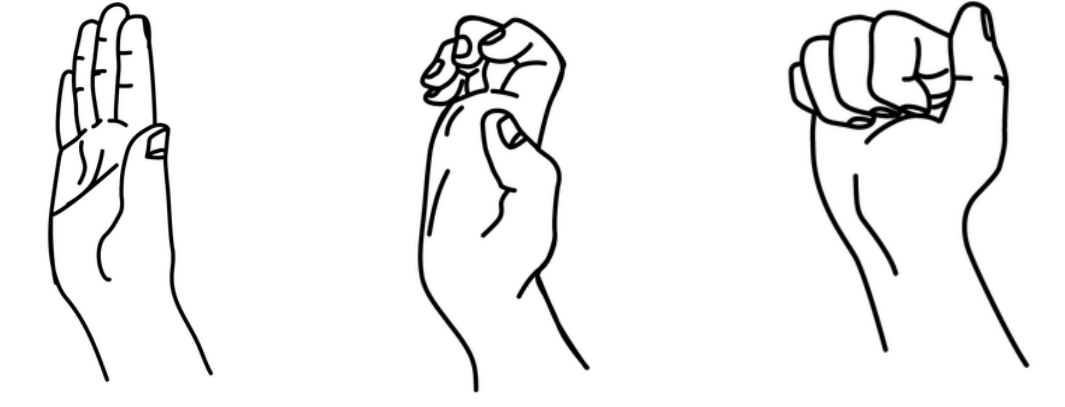
- Các chuỗi bài tập trượt gân và khóa khớp được thiết kế nhằm tối đa hóa sự di chuyển riêng biệt của các gân gập so với nhau và so với bao gân; nên thay đổi các tư thế (duỗi thẳng, cong hình móc, đặt tay lên mặt bàn, nắm thành nắm đấm) thay vì chỉ lặp lại một tư thế duy nhất [2].
Các biện pháp phòng ngừa
- Bạn nên sử dụng bàn tay một cách nhẹ nhàng cho các hoạt động sinh hoạt hàng ngày (chăm sóc bản thân, ăn uống, mặc quần áo, viết lách, đánh máy) trừ khi có chỉ định khác.
- Trong vòng 6 tuần sau phẫu thuật (tùy theo chấn thương và loại phẫu thuật), không được nâng vật nặng, nắm chặt, chịu tải trọng hay gây tác động mạnh lên bàn tay.
- Các biện pháp phòng ngừa và hạn chế cụ thể sẽ được xác nhận tại buổi tái khám sau phẫu thuật.
- Đây là chương trình tập luyện tổng quát sau phẫu thuật; nếu ca phẫu thuật cụ thể có những hạn chế về phạm vi vận động, mức độ vận động hoặc yêu cầu dùng nẹp riêng (ví dụ sau phẫu thuật sửa chữa gân), thì các hướng dẫn đặc thù cho ca phẫu thuật đó sẽ được ưu tiên áp dụng.
Đây là các bài tập trong tờ hướng dẫn tập luyện; bạn cần tiếp tục thực hiện tại nhà theo sự hướng dẫn của chuyên viên vật lý trị liệu hoặc chuyên viên trị liệu tay.
Các bài tập của bạn
Kieran Hirpara 4.0
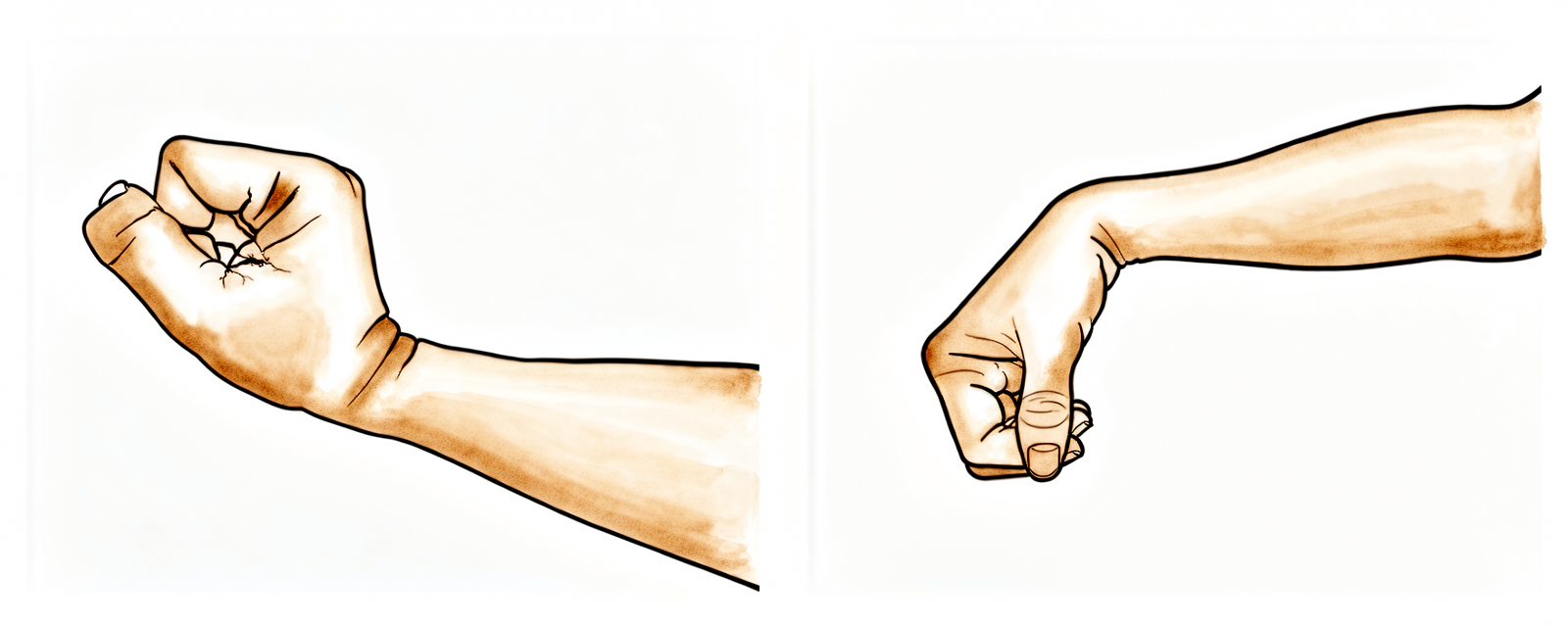
Gập và duỗi cổ tay
Đặt khuỷu tay lên bàn và nhẹ nhàng đung đưa cổ tay qua lại (hoặc đặt cổ tay lên mép bàn hoặc tay vịn ghế như trong hình). Khi đã cảm thấy thoải mái hơn, dùng tay kia nắm lấy lòng bàn tay và đẩy cổ tay ra phía sau sao cho các ngón tay hướng lên trần nhà; sau đó làm ngược lại để các ngón tay hướng xuống sàn. Giữ các ngón tay thả lỏng — chúng sẽ tự uốn cong hoặc duỗi thẳng ra. Giữ mỗi tư thế kéo giãn trong 15 giây; lặp lại 5 lần theo mỗi hướng.
10 lần lặp, 4–5 lần mỗi ngày.
Kieran Hirpara 4.0
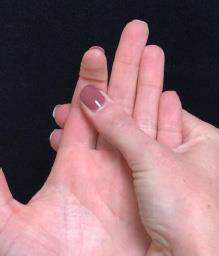
Chặn khớp ngón tay xa
Bắt đầu với tư thế lòng bàn tay hướng lên trên; dùng tay kia nâng đỡ bàn tay đang tập ngay dưới khớp cuối — tức là khớp liên đốt xa (DIP). Gập và duỗi thẳng khớp cuối, giữ mỗi tư thế trong 3–5 giây. Chỉ đỡ khớp giữa vừa đủ để nó không bị gập lại. Việc các ngón tay khác di chuyển trong lúc tập là hoàn toàn bình thường.
10 lần lặp, 4 lần mỗi ngày, thực hiện hàng ngày.
Kieran Hirpara 4.0
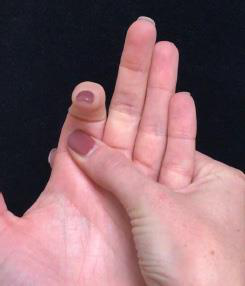
Chặn khớp PIP
Bắt đầu với tư thế lòng bàn tay hướng lên trên; dùng tay kia nâng đỡ bàn tay đang tập luyện ngay phía dưới khớp thứ hai – tức là khớp gian đốt ngón tay gần thân ngón (PIP). Gập và duỗi ngón tay tại khớp giữa, giữ mỗi tư thế trong 3–5 giây. Việc các ngón tay khác cũng di chuyển là hoàn toàn bình thường.
10 lần lặp lại, 4 lần mỗi ngày, thực hiện hàng ngày.
Kieran Hirpara 4.0
Các bài tập trượt gân — Loạt A
Hãy đặt tay ra trước mặt, giữ cổ tay thẳng; sau đó duỗi thẳng hết các ngón tay (1). Tiếp theo, gập đầu ngón tay lại thành tư thế “móc”, sao cho các khớp ngón hướng lên trên (2). Cuối cùng, nắm tay chặt lại và đặt ngón tay cái lên trên các ngón còn lại (3).
5–10 lần lặp, 2–3 lần mỗi ngày, thực hiện hàng ngày.
Kieran Hirpara 4.0
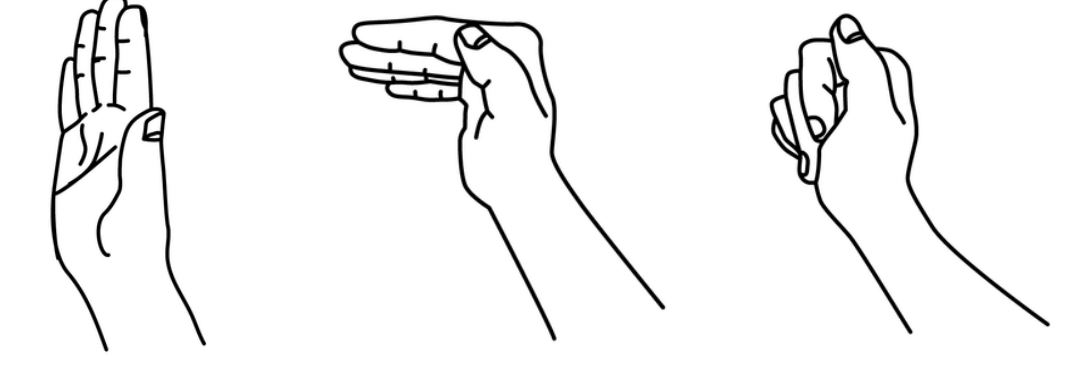
Các bài tập trượt gân — Loạt B
Hãy đặt tay ra phía trước, giữ cổ tay thẳng; sau đó duỗi thẳng hết các ngón tay (1). Tiếp theo, hơi gập các ngón tay ở khớp đốt ngón tay gần lòng bàn tay để tạo thành hình “mặt bàn”, đồng thời vẫn giữ các ngón tay thẳng — chú ý không để cổ tay gập về phía trước (2). Cuối cùng, gập các ngón tay ở khớp giữa, sao cho đầu ngón tay chạm vào lòng bàn tay (3).
5–10 lần lặp, 2–3 lần mỗi ngày, thực hiện hàng ngày.
Chỉ bắt đầu thực hiện các bài tập dưới đây khi có sự hướng dẫn từ Bác sĩ Hirpara và chuyên viên trị liệu vận động; đồng thời phải tuân thủ mọi phạm vi chuyển động và giới hạn đã được đặt ra. Các bài tập “chặn” là những bài cụ thể: bằng cách giữ yên khớp phía dưới, bạn buộc chuyển động phải diễn ra ở khớp mà bạn muốn phục hồi, thay vì ở khớp vốn đã di chuyển dễ dàng. Chuỗi bài tập trượt gân giúp các gân gấp vận hành trơn tru trong bao gân; còn bài kéo căng cổ tay ngăn tình trạng cổ tay bị cứng trong lúc bạn tập trung vào các ngón tay. Việc tập luyện ít lần nhưng thường xuyên sẽ hiệu quả hơn so với những buổi tập dài thỉnh thoảng. Ngưng ngay mọi bài tập gây ra cơn đau dữ dội.
Sau khi thực hiện theo quy trình
Quy trình này được áp dụng song song với các hướng dẫn phục hồi chung của phòng khám; vui lòng tham khảo mục xử lý cơn đau sau phẫu thuật, chăm sóc vết thương và những điều cơ bản về vật lý trị liệu tay. Đối với các ca phẫu thuật thường áp dụng chương trình này, hãy xem thêm phẫu thuật cắt bỏ gân ngón tay cò súng và phẫu thuật cắt bỏ màng cứng Dupuytren.
Chương trình bài tập này được biên soạn với sự hợp tác của Sarah Farrell, BOccThy, chuyên gia vật lý trị liệu tay được công nhận.
Tài liệu tham khảo
[1] Miller LK, Jerosch-Herold C, Shepstone L. Hiệu quả của các kỹ thuật kiểm soát phù nề đối với tình trạng phù nề bàn tay ở giai đoạn bán cấp: một phân tích có hệ thống. J Hand Ther. 2017;30(4):432–446. https://pubmed.ncbi.nlm.nih.gov/28807598/ [2] Wehbé MA, Hunter JM. Cơ chế trượt của gân cơ duỗi ở bàn tay. Phần II: Các cơ chế trượt khác nhau. J Hand Surg Am. 1985;10(4):575–579. https://pubmed.ncbi.nlm.nih.gov/4020073/
Evidence & references
This is the clinical evidence summary written for health professionals. It is technical, and it lists the research this page was built from. You do not need to read it to understand your treatment or to make a decision about it.
Topic scope: This is a general post-operative finger rehabilitation program, not a single-procedure protocol. It applies as the default hand-therapy pathway after common finger operations where the repaired or released structure does not mandate its own protected range — most typically trigger finger (A1 pulley) release and Dupuytren's fasciectomy, and as a baseline mobility/oedema program after finger fracture fixation (proximal/middle phalanx ORIF or K-wire), PIP joint and volar-plate / collateral-ligament procedures, and minor soft-tissue work. The program rests on three levers the patient handout puts into practice — (1) oedema control, (2) early gentle protected movement, and (3) tendon gliding / joint-blocking to preserve differential excursion. It explicitly defers to the operation-specific protocol whenever the surgery carries a defined protected arc, motion limit or splinting regime (most importantly flexor or extensor tendon repair), which this general program does not attempt to reproduce.
Defining principle: fingers stiffen faster than almost any other joint complex in the body. The small interphalangeal joints, the gliding flexor/extensor tendons within their sheaths, and the dense soft-tissue envelope are all exquisitely sensitive to swelling and immobility — adhesions and joint contracture establish within days, not weeks. Rehabilitation is therefore a constant balancing act: protect the repaired structure for exactly the window it needs, and not one day longer, while restoring controlled glide and range early to outrun the stiffness. When in doubt, the default after finger surgery is controlled motion, not rest.
A. WHY EARLY CONTROLLED MOTION (THE CORE RATIONALE)
The unifying problem after any finger operation is the stiff finger: persistent oedema and immobility drive scar between the gliding planes, contract the joint capsule and collateral ligaments, and convert a mechanically sound repair into a functionally poor hand. The hand-surgery literature treats the stiff finger as a largely preventable complication of inadequate early rehabilitation rather than an inevitable consequence of surgery [The Stiff Finger; Stiff Digit, JAAOS].
- Immobilisation has a cost. Reduced range of motion after immobilisation arises from increased swelling, scarring between tendons and surrounding structures, and joint/ligament contracture — the exact mechanisms early motion is designed to defeat (BSSH early-mobilisation guidance).
- Adhesions establish early. The rationale for getting the patient moving — ideally with instructions given pre-operatively — and for a first therapy review at 5–7 days is to begin glide before adhesions become established (BSSH). The synthesis mirrors this: the home program starts as soon as the wound and operation allow, not at an arbitrary late milestone.
- Time to active exercise predicts the end result. In hand-fracture rehabilitation, earlier commencement of active exercise predicts greater total active range of motion at 6 weeks — a direct, measurable dose-response between early motion and outcome [Time to commencement of active exercise predicts TAM, Hand Therapy 2016].
B. EVIDENCE BY PROCEDURE GROUP
Finger fracture fixation (phalangeal ORIF / K-wire)
- The modern standard is stable fixation that permits early protected motion. Wide-awake surgery with early protected movement and pain-guided progression yields better finger ROM than rigid immobilisation (Saint John / pain-guided protocols; "better results with wide-awake surgery and early protected motion"). A systematic review and meta-analysis of mobilisation after ORIF of hand fractures supports earlier mobilisation over prolonged immobilisation for range without compromising union (ScienceDirect 2025 SR).
- Stable construct is the prerequisite. The whole early-motion strategy is contingent on the surgeon's judgement that the fixation will tolerate movement — which is why the synthesis hands the precaution set (load limits, the up-to-6-week no-lift window) back to the post-operative review. Surgeon to confirm per case.
- Minimally invasive fixation techniques are explicitly framed around preserving the soft-tissue envelope to reduce stiffness and allow early motion [Minimally Invasive Finger Fracture Management, Hand Clin].
PIP joint, volar-plate and collateral-ligament injuries
- These are stiffness-prone injuries where the management trade-off (stability vs early motion) is sharpest. The literature on PIP dislocations, fracture-dislocations and volar-plate injuries consistently favours early protected/active motion, often with buddy-strapping or a dorsal blocking approach, over static immobilisation, precisely because the PIP joint contracts so readily [PIP dislocations in athletes, Hand Clin; PIP fracture-dislocations, JBJS Rev; finger joint dislocations, Clin Sports Med].
- Buddy taping — depicted in the handout's hero image — is the canonical low-tech "protected early movement" tool here: it shares load with the neighbouring digit while permitting active glide.
Trigger finger (A1 pulley) release
- Release of the A1 pulley is a high-yield day procedure with reliably good patient-perceived recovery [Patient-Perceived Outcomes of Recovery After Trigger Digit Release, JHS 2023].
- Formal supervised therapy is usually NOT required for an uncomplicated release. A prospective randomised controlled trial found no significant difference in DASH, grip strength, ROM or pain between a structured post-operative occupational-therapy arm and a simple home-advice/ROM arm at final follow-up (RCT, PMC10671987). This validates the synthesis framing this as a home program with therapy escalation reserved for those who are slow to settle, stiff or swollen — not mandated for everyone.
Dupuytren's fasciectomy
- Therapy after fasciectomy centres on oedema and wound management, a home exercise program, and night extension splinting — a typical "brief" protocol runs 4 sessions (days 0-3, 2 wk, 4 wk, 8 wk) with a night extension orthosis to ~3 months (post-fasciectomy rehab trials).
- Routine night-splinting for all is contested. The SCoRD-type trials and subsequent work show static night splinting does not clearly improve ROM over hand therapy alone for unselected patients — splinting is best targeted at those losing extension, not applied universally [SCoRD protocol; Dutch Multidisciplinary Guideline on Dupuytren Disease].
- For established post-fasciectomy or post-fracture flexion stiffness, casting motion to mobilise stiffness (CMMS) is an evidence-supported salvage technique to regain digital flexion [Casting motion to mobilise stiffness, Hand Therapy 2010].
C. OEDEMA, SCAR AND STIFFNESS MANAGEMENT
- Oedema control is first-line and non-negotiable. Persistent hand oedema stiffens the soft tissues and degrades both ROM and function. The best systematic review of subacute hand oedema management concluded that active exercise enabling tendon gliding and muscular contraction acts as a pump to drive oedema away from the periphery, and supports elevation and active movement as first-line, with retrograde massage, compression and manual oedema mobilisation as adjuncts — there is no single superior modality, so the program layers them [Miller, Jerosch-Herold & Shepstone, J Hand Ther 2017]. This is reference [1] in the synthesis.
- Tendon gliding works through differential excursion. The straight / hook / tabletop / full-fist positions are not interchangeable repetitions: each moves the FDP relative to the FDS and relative to the sheath by a different amount, and it is this differential glide that keeps the tendons from scarring to one another and to the sheath [Wehbe & Hunter, J Hand Surg Am 1985 — reference [2] in the synthesis]. Joint-by-joint DIP and PIP blocking isolates the same glide at a single joint.
- Scar management. Once the wound is healed, scar massage and desensitisation reduce adherent scar over the incision — relevant to every open finger procedure and the surgical interval through which the tendons must glide.
- Heat before, ice after the exercise session is a standard hand-therapy adjunct to improve tissue extensibility for movement and settle the post-exercise inflammatory flare (consensus practice).
Phased timeline (maps to the synthesis sections)
| Phase | Window | Protect | Motion / glide | Oedema & scar | Notes |
|---|---|---|---|---|---|
| I — Settle & protect | Week 0-~2 | Protect per the specific operation (buddy tape / splint / load limits as set at review); light functional use for self-care, dressing, writing, typing | Begin gentle active motion within the operation's limits; tendon glides and DIP/PIP blocking as the wound and fixation allow | Elevation + active movement first-line for swelling; wound care per handout | First therapy review ideally 5-7 days to start glide before adhesions set (BSSH). No lifting/gripping/impact |
| II — Restore glide & range | Week ~2-6 | Wean protection as the structure consolidates; precautions confirmed at post-op review | Progress active ROM, full tendon-glide series, joint blocking; buddy strapping for PIP/collateral injuries | Once healed: commence scar massage (firm circles); heat before / ice after exercises; retrograde massage + compression if oedema persists | Most ROM is won in this window — frequent gentle practice beats occasional hard effort |
| III — Strengthen & return | Week ~6-12 | Protection generally off (operation-dependent) | Restore full ROM; introduce grip and functional strengthening | Continue scar work until mature; night extension splint to ~3 mo if losing extension (Dupuytren) | Return to lifting/gripping/impact from ~6 weeks per the operation; escalate persistent stiffness to hand therapy / CMMS |
Phase windows are typical and consensus-based; the operation-specific protocol and the surgeon's post-operative review override any timing here.
D. KEY CONTROVERSIES / EVIDENCE QUALITY
- Universal supervised therapy vs home program. For simple procedures (trigger finger release) an RCT shows no benefit of routine formal therapy over good home advice — supporting a targeted therapy model. For complex/stiffness-prone injuries (PIP, fracture-dislocation, fracture ORIF) early supervised hand therapy is far more clearly beneficial. The synthesis correctly pitches a home program with therapist escalation rather than mandating identical input for every operation. Moderate.
- Night-splinting after Dupuytren's fasciectomy. Routine static night splinting is not supported for unselected patients (SCoRD, Dutch guideline); reserve it for those demonstrably losing extension. Moderate (RCT/guideline).
- How early, and how much, to move a fixed fracture. Early protected motion is favoured, but it is strictly contingent on a stable construct — a judgement only the operating surgeon can make. The "early motion is better" evidence assumes adequate fixation. Moderate (SR), construct-dependent.
- The general protocol itself is a consensus scaffold. A single "finger surgery" rehab program necessarily generalises across heterogeneous operations; its three principles (oedema, early motion, glide) are very well supported, but the exact dosing/timing is expert-consensus, individualised by the treating therapist and surgeon.
E. EVIDENCE STRENGTH FLAGS (summary)
- STRONG: oedema control via elevation + active tendon-gliding exercise as first-line (SR, J Hand Ther 2017); tendon differential-excursion rationale for the varied glide positions (mechanistic, Wehbe & Hunter); early motion reduces stiffness/adhesions after finger surgery (consistent across the stiff-finger and BSSH literature).
- MODERATE (RCT / SR / guideline): early mobilisation > immobilisation after hand-fracture ORIF (SR + meta-analysis, 2025); time-to-active-exercise predicts 6-week TAM; no added benefit of routine formal therapy after simple trigger-finger release (RCT); selective (not universal) night splinting after Dupuytren's fasciectomy (SCoRD/Dutch guideline).
- WEAK / CONSENSUS: the precise phase windows and exercise dosing in this general program (expert hand-therapy consensus, individualised); heat-before/ice-after adjunct; the principle that operation-specific protocols override this general scaffold (sound clinical practice, not trial-derived).
CITATIONS
RAG corpus (180,000+ Orthopaedic articles)
- Time to commencement of active exercise predicts total active range of motion 6 weeks after hand-fracture fixation. Hand Therapy. 2016. DOI: 10.1177/1758998316679386
- Hardy MA. The Stiff Finger. Hand Clinics. 2010. DOI: 10.1016/j.hcl.2010.02.001
- Etiology, Evaluation, and Management Options for the Stiff Digit. JAAOS. DOI: 10.5435/jaaos-d-18-00310
- Phalangeal neck fractures of the proximal phalanx of the fingers in adults. Injury. 2010. DOI: 10.1016/j.injury.2010.06.017
- Minimally Invasive Finger Fracture Management. Hand Clinics. 2013. DOI: 10.1016/j.hcl.2013.08.014
- Management of Proximal Interphalangeal Joint Dislocations in Athletes. Hand Clinics. 2009. DOI: 10.1016/j.hcl.2009.05.008
- Treatment of Proximal Interphalangeal Joint Fracture-Dislocations. JBJS Reviews. DOI: 10.2106/jbjs.rvw.o.00019
- Management of Finger Joint Dislocation and Fracture-Dislocations in Athletes. Clinics in Sports Medicine. 2019. DOI: 10.1016/j.csm.2019.10.006
- Patient-Perceived Outcomes of Recovery After Trigger Digit Release. J Hand Surg Am. 2023. DOI: 10.1016/j.jhsa.2023.03.016
- Comparative Study of A1 Pulley Release and Ulnar Superficialis Slip Resection (trigger digit). J Hand Surg Am. 2022. DOI: 10.1016/j.jhsa.2022.04.021
- Use of casting motion to mobilize stiffness (CMMS) to regain digital flexion. Hand Therapy. 2010. DOI: 10.1258/ht.2010.010008
- Dutch Multidisciplinary Guideline on Dupuytren Disease. J Hand Surg Glob Online. 2022. DOI: 10.1016/j.jhsg.2022.11.008
- Factors affecting functional recovery after surgery and hand therapy in Dupuytren's patients. J Hand Ther. 2014. DOI: 10.1016/j.jht.2014.11.006
- Rehabilitation Regimens Following Surgical Repair of Extensor Tendon Injuries of the hand. DOI: 10.1007/s12593-012-0075-x
Hand-therapy / rehabilitation literature (URLs)
- Miller LK, Jerosch-Herold C, Shepstone L. Effectiveness of edema management techniques for subacute hand edema: a systematic review. J Hand Ther. 2017;30(4):432-446. https://pubmed.ncbi.nlm.nih.gov/28807598/
- Wehbe MA, Hunter JM. Flexor tendon gliding in the hand. Part II. Differential gliding. J Hand Surg Am.
- https://pubmed.ncbi.nlm.nih.gov/4020073/
- Systematic review and meta-analysis of mobilisation following ORIF of hand fractures. ScienceDirect.
- https://www.sciencedirect.com/science/article/pii/S1748681525003109
- Better results of finger fractures with wide-awake surgery and early protected motion. PMC. https://www.ncbi.nlm.nih.gov/pmc/articles/PMC4445035/
- The effectiveness of rehabilitation after open surgical release for trigger finger: a prospective, randomized, controlled study. PMC. https://www.ncbi.nlm.nih.gov/pmc/articles/PMC10671987/
- Splinting after contracture release for Dupuytren's contracture (SCoRD): RCT protocol. PMC. https://www.ncbi.nlm.nih.gov/pmc/articles/PMC2386788/
Published rehab protocols (patient-guidance / society — basis for the phase structure)
- The British Society for Surgery of the Hand (BSSH) — Guidelines. https://www.bssh.ac.uk/professionals/guidelines.aspx
- Pain-Guided Hand Therapy for early protected movement of finger fractures (The Saint John Protocol), ASSH. https://handsurgery.org/multimedia/files/preCourse/Pain%20Guided%20Hand%20Therapy%20for%20early%20protected%20movement%20finger%20fractures.pdf
- Rehabilitative Strategies Following Hand Fractures. Hand Clinics. https://www.hand.theclinics.com/article/S0749-0712(13)00066-8/fulltext
- University of Kentucky HealthCare — Hand Rehabilitation Protocols. https://ukhealthcare.uky.edu/sites/default/files/m21-0609_ortho_protocols-final.pdf