

மேலட் ஃபிங்கர் (Mallet Finger) தகவல்
Mater Private Hospital Rockhampton-இல் டாக்டர் கியரன் ஹிர்பராவின் பராமரிப்பில், மேலட் ஃபிங்கரிலிருந்து (mallet finger — விரலின் கடைசி மூட்டை நேராக்கும் தசைநாணுக்கு ஏற்பட்ட காயத்தால் விரல் நுனி தொங்குவது) நீங்கள் மீள்வதற்கு இந்த நெறிமுறை வழிகாட்டுகிறது. பெரும்பாலான மேலட் ஃபிங்கர்கள் அறுவை சிகிச்சை இல்லாமலேயே சிகிச்சை பெறுகின்றன; குணமாகும் வரை விரல் நுனியை நேராகப் பிடித்து வைக்கும் ஒரு சிம்பே (splint) இதற்குப் பயன்படுகிறது. இது உங்கள் வீட்டுப் பயிற்சித் திட்டத்துடன் தொடங்குகிறது; அதைத் தொடர்ந்து, உங்கள் கை சிகிச்சையாளருக்கு எழுதப்பட்ட, கட்டமைக்கப்பட்ட மருத்துவ நெறிமுறை வருகிறது. உங்கள் மறுவாழ்வுப் பயிற்சி ஒருங்கிணைந்து இருக்க, இந்தப் பக்கத்தையோ அதன் PDF-ஐயோ உங்கள் முதல் சிகிச்சைச் சந்திப்புக்குக் கொண்டு வாருங்கள். உங்கள் மீட்சி எப்படி முன்னேறுகிறது என்பதைப் பொறுத்து, உங்கள் சிகிச்சையாளர் திட்டத்தை மாற்றியமைக்கலாம்.
விரலைப் பற்றியோ, சிம்புக்கு அடியில் உள்ள தோலைப் பற்றியோ, உங்கள் முன்னேற்றத்தைப் பற்றியோ ஏதேனும் கவலை இருந்தால், கிளினிக்கைத் தொடர்புகொள்ளுங்கள். ஒரு புகைப்படம் எடுத்து, மதிப்பாய்வுக்காக மின்னஞ்சலில் அனுப்புவது பெரும்பாலும் உதவியாக இருக்கும்.
என்ன எதிர்பார்க்கலாம்
நுனி நீட்டு தசைநாண் (terminal extensor tendon — விரலின் கடைசி மூட்டை, அதாவது நகத்திற்கு மிக அருகில் உள்ள நுனி மூட்டை (DIP), நேராக்கும் மெல்லிய தசைநாண்) எலும்பிலிருந்து கிழிந்து விலகும்போது மேலட் ஃபிங்கர் ஏற்படுகிறது. நேராக இருக்கும் விரல் நுனி வலுக்கட்டாயமாக வளைக்கப்படுவதே பொதுவாக இதற்குக் காரணம் — உதாரணமாக, ஒரு பந்தோ ஓர் இடியோ விரலின் முனையில் "இடித்து" அழுத்துவது. சில சமயங்களில் தசைநாண் ஒரு சிறிய எலும்புச் செதிளையும் சேர்த்துப் பிய்த்துக்கொண்டு விலகுகிறது (எலும்பு சார்ந்த மேலட், bony mallet); சில சமயங்களில் தசைநாண் மட்டுமே கிழிகிறது (தசைநாண் சார்ந்த மேலட், tendinous mallet). எப்படி இருந்தாலும் விளைவு ஒன்றுதான்: விரல் நுனி தொங்குகிறது, அதை உங்களாலேயே நேராக்க முடிவதில்லை — விரலின் மற்ற பகுதி இயல்பாக வேலை செய்தாலும்கூட.
நல்ல செய்தி என்னவென்றால், சிம்பு சிகிச்சை மட்டுமே இந்தக் காயத்தை மிக நம்பகமான முறையில் குணப்படுத்துகிறது; பெரும்பாலானோருக்கு அறுவை சிகிச்சை தேவைப்படுவதில்லை. முழுச் சிகிச்சையும் ஒரு எளிய கொள்கையின் மீதே நிற்கிறது:
- தசைநாண் குணமாகும் வரை, விரல் நுனி மூட்டு இடைவிடாமல், முற்றிலும் நேராகப் பிடித்து வைக்கப்பட வேண்டும். கிழிந்த முனைகள் ஒன்றோடொன்று ஒட்டிக்கொள்ள, ஒரு சிம்பு கடைசி மூட்டை நேராக (அல்லது மிக லேசாகப் பின்னோக்கி) வைத்திருக்கிறது. தசைநாண் சார்ந்த மேலட்டுக்குச் சுமார் எட்டு வாரங்களும், எலும்பு சார்ந்த மேலட்டுக்குச் சுமார் ஆறு வாரங்களும் இது முழுநேரமும் (இரவும் பகலும்) அணியப்படுகிறது.
- இந்தக் காலத்தில் விரல் நுனி ஒருபோதும் வளைய அனுமதிக்கப்படக் கூடாது. சிம்பை மாற்றும்போதோ கழுவும்போதோ நுனி சில நொடிகள் தொங்கினால்கூட, குணமாகும் செயல்முறை முறிந்து, கடிகாரம் மீண்டும் பூஜ்ஜியத்திலிருந்து ஓடத் தொடங்கும். இதனால்தான், நுனியை நீங்கள் எவ்வளவு கவனமாக நேராக வைத்திருக்கிறீர்கள் என்பதே விரல் எவ்வளவு நன்றாக மீள்கிறது என்பதைத் தீர்மானிக்கும் மிக முக்கியமான ஒற்றைக் காரணி.
- விரலின் மற்ற மூட்டுகள் கட்டுப்பாடின்றி, தொடர்ந்து அசைந்துகொண்டே இருக்க வேண்டும். நடு மூட்டும் (PIP) விரல் கணுவும் (MCP) சிம்புக்கு வெளியே விடப்படுகின்றன; தொடக்கத்திலிருந்தே அவற்றைத் தடையின்றி அசைக்க வேண்டும். அவற்றை அசைப்பதால் குணமாகிக்கொண்டிருக்கும் நுனிக்கு எந்தத் தொந்தரவும் இல்லை.
முழுநேரக் காலம் முடிந்த பிறகு, சிம்பு படிப்படியாகக் குறைக்கப்படுகிறது (முதலில் இரவு நேரத்துக்கும் ஆபத்தான செயல்களுக்கும் மட்டும், பிறகு முற்றிலும் நிறுத்தப்படுகிறது); அதே நேரத்தில் நீங்கள் நுனியை மெதுவாக மீண்டும் வளைக்கத் தொடங்குகிறீர்கள். சுமார் ஐந்து முதல் பத்து பாகை அளவுக்கு ஒரு லேசான நிரந்தரத் தொங்கல் எஞ்சுவது இயல்பானது; இது எதிர்பார்க்கப்படுவதுதான், விரல் வேலை செய்யும் விதத்தை இது பொதுவாகப் பாதிப்பதில்லை, பெரும்பாலானோர் முடிவில் மிகவும் திருப்தி அடைகிறார்கள்.
முன்னெச்சரிக்கைகளும் கட்டுப்பாடுகளும்
- சிம்பு கட்டத்தில் இருக்கும்போது விரல் நுனியை ஒருபோதும் வளைய விடாதீர்கள் — கழுவும்போதோ சிம்பை மாற்றும்போதோ ஒரு நொடிகூட. அது தொங்கினால், குணமாகும் செயல்முறை மீண்டும் தொடக்கத்துக்குச் செல்கிறது; சிம்பு அணியும் காலம் மீண்டும் புதிதாகத் தொடங்குகிறது.
- உங்கள் சிகிச்சையாளர் நிர்ணயிக்கும் முழுக் காலத்துக்கும் சிம்பை முழுநேரமும் அணியுங்கள் (இரவும் பகலும்): தசைநாண் சார்ந்த மேலட்டுக்குச் சுமார் 8 வாரங்கள், எலும்பு சார்ந்த மேலட்டுக்குச் சுமார் 6 வாரங்கள்.
- தோலைச் சுத்தம் செய்து உலர வைக்க மட்டுமே சிம்பைக் கழற்றுங்கள்; அதுவும், அந்த நேரம் முழுவதும் நுனியை முற்றிலும் நேராக வைத்திருக்க முடியும் என்றால் மட்டுமே (விரலை ஒரு மேசையின் மேல் தட்டையாக வைத்து ஆதரவு கொடுங்கள், அல்லது மறு கையால் நேராகப் பிடித்துக்கொள்ளுங்கள்).
- தொடக்கத்திலிருந்தே நடு மூட்டையும் விரல் கணுவையும் தடையின்றி அசைத்துக்கொண்டே இருங்கள்; கடைசி மூட்டு மட்டுமே அசைவின்றிப் பிடித்து வைக்கப்படுகிறது.
- தினமும் தோலைப் பரிசோதியுங்கள். மூட்டின் மேற்புறத் தோல் வெளிறியோ வெண்மையாகவோ மாறினால், அல்லது வலித்தால், உங்கள் கை சிகிச்சையாளரிடம் சொல்லுங்கள்; சிம்பு நுனியை அளவுக்கு அதிகமாகப் பின்னோக்கிப் பிடித்து வைத்திருக்கலாம், அதைச் சரிசெய்ய வேண்டியிருக்கலாம்.
- உங்கள் கை சிகிச்சையாளர் சிம்பைப் படிப்படியாகக் குறைக்கும் கட்டத்தைத் தொடங்கும் வரை, விரல் நுனியை வளைக்கத் தொடங்காதீர்கள்.
காயம், வீக்கம், தோல் பராமரிப்பு குறித்து அறிய, கிளினிக்கின் காயப் பராமரிப்பு வழிகாட்டுதலைப் பாருங்கள்.
உங்கள் பயிற்சிகள்
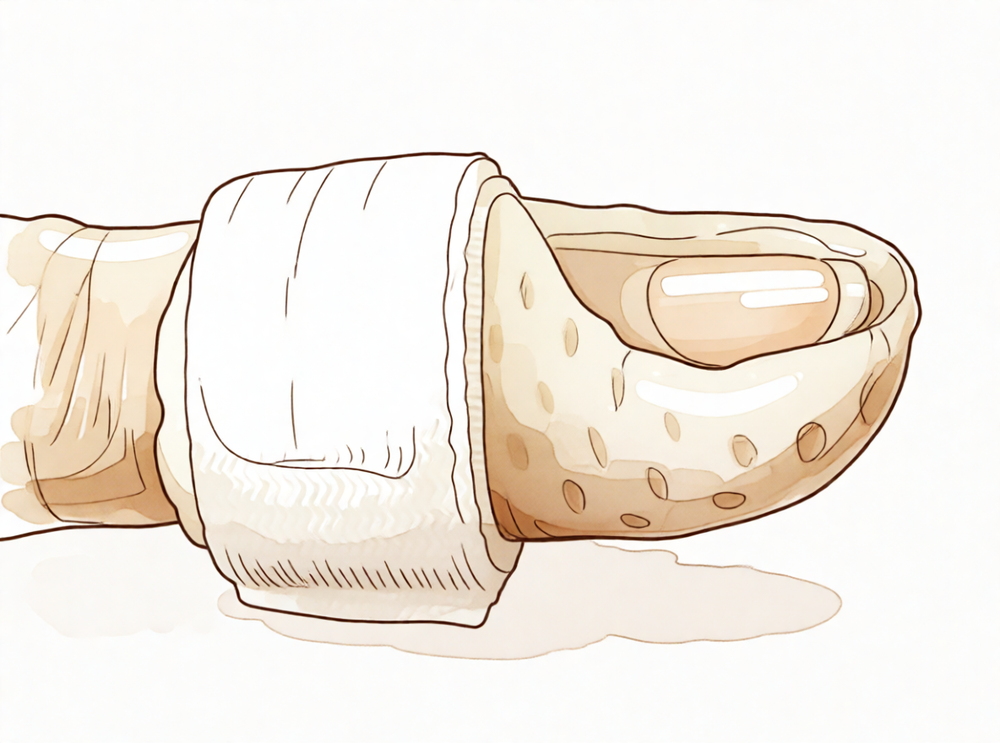
Davplast / Wikimedia Commons, CC BY-SA 4.0
உங்கள் நுனி மூட்டு (DIP) நீட்டல் சிம்பை அணிதல் (விரல் நுனி ஒருபோதும் வளையக் கூடாது)
விரலின் கடைசி மூட்டு (நகத்திற்கு மிக அருகில் உள்ள நுனி மூட்டு, DIP) முற்றிலும் நேராகப் பிடித்து வைக்கப்படும்படி, உங்கள் சிம்பை எல்லா நேரமும் — இரவும் பகலும் — விரல் நுனி மூட்டில் அணியுங்கள். இதுவே உங்கள் சிகிச்சையின் மிக முக்கியமான பகுதி. விரல் நுனி ஒருபோதும் வளைய அனுமதிக்கப்படக் கூடாது, ஒரு கணம்கூட: அது எந்த நேரத்திலாவது தொங்கினால், குணமாகும் செயல்முறை மீண்டும் பூஜ்ஜியத்திலிருந்து தொடங்குகிறது, கடிகாரம் மீண்டும் ஓடத் தொடங்குகிறது. கழுவும்போதும், தூங்கும்போதும், வேலை செய்யும்போதும் சிம்பை அணிந்தே இருங்கள்; அதற்குள் நுனி எப்போதும் நேராகவே இருக்கிறதா என்று பரிசோதியுங்கள்.
தொடர்ச்சியாக அணியப்படுகிறது — தசைநாண் சார்ந்த மேலட்டுக்குச் சுமார் 8 வாரங்கள், எலும்பு சார்ந்த மேலட்டுக்குச் சுமார் 6 வாரங்கள்
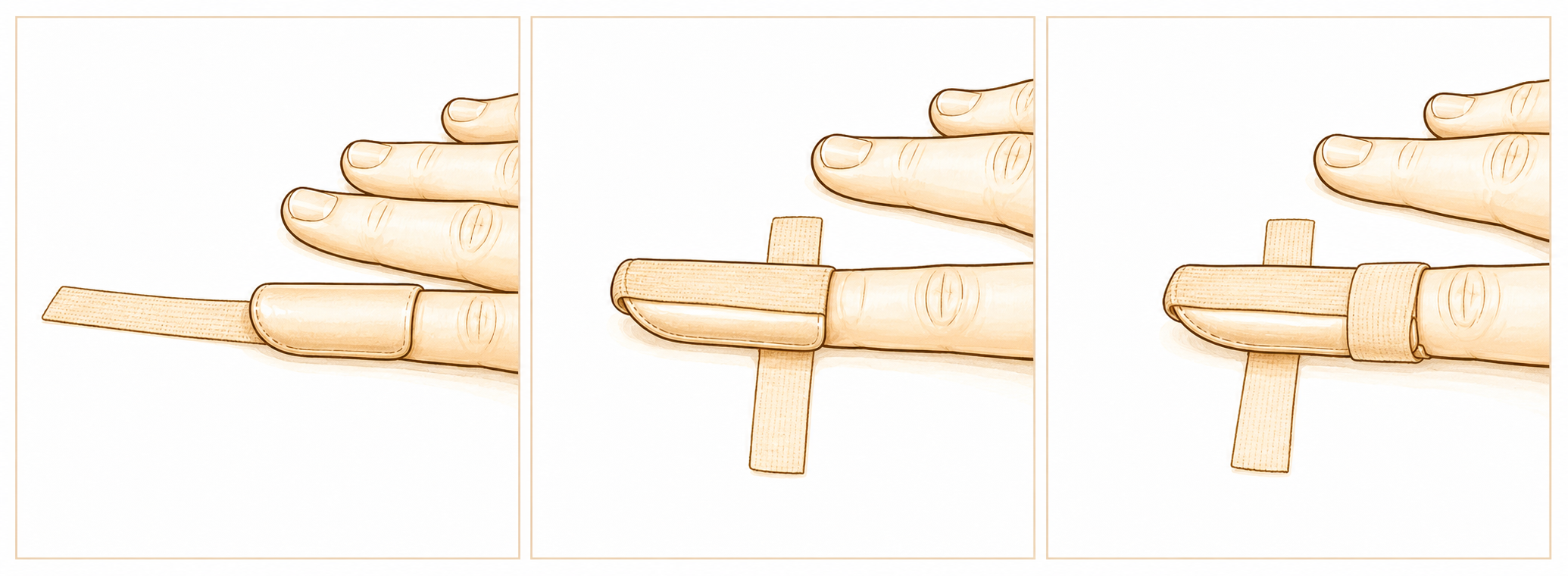
Kieran Hirpara 4.0
சிம்பைப் பாதுகாப்பாக மாற்றுதல் (விரல் நுனியை நேராக வைத்திருங்கள்)
தோலைச் சுத்தம் செய்து உலர வைக்க மட்டுமே சிம்பு கழற்றப்படுகிறது — அதுவும், அந்த நேரம் முழுவதும் விரல் நுனியை முற்றிலும் நேராக வைத்திருக்க முடியும் என்றால் மட்டுமே. நுனிக்கு ஆதரவு கிடைத்து அது கீழே விழாதபடி, விரலை ஒரு மேசையின் விளிம்பில் தட்டையாக வையுங்கள்; அல்லது மறு கையால் அதை நேராகப் பிடித்துக்கொள்ளுங்கள். பழைய சிம்பை நழுவ விடுங்கள், தோலைச் சுத்தம் செய்து உலர வையுங்கள், பிறகு புதிய சிம்பை நழுவவிட்டு மாட்டுங்கள் — இதில் எந்தக் கட்டத்திலும் நுனி வளையக் கூடாது. இதைச் செய்வதில் உங்களுக்கு நம்பிக்கை இல்லை என்றால், அதை உங்கள் கை சிகிச்சையாளரிடமே விட்டுவிடுங்கள்.
தோல் பராமரிப்புக்காக நாளொன்றுக்கு ஒரு முறை, விரல் நுனியை முற்றிலும் நேராக வைத்திருந்தால் மட்டுமே
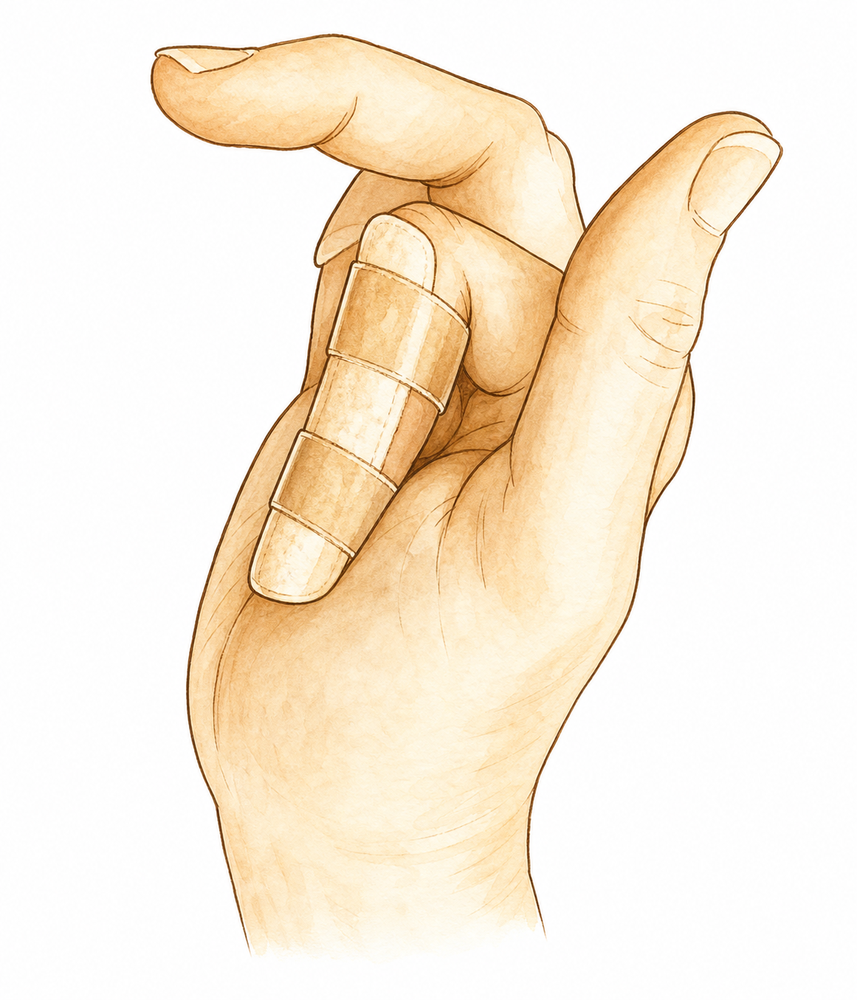
Kieran Hirpara 4.0
நடு மூட்டையும் விரல் கணுவையும் அசைத்துக்கொண்டே இருங்கள் (PIP மற்றும் MCP)
விரல் நுனி சிம்பால் நேராகப் பிடித்து வைக்கப்பட்டிருக்கும்போது, விரலின் மற்ற மூட்டுகள் விறைத்துப் போகாதபடி அவற்றை அசைத்துக்கொண்டே இருங்கள். நடு மூட்டையும் (PIP) விரல் கணுவையும் (MCP) முழுமையாகவும் தடையின்றியும் வளைத்து நேராக்குங்கள் — இந்த மூட்டுகளை அசைப்பது பாதுகாப்பானது; அவற்றை அசைப்பதால் நுனியில் குணமாகிக்கொண்டிருக்கும் தசைநாணுக்கு எந்தத் தொந்தரவும் இல்லை. சிம்பு அணிந்த நுனியை நேராகவே வைத்தபடி, பாதி முஷ்டி மூடி மீண்டும் விரியுங்கள்.
ஒவ்வொரு மூட்டுக்கும் 10 முறை, நாளொன்றுக்குச் சில முறை, சிம்பு அணிந்தபடியே
Kieran Hirpara 4.0
சிம்புக்கு அடியில் தோலையும் வீக்கத்தையும் கவனித்தல்
ஒவ்வொரு நாளும், விரல் நுனியை நேராக வைத்தபடி தோலைப் பரிசோதியுங்கள் — குறிப்பாக மூட்டின் மேற்புறத்திலும் நகத்திலும். சிறிது சிவப்பு இருப்பது இயல்பானது; ஆனால் சிம்பு அழுத்தும் இடத்தில் தோல் வெளிறியோ வெண்மையாகவோ தெரிந்தால், அல்லது வலித்தால், சிம்பு நுனியை அளவுக்கு அதிகமாகப் பின்னோக்கிப் பிடித்து வைத்திருக்கலாம்; அதைச் சரிசெய்ய முடியும் என்பதால் உங்கள் கை சிகிச்சையாளரிடம் சொல்லுங்கள். விரலையும் சிம்பையும் சுத்தமாகவும் உலர்ந்தும் வைத்திருங்கள்; வீக்கம் இருந்தால் கையை உயர்த்தி வையுங்கள்.
தினமும் பரிசோதியுங்கள்; வெளிறிய, வலிக்கும் அல்லது உடைந்த தோலைத் தெரிவியுங்கள்
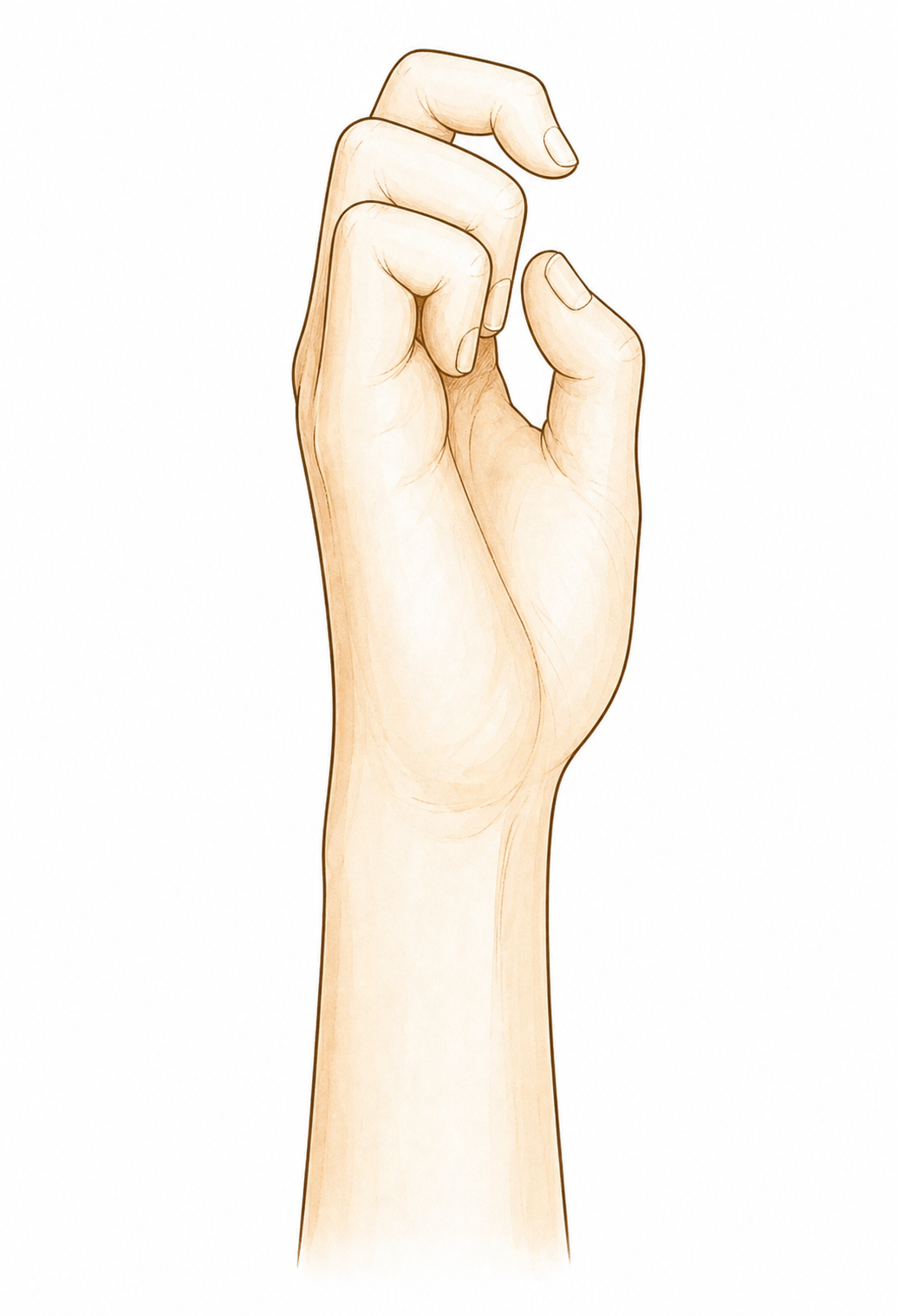
Kieran Hirpara 4.0
படிப்படியான விரல் நுனி மடக்கு (சிம்பைக் குறைக்கும் கட்டம்)
இது பிற்பாடு செய்யும் பயிற்சி — உங்கள் கை சிகிச்சையாளர் சிம்பைப் படிப்படியாகக் குறைக்கத் தொடங்கிய பிறகு (பொதுவாகச் சுமார் 6 முதல் 8 வாரங்கள் முதல்), மேலும் நுனியில் தொங்கல் இல்லாத — அல்லது ஏற்கத்தக்க அளவே உள்ள — நிலையில் மட்டுமே இதைச் செய்ய வேண்டும். சிம்பைக் கழற்றிவிட்டு, விரல் நுனி மூட்டை மென்மையாகச் சிறிது அளவு வளையுங்கள்; பிறகு மீண்டும் முழுமையாக நேராக்குங்கள் — சௌகரியமான எல்லைக்குள்ளேயே இருங்கள். அதை வலுக்கட்டாயமாகச் செய்ய வேண்டாம். நுனி மீண்டும் தொங்கத் தொடங்கினால், முழுநேரச் சிம்புக்குத் திரும்பிச் சென்று உங்கள் சிகிச்சையாளரிடம் சொல்லுங்கள்.
சில மென்மையான மடக்குகள், சிம்பைக் குறைக்கும் கட்டத்தில் வழிகாட்டப்படும்படி மட்டுமே
இவை உங்கள் கையேட்டில் உள்ள பயிற்சிகள். எல்லாவற்றிலும் மிக முக்கியமான "பயிற்சி", உங்கள் சிம்பைச் சரியாக அணிந்து, ஒவ்வொரு கணமும் விரல் நுனியை நேராக வைத்திருப்பதுதான்; மற்ற அனைத்தும் அதைச் சுற்றியே கட்டமைக்கப்பட்டுள்ளன. ஆரம்பத்தில் உங்கள் வேலை, சிம்பை அணிந்திருப்பது, தோலை ஆரோக்கியமாக வைத்திருப்பது, விரலின் மற்ற மூட்டுகளைத் தடையின்றி அசைத்துக்கொண்டே இருப்பது. விரல் நுனியை மென்மையாக வளைக்கும் பயிற்சியும், நடு மூட்டைப் பிடித்து வைத்து நுனியை நேராக்கும் பயிற்சியும் பிற்பாடு வரும், சிம்பைக் குறைக்கும் கட்டத்துக்கு உரியவை; உங்கள் கை சிகிச்சையாளர் குறிப்பாக அவற்றைத் தொடங்கும் வரை அவற்றைத் தொடங்கக் கூடாது. விரல் நுனியைத் தொங்கச் செய்யும் எதையும் நிறுத்திவிட்டு, முழுநேரச் சிம்புக்குத் திரும்பிச் செல்லுங்கள்.
உங்கள் மருத்துவ நெறிமுறை
இந்தப் பக்கத்தின் மீதமுள்ள பகுதி, மேலட் ஃபிங்கருக்குச் சிம்பை மையமாகக் கொண்ட மறுவாழ்வுப் பயிற்சிக்கான, கட்டவாரியான மருத்துவ நெறிமுறை. இந்தப் பகுதி கை சிகிச்சையாளரிடம் கொடுக்கப்பட வேண்டியது; ஒவ்வொரு கட்டமும் என்ன நடக்கிறது என்பதற்கான எளிய விளக்கத்துடன் தொடங்குகிறது. குணமாவது இடைவிடாத நுனி மூட்டு (DIP) நீட்டலைப் பொறுத்தது: சிம்பு காலத்தில் நுனி மூட்டு ஒருபோதும் மடங்க அனுமதிக்கப்படாவிட்டால் மட்டுமே நுனித் தசைநாண் (அல்லது பிய்ந்து விலகிய எலும்புத் துண்டு) ஒன்றிணைகிறது; அதே நேரத்தில் நடு மூட்டும் (PIP) விரல் கணுவும் (MCP) கட்டுப்பாடின்றி விடப்படுகின்றன, ஏனெனில் அவற்றின் அசைவு நுனித் தசைநாண் குணமாவதைத் தொந்தரவு செய்வதில்லை. நோயாளி சொன்னபடி கடைப்பிடிப்பதே விளைவைத் தீர்மானிக்கும் முதன்மையான காரணி.
சிகிச்சைக்கு முன், மேலட் தசைநாண் சார்ந்ததா எலும்பு சார்ந்ததா என்பதை உறுதிப்படுத்தி, படிமங்களை மதிப்பாய்வு செய்யவும். நுனி மூட்டை (DIP) நீட்டிப் பிடித்து வைக்கும் ஒரு சிம்பு (DIP extension orthosis) பயன்படுத்தப்படுகிறது: ஸ்டாக் (Stack), வெப்பநெகிழி (thermoplastic), அல்லது உள்ளங்கைப் பக்க / புறப்பக்க அலுமிஃபோம் (alumifoam). சிம்பின் வகை விளைவில் குறிப்பிடத்தக்க வேறுபாட்டை ஏற்படுத்துவதில்லை; எனவே பொருத்தம், தோல் தாங்கும் தன்மை, சொன்னபடி அணியும் வாய்ப்பு ஆகியவற்றை வைத்தே தேர்வு செய்யவும். நுனி மூட்டை முழுமையாக நீட்டிய நிலையிலோ லேசாக அளவுக்கு மீறி நீட்டிய நிலையிலோ (slight hyperextension) பிடித்து வைக்கவும்; ஆனால் அதிகப்படியான அளவுக்கு மீறிய நீட்டலைத் தவிர்க்கவும் (புறப்பக்கத் தோல் வெளிறுதல் / புண் ஏற்படும் அபாயம்). எலும்பு சார்ந்த மேலட்டுக்கு, விரல் நுனி எலும்பு (distal phalanx) உள்ளங்கையை நோக்கி இடம்பெயர்வதைத் (volar subluxation) தவிர்க்க, அளவுக்கு மீறிய நீட்டலுக்குப் பதிலாக நேரான / நடுநிலை நுனி மூட்டையே விரும்பவும். நடு மூட்டு (PIP) எப்போதும் கட்டுப்பாடின்றி விடப்படுகிறது.
கட்டம் I — இடைவிடாத, முழுநேர நீட்டல் சிம்பு (வாரம் 0 முதல் 6/8 வரை)
தசைநாணோ எலும்புத் துண்டோ குணமாகும்படி, விரல் நுனி மூட்டு இரவும் பகலும் தொடர்ச்சியாக நேராகப் பிடித்து வைக்கப்படுகிறது. தோல் பராமரிப்புக்காக மட்டுமே சிம்பு கழற்றப்படுகிறது; அதுவும், அந்த நேரம் முழுவதும் நுனி மூட்டு நீட்டிய நிலையில் வைக்கப்பட்டால் மட்டுமே. நுனி மூட்டு ஒரே ஒரு முறை மடங்கினாலும் குணமாகும் கடிகாரம் மீண்டும் தொடக்கத்திலிருந்து ஓடத் தொடங்கும். நடு மூட்டும் விரல் கணுவும் தடையின்றி அசைகின்றன.
உங்கள் கை சிகிச்சையாளருக்கு:
கற்பித்தலும் முன்னெச்சரிக்கைகளும் - நுனி மூட்டு நீட்டல் சிம்பை (DIP extension orthosis) பொருத்தவும் (ஸ்டாக் / வெப்பநெகிழி / அலுமிஃபோம்); நுனி மூட்டு முழுமையாக நீட்டிய நிலையிலோ லேசாக அளவுக்கு மீறி நீட்டிய நிலையிலோ இருக்க வேண்டும்; அதிகப்படியான அளவுக்கு மீறிய நீட்டலைத் தவிர்க்கவும் (தோல் வெளிறுதல் / புண்); எலும்பு சார்ந்த மேலட் → நேரான / நடுநிலை, அளவுக்கு மீறி நீட்டியது அல்ல (இடப்பெயர்வு அபாயம்) - தொடர்ச்சியாக அணிதல்: தசைநாண் சார்ந்தது ~8 வாரங்கள், எலும்பு சார்ந்தது ~6 வாரங்கள்; இந்தக் காலத்தில் நுனி மூட்டு ஒருபோதும் மடங்கக் கூடாது - நுனி மூட்டு ஒருபோதும் தொங்க அனுமதிக்கப்படாதபடி, தட்டையான மேற்பரப்பில் சிம்பை மாற்றும் முறையைக் கற்பிக்கவும்; நோயாளியால் நீட்டிய நிலையைத் தக்கவைக்க முடியவில்லை என்றால், சிகிச்சையாளரே சிம்பை மாற்ற வேண்டும் - நடு மூட்டும் (PIP) விரல் கணுவும் (MCP) கட்டுப்பாடின்றி விடப்பட வேண்டும்; 1-ஆம் நாளிலிருந்தே அவற்றைச் சுயமாக அசைக்க வேண்டும்
சிகிச்சை மேலாண்மை - தோல்: நுனி மூட்டின் புறப்பக்கத்திலும் நக மடிப்பிலும் தினசரிப் பரிசோதனை; வெளிறுதலோ அழுத்தமோ இருந்தால் சிம்பைச் சரிசெய்யவும்; சுத்தமாகவும் உலர்ந்தும் வைத்திருக்கவும் - வீக்கம்: கையை உயர்த்தி வைத்தல்; அண்மை மூட்டுகளின் மென்மையான அசைவு - பயிற்சிகள்: நடு மூட்டு (PIP) மற்றும் விரல் கணு (MCP) முழுச் சுய அசைவின் வீச்சு; நுனி மூட்டு அசைவு கூடாது - எலும்பு சார்ந்த மேலட்: சிம்பு காலத்தில் எக்ஸ்-கதிர் கண்காணிப்பைத் தொடரவும் (சீரமைவு / இடப்பெயர்வு); ஏனெனில் நீட்டல் பின்னடைவைப் (extensor lag) பொறுத்தவரை சிம்பு சிகிச்சை கம்பி போடுவதைவிடத் தாழ்ந்ததல்ல, ஆனால் எலும்புத் துண்டின் நிலையைக் கண்காணிக்க வேண்டும்
அடுத்த கட்டத்துக்குச் செல்வதற்கான அளவுகோல்கள் - முழுநேரக் காலம் முடிந்திருக்க வேண்டும் (தசைநாண் சார்ந்தது ~8 வாரங்கள் / எலும்பு சார்ந்தது ~6 வாரங்கள்); ஏற்கத்தக்க அளவுக்கு மேல் நுனி மூட்டில் நீட்டல் பின்னடைவு இல்லாமல் இருக்க வேண்டும்; தோல் ஆரோக்கியமாக இருக்க வேண்டும்
கட்டம் II — சிம்பைப் படிப்படியாகக் குறைத்தலும், கட்டுப்பாடான நுனி மூட்டு அசைவைத் தொடங்குதலும் (வாரம் 6/8, பிறகு +2 முதல் 6 வரை)
முழுநேரக் காலம் முடிந்து, நீட்டல் பின்னடைவு இல்லாத — அல்லது ஏற்கத்தக்க அளவே உள்ள — நிலையில், சிம்பு இரவு நேரத்துக்கும் ஆபத்தான செயல்களுக்கும் மட்டும் அணியும் அளவுக்குக் குறைக்கப்படுகிறது; அதே நேரத்தில் நுனி மூட்டை மென்மையாக, கட்டுப்பாட்டுடன் மடக்கும் பயிற்சி தொடங்குகிறது. இரவு நேரச் சிம்பை விருப்பத்தேர்வாகக் கருதலாம் (ஒரு Level-I ஆய்வு அது அத்தியாவசியமல்ல என்று கண்டறிந்தது); நடைமுறைக்கேற்ப அது பயன்படுத்தப்படுகிறது. குறிப்பிடத்தக்க பின்னடைவு மீண்டும் தோன்றினால், நோயாளி முழுநேர நீட்டல் சிம்புக்குத் திரும்ப வேண்டும்.
உங்கள் கை சிகிச்சையாளருக்கு:
மதிப்பீடுகள் - நுனி மூட்டின் சுய நீட்டல் பின்னடைவு (பாகைகளில்) மற்றும் சுய மடக்கு; தோல்; சிம்பிலிருந்து நுனியை வெளியே எடுக்கும்போது நோயாளியின் நம்பிக்கை
கற்பித்தலும் முன்னெச்சரிக்கைகளும் - மேலும் சுமார் 2 முதல் 6 வாரங்களுக்கு, இரவு நேரம் + அதிக ஆபத்துள்ள செயல்களின்போது மட்டும் சிம்பு என்ற அளவுக்குக் குறைக்கவும்; தற்போதைய சான்றுகளின்படி இரவு நேரம் அணிவது விருப்பத்தேர்வு - சிம்பு சிகிச்சைக்குப் பிறகு நீட்டல் பின்னடைவு >20° மீண்டும் தோன்றினால், ~4 முதல் 6 வாரங்களுக்கு முழுநேர நீட்டல் சிம்பை மீண்டும் தொடங்கவும்
சிகிச்சை மேலாண்மை - பயிற்சிகள்: மென்மையான, படிப்படியான சுய நுனி மூட்டு மடக்கை (முதலில் சிறிய வீச்சு) மற்றும் நடு மூட்டைப் பிடித்து வைத்துச் செய்யும் சுய நுனி மூட்டு நீட்டலை (blocked active DIP extension — நடு மூட்டை நிலைப்படுத்தி, நுனி மூட்டை நீட்டுதல்) தொடங்கவும்; பின்னடைவு அனுமதிக்கும் அளவுக்கு மடக்கு வீச்சை முன்னேற்றவும் - நுனி மூட்டு சுயமாக நீட்டிய நிலையைப் பின்னடைவு இல்லாமல் — அல்லது ஏற்கத்தக்க (≤10–20°) பின்னடைவுடன் — தக்கவைத்தவுடன், பகல் நேரச் சிம்பு அணிவதைக் குறைக்கவும் - நடு மூட்டு / விரல் கணு முழு அசைவைத் தொடரவும்; தேவைக்கேற்பத் தழும்பு / தோல் பராமரிப்பு - நாள்பட்ட, அல்லது தாமதமாக வந்த மேலட்களும் நீட்டல் சிம்பு சிகிச்சைக்குப் பலனளிக்கின்றன; தாமதமாகத் தொடங்குவது ஒரு தடை அல்ல
அடுத்த கட்டத்துக்குச் செல்வதற்கான அளவுகோல்கள் - நுனி மூட்டு ஏற்கத்தக்க பின்னடைவுடன் சுய நீட்டலைத் தக்கவைக்கிறது; கட்டுப்பாடான, வலியற்ற நுனி மூட்டு மடக்கு மீண்டும் கிடைத்துள்ளது; தோல் பாதிப்பின்றி உள்ளது
கட்டம் III — வலுப்படுத்துதலும் திரும்புதலும் (சுமார் 8 முதல் 12 வாரங்கள் முதல்)
தசைநாண் குணமாகி, சுய அசைவு மீண்டும் கிடைத்த நிலையில், விரல் சிம்பிலிருந்து முழுமையாக விடுவிக்கப்படுகிறது; படிப்படியான வலுப்படுத்தும் பயிற்சியும் செயல்பாட்டுக்குத் திரும்புதலும் தொடங்குகின்றன. ஒரு சிறிய நிரந்தர நீட்டல் பின்னடைவு (சராசரி ~8°) எதிர்பார்க்கப்படுகிறது; அது சிறந்த செயல்பாட்டு விளைவுக்குத் தடையல்ல.
உங்கள் கை சிகிச்சையாளருக்கு:
மதிப்பீடுகள் - நுனி மூட்டின் சுய நீட்டல் பின்னடைவு மற்றும் மடக்கு வீச்சு; பிடி; சுமைக்கும் விளையாட்டுக்கும் தயார் நிலை
கற்பித்தலும் முன்னெச்சரிக்கைகளும் - அன்றாடப் பயன்பாட்டில் சிம்பு இல்லாமல்; திரும்பும் காலத்தில் உடல் மோதும் விளையாட்டுகளுக்குப் பாதுகாப்புச் சிம்பு - எஞ்சும் ~5–10° நீட்டல் பின்னடைவு இயல்பானது என்றும், அது திருப்தியைப் பாதிப்பதில்லை என்றும் நோயாளிக்கு விளக்கவும்
சிகிச்சை மேலாண்மை - பயிற்சிகள்: படிப்படியான பிடி மற்றும் கிள்ளுப் பிடி வலுப்படுத்துதல்; முழு விரல் அசைவின் வீச்சு; வேலை மற்றும் விளையாட்டுக்குரிய குறிப்பிட்ட முன்னேற்றம் - விளையாட்டுக்கும் கனமான வேலைக்கும் ~8 முதல் 12 வாரங்கள் முதல், அளவுகோல்களின் அடிப்படையில் திரும்புதல் (உடல் மோதும் விளையாட்டுகளுக்குப் பாதுகாப்புச் சிம்பு) - வலிமையும் செயல்பாடும் போதுமானதாக இருந்து, பின்னடைவு நிலையானதாக இருக்கும்போது விடுவிக்கவும்; குறிப்பிடத்தக்க பின்னடைவு நீடித்தாலோ மீண்டும் தோன்றினாலோ திரும்பப் பரிந்துரைக்கவும்
வேலைக்கும் செயல்பாடுகளுக்கும் திரும்புதல்
சிம்பு அணிந்த கையை ஆரம்பத்திலிருந்தே லேசாகப் பயன்படுத்துவது பரவாயில்லை: சிம்பு அப்படியே இருக்கும், விரல் நுனி நேராகவே இருக்கும், அந்த வரம்புக்குள் நீங்கள் அன்றாட வேலைகளுக்குக் கையைப் பயன்படுத்தலாம். விரல் நுனிச் சிம்பு அணிந்திருக்கும் வரை நீங்கள் வாகனம் ஓட்டக் கூடாது: சிம்பு அகற்றப்பட்டு, ஸ்டியரிங்கைப் பிடித்துக் காரைப் பாதுகாப்பாகக் கட்டுப்படுத்த உங்களால் முடியும் வரை வாகனம் ஓட்டுவது காத்திருக்க வேண்டும்; இதை உங்கள் மதிப்பாய்வின்போது டாக்டர் ஹிர்பராவிடம் உறுதிப்படுத்திக்கொள்ளுங்கள். சிம்பு படிப்படியாகக் குறைக்கப்படும்போது, சுமார் ஆறு முதல் எட்டு வாரங்களிலிருந்து பிடிப்பதும் வலுப்படுத்தும் பயிற்சியும் படிப்படியாக அதிகரிக்கின்றன. விளையாட்டுக்கும் கனமான உடல் உழைப்பு வேலைக்கும் திரும்புவது பொதுவாகச் சுமார் எட்டு முதல் பன்னிரண்டு வாரங்களிலிருந்து; இது நாட்காட்டியை மட்டும் வைத்து அல்ல, கட்டுப்பாடான அசைவு மீண்டும் கிடைத்ததை வைத்தே தீர்மானிக்கப்படுகிறது; அந்தக் காலத்தில் உடல் மோதும் விளையாட்டுகளுக்குப் பாதுகாப்புச் சிம்பு அணியப்படுகிறது. விரல் நுனியில் சுமார் ஐந்து முதல் பத்து பாகை அளவுக்கு ஒரு லேசான நிரந்தரத் தொங்கலை எதிர்பாருங்கள்; இது இயல்பானது, கை வேலை செய்யும் விதத்தைப் பாதிப்பதில்லை, பெரும்பாலானோர் இதைக் கவனிப்பதேயில்லை.
உங்கள் நெறிமுறைக்குப் பிறகு
இந்த நெறிமுறை கிளினிக்கின் பொதுவான மீட்சி ஆலோசனைகளுடன் இணைந்து செயல்படுகிறது; அறுவை சிகிச்சைக்குப் பிந்தைய வலியைக் கையாளுதல், காயப் பராமரிப்பு மற்றும் தழும்பு மேலாண்மை பக்கங்களைப் பாருங்கள். மேலே உள்ள கட்டவாரியான திட்டம், மேலட் ஃபிங்கருக்குச் சிம்பு போடுவது குறித்து வெளியிடப்பட்ட வழிகாட்டுதலைப் பிரதிபலிக்கிறது; உங்கள் விரல் நுனி எப்படி முன்னேறுகிறது என்பதைப் பொறுத்து, டாக்டர் ஹிர்பராவும் உங்கள் கை சிகிச்சையாளரும் உங்கள் தொடர் மீட்சிக்குத் தனிப்பட்ட முறையில் வழிகாட்டுவார்கள்.
உங்கள் மேலட் ஃபிங்கர் அறுவை சிகிச்சை மூலம் சரிசெய்யப்பட்டால் — ஒரு குறிப்பு
பெரும்பாலான மேலட் ஃபிங்கர்களுக்கு அறுவை சிகிச்சை ஒருபோதும் தேவைப்படுவதில்லை. எலும்பு சார்ந்த மேலட்டில் மட்டுமே — முறிவு மூட்டுப் பரப்பின் பெரிய பகுதியை (சுமார் மூன்றில் ஒரு பங்குக்கு மேல்) உள்ளடக்கியிருக்கும்போது, அல்லது கடைசி மூட்டு அதன் இடத்திலிருந்து நழுவும்போது (உள்ளங்கையை நோக்கிய இடப்பெயர்வு, volar subluxation) — அறுவை சிகிச்சை பரிசீலிக்கப்படுகிறது. நிலைநிறுத்தல் செய்யப்படும்போது, அது பொதுவாக நீட்டல்-தடுப்பு (extension-block; இஷிகுரோ, Ishiguro) K-கம்பி முறை; சில சமயங்களில் விரல் நுனி மூட்டை நேராகப் பிடித்து வைக்க, அதன் குறுக்கே ஒரு தற்காலிகக் கம்பியும் செலுத்தப்படுகிறது. அந்தக் கம்பி பொதுவாகச் சுமார் நான்கு முதல் ஆறு வாரங்கள் வரை வைக்கப்பட்டு, ஏறக்குறைய ஐந்து முதல் ஆறு வாரங்களில் அகற்றப்படுகிறது; அதன் பிறகு விரல் நுனியின் சுய அசைவு தொடங்குகிறது, மேலும் சுமார் நான்கு வாரங்களுக்கு இரவு நேரச் சிம்பு அணியப்படலாம். இறுதியாக எஞ்சும் தொங்கலின் அளவைப் பொறுத்தவரை, சிம்பு சிகிச்சை கம்பி போடுவதைவிடத் தாழ்ந்ததல்ல என்று சான்றுகள் காட்டுகின்றன; எனவே அறுவை சிகிச்சை வழக்கமாகப் பயன்படுத்தப்படாமல், மேலே சொன்ன குறிப்பிட்ட சூழ்நிலைகளுக்கு மட்டுமே ஒதுக்கப்படுகிறது.
Evidence & references
This is the clinical evidence summary written for health professionals. It is technical, and it lists the research this page was built from. You do not need to read it to understand your treatment or to make a decision about it.
Topic scope: non-operative (and, where indicated, post-fixation) management of a mallet finger — disruption of the terminal extensor tendon at the distal interphalangeal (DIP) joint, either purely tendinous or with an avulsion bony fragment (bony mallet). This is a healing injury, not a reconstruction: the entire treatment is uninterrupted DIP extension splinting that holds the tendon (or fragment) in apposition while it unites, with the PIP and MCP left free.
Defining principle of the rehab here: the terminal extensor tendon heals only if the DIP is held in continuous extension and is never allowed to flex during the splinting period. Any single lapse into DIP flexion separates the healing ends and restarts the healing clock, which is why patient compliance is the dominant outcome driver. The PIP is deliberately kept mobile because proximal-joint motion does not disturb terminal-tendon healing. Splint type (Stack, thermoplastic, volar/dorsal alumifoam) does not materially change the outcome — fit, skin tolerance and compliance matter more than the device. The single branch point is the bony mallet with a large articular fragment or DIP volar subluxation, where surgical fixation is considered; even there, splinting is non-inferior to pinning for the final extensor lag, so operation is reserved rather than routine.
A. INJURY OUTCOMES (tendinous vs bony mallet; splinting vs fixation)
Mallet finger is one of the most reliably treated closed tendon injuries in the hand: the great majority heal well with splinting alone, and the principal debate is over the bony mallet — when, if ever, to fix it.
- Continuous extension splinting is the standard of care and works well for both tendinous and bony mallets, including chronic and delayed presentations, which still respond to splinting weeks after injury [Valdes systematic review LoE 1a; Salazar Botero review; Medscape; StatPearls]. Strong (SR + reviews).
- Splint type makes no meaningful outcome difference. A randomised comparison of splint designs found no superiority of one orthosis over another; the determinant is uninterrupted DIP extension and compliance, not the device [Pike RCT]. Strong (RCT).
- Splinting is non-inferior to extension-block pinning for the final extensor lag. A randomised trial comparing conservative extension splinting with operative extension-block K-wiring for bony mallet found no advantage to pinning in the residual lag, supporting non-operative management as the default even for many bony mallets [Thillemann RCT]. Strong (RCT).
- Surgery is reserved for the large bony fragment or subluxating DIP. Operative fixation is
considered when the fracture involves a large part of the articular surface (often cited as
~30%) or there is volar subluxation of the distal phalanx; common techniques are extension-block (Ishiguro) K-wiring with or without a trans-articular DIP pin. Single-K-wire constructs perform less well in non-compliant settings [Aksan; Salazar Botero; Medscape]. Moderate.
- Stack splints can subluxate a bony mallet. Volar-based Stack-type orthoses holding the DIP in hyperextension can displace a bony-mallet fragment / promote subluxation, which is why a straight/neutral DIP is preferred for bony mallets rather than hyperextension [Kaplan]. Moderate (mechanistic/clinical).
- The underlying mechanism is a terminal tendon avulsion at the distal phalanx. Anatomical and injury studies characterise the lesion as avulsion of the terminal extensor at its distal-phalanx insertion, and a very small amount of tendon lengthening translates into a large extensor lag — roughly 1 mm of lengthening ≈ 25° of lag — which is the biomechanical reason apposition must be maintained so strictly [Tuttle; Yeh; PMC current concepts]. Mechanistic.
B. REHABILITATION / THERAPY EVIDENCE
The central rehab questions are (1) how long and how strictly to splint, (2) whether the PIP should be included, and (3) whether night-time and post-splinting splinting are needed. The evidence supports uninterrupted full-time DIP extension splinting (~6–8 weeks) with the PIP free, followed by a weaning phase, and downgrades routine night-splinting to optional.
- Uninterrupted DIP extension is the active ingredient; the PIP must stay free. Splinting holds the DIP in full extension (or slight hyperextension) continuously; the PIP and MCP are mobilised from the outset because proximal-joint motion does not load the terminal tendon. Full-time wear is about 8 weeks for tendinous and 6 weeks for bony mallets [Valdes SR 1a; Salazar Botero; StatPearls; Physiopedia]. Strong (SR + guideline-level reviews).
- Compliance is the dominant outcome driver. Because any DIP flexion restarts healing, outcome tracks adherence to continuous extension more than any device choice; patient education and a safe flat-surface splint-change technique are central [Valdes SR; Cook BAHT survey of therapist practice]. Strong (mechanism + practice consensus).
- Avoid excessive hyperextension. Holding the DIP in marked hyperextension risks dorsal-skin blanching and pressure ulceration over the joint; slight hyperextension or neutral is sufficient, and bony mallets should be held straight/neutral to avoid fragment subluxation [Azad dorsal splinting outcomes; Kaplan]. Moderate.
- Night-time splinting after the full-time phase is non-essential (optional). A Level-I study found that continued night-splinting after the primary full-time period was not essential to the result, so the ~2–6 week post-splinting night/risky-activity phase is framed as optional and pragmatic rather than mandatory [Valdes SR 1a evidence base]. Moderate (Level I within SR).
- Recurrent lag responds to re-splinting. If an extensor lag (>~20°) recurs after the splinting period, a further ~4–6 weeks of full-time extension splinting is appropriate; chronic/delayed mallets likewise still respond [Salazar Botero; Medscape; StatPearls]. Moderate.
- A small residual extensor lag is the expected, satisfactory result. Most patients are left with a slight permanent lag (mean ~8°, typically 5–10°) that does not impair function or satisfaction; this should be counselled as normal rather than as failure [Salazar Botero; PMC current concepts; Physiopedia]. Moderate–strong (natural history).
Recovery trajectory (expected, evidence-anchored)
| Phase | Window | Restraint | Hand use / therapy focus | Strength / load | Notes |
|---|---|---|---|---|---|
| I — Continuous DIP extension splinting | Week 0–6/8 (bony ~6, tendinous ~8) | DIP held continuously extended; never flex the DIP | Full-time extension orthosis (Stack/thermoplastic/alumifoam); flat-surface splint changes only; PIP + MCP moved freely from day 1; daily dorsal-skin checks | No DIP loading; light splinted hand use | Any DIP flexion resets the clock; bony mallet held straight/neutral + radiographic surveillance |
| II — Weaning & controlled DIP motion | +2–6 weeks after full-time phase | Night / high-risk-activity splinting (night wear optional) | Begin gentle graded active DIP flexion + blocked active DIP extension; reduce day wear once lag ≤10–20° | Light functional load | Lag >20° recurring → re-splint full-time ~4–6 wk; chronic mallets still respond |
| III — Strengthening & return | From ~week 8–12 | None (protective splint for contact sport) | Splint-free use; graded grip/pinch strengthening; full ROM; sport-/work-specific progression | Grip/strength built up; driving once able to grip the wheel safely | Expect ~5–10° permanent lag (mean ~8°) — normal, satisfaction preserved |
(Phase windows mirror the precautions in the patient protocol; they are typical guides, not trial-derived deadlines.)
C. KEY CONTROVERSIES / EVIDENCE QUALITY
- Splint type. Stack vs thermoplastic vs volar/dorsal alumifoam — randomised data show no meaningful outcome difference; the determinant is uninterrupted extension and compliance, not the device [Pike RCT]. Strong evidence of equivalence.
- Splinting vs operative fixation for bony mallet. Randomised data show extension splinting is non-inferior to extension-block pinning for the residual lag; surgery is reserved for the large articular fragment (>~30%) or volar DIP subluxation, not used routinely [Thillemann RCT; Aksan; Salazar Botero]. Strong (RCT) for non-inferiority; moderate for the fixation indications.
- Hyperextension vs neutral. Slight hyperextension aids tendinous apposition but excessive hyperextension risks dorsal-skin ischaemia/ulcer, and in bony mallets can subluxate the fragment — hence straight/neutral for bony mallets [Azad; Kaplan]. Moderate.
- Is night-splinting necessary? A Level-I study found continued night-splinting after the full-time phase non-essential; the post-splinting phase is therefore optional/pragmatic rather than mandatory [Valdes SR 1a]. Moderate.
- Residual lag as expected outcome, not failure. A small permanent lag (mean ~8°) is the norm and is compatible with full function and satisfaction; mislabelling it as failure drives unnecessary intervention [Salazar Botero; PMC current concepts]. Strong natural-history data.
D. EVIDENCE STRENGTH FLAGS (summary)
- STRONG (RCT / SR): uninterrupted DIP extension splinting as standard of care (6–8 wk full-time, tendinous ~8 / bony ~6); splint-type equivalence; PIP-free mobilisation; compliance as the key outcome driver; expected ~5–10° residual lag; splinting non-inferior to pinning for bony mallet (with radiographic surveillance during splinting).
- MODERATE: exact length of the weaning/night-splinting phase (night wear non-essential per a Level-I study); strengthening and return-to-sport/work timing (~8–12 weeks, criterion-based); hyperextension-vs-neutral splint positioning and the bony-mallet subluxation caveat; surgical indications (>~30% articular fragment / volar subluxation) and fixation technique.
- WEAK / CONFIRM: driving — a fingertip splint is not usually a contraindication once the wheel can be gripped safely, but this is confirmed clinically rather than evidence-defined.
CITATIONS
RAG corpus (180,000+ Orthopaedic articles)
- A randomized controlled trial comparing splint designs for mallet finger. J Hand Surg Am. 2010. DOI: 10.1016/j.jhsa.2010.01.005
- Conservative management of mallet finger: a systematic review (Level of Evidence 1a). J Hand Ther. 2015. DOI: 10.1016/j.jht.2015.03.001
- Mallet finger: a survey of British Association of Hand Therapists practice. Hand Therapy. 2016. DOI: 10.1177/1758998316664822
- The mallet finger injury: a review (current concepts in diagnosis and management). Arch Plast Surg. 2016. DOI: 10.5999/aps.2016.43.2.134
- Outcomes of dorsal splinting for mallet finger. Hand (N Y). 2022. DOI: 10.1177/15589447221093674
- Conservative splinting versus extension-block K-wiring for bony mallet finger: a randomized controlled trial. J Hand Surg (Eur Vol). 2020. DOI: 10.1177/1753193420917567
- Tendon avulsion fractures of the distal phalanx (terminal extensor avulsion). Clin Orthop Relat Res. 2006. DOI: 10.1097/01.blo.0000205903.51727.62
- Tendon ruptures in the hand. Hand Clin. 2012. DOI: 10.1016/j.hcl.2012.05.040
- Single K-wire fixation of bony mallet finger in non-compliant patients. Arch Orthop Trauma Surg. 2021. DOI: 10.1007/s00402-021-03793-4
- Subluxation of bony mallet fractures with Stack splint immobilisation. J Hand Surg Am. 2013. DOI: 10.1016/j.jhsa.2013.08.111
Mallet-finger management literature (URLs)
- Medscape — Mallet Finger Treatment & Management. https://emedicine.medscape.com/article/1242305-treatment
- StatPearls — Mallet Finger (NCBI Bookshelf). https://www.ncbi.nlm.nih.gov/books/NBK459373/
- Current concepts in the management of mallet finger (PMC; ~1 mm terminal-tendon lengthening ≈ 25° extensor lag). https://pmc.ncbi.nlm.nih.gov/articles/PMC4022957/
- Physiopedia — Mallet Finger. https://www.physio-pedia.com/Mallet_Finger





